
WA flu season slowed in January. Here’s how a new second wave is impacting Whatcom County

By mid-January, Washington looked like it had made it through the worst of flu season. Hospitalization rates had fallen two weeks in a row, emergency room visits as a result of the flu were holding steady after two straight weeks of declining, and the number of intensive care unit beds taken up by flu patients was down nearly 30% from the week of New Year’s. Transmission levels were higher than last winter, but nothing catastrophic.
Just a month later, amid a national surge, the state’s flu transmission levels are on the rise again.
Washington flu cases surge
In the first full week of February, the state saw 476 people hospitalized by the flu, up from 227 just three weeks prior, according to the Washington State Department of Health’s respiratory illness dashboard. 5.3% of hospital beds and 7.7% of emergency room visits were attributed to the virus, up from 2.7% and 4.1% respectively in mid-January.
Transmission has already blown past the season’s previous peak. Hospitalizations were up 58% from their peak over the last week of December and first week of January.
The week of Feb. 2, 2025, DOH recorded 1,655 cases, which DOH classifies as “very high,” up from a December peak right around 750.
Whatcom County flu season
The situation in Whatcom County isn’t much better — if anything, it might be worse than the statewide average.
The Whatcom County Health and Community Services maintains its own respiratory illness dashboard. While it doesn’t include illness-specific data, it does provide some insights into the state of flu season in the county. Between Feb. 2-8, 23.6% of the county’s emergency room visits were attributed to respiratory illnesses, including the flu, respiratory syncytial virus and COVID-19. That figure represents a 51% increase over three weeks and has already surpassed last winter’s peak of 20.4%.
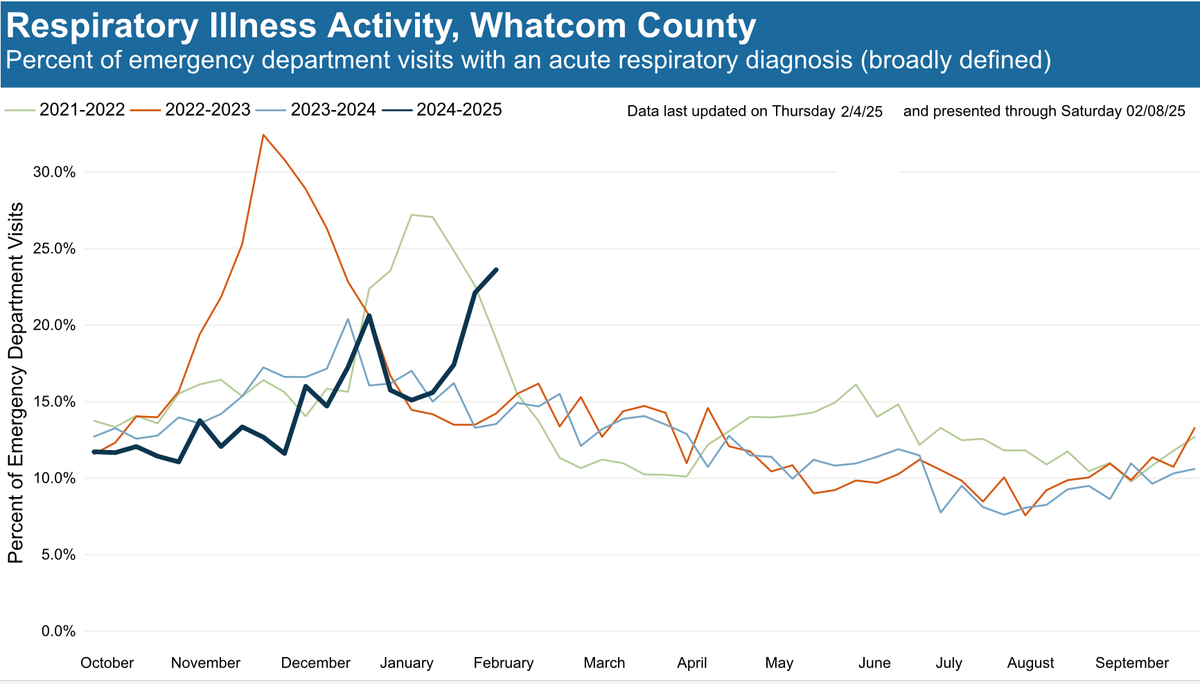
According to Ron Warner, communications specialist for the county health department, much of the surge can be attributed to the flu.
“There is an upward trend in respiratory illnesses, specifically influenza, both statewide and nationwide, and this is not unique to Whatcom County. Influenza activity is higher than other respiratory viruses,” Warner told The Herald in an email.
For local data on each illness, the state breaks down its data into nine regions. In the North Sound region, which includes Whatcom, Skagit, Snohomish, Island and San Juan counties, flu cases accounted for 6.5% of hospitalizations between Feb. 2 and Feb. 8. That’s over double the percentage recorded two weeks earlier and 91% higher than the season’s previous peak. It’s also nearly four times higher than last winter’s peak, although it’s still significantly lower than the 8.3% rate that the region saw two winters ago.
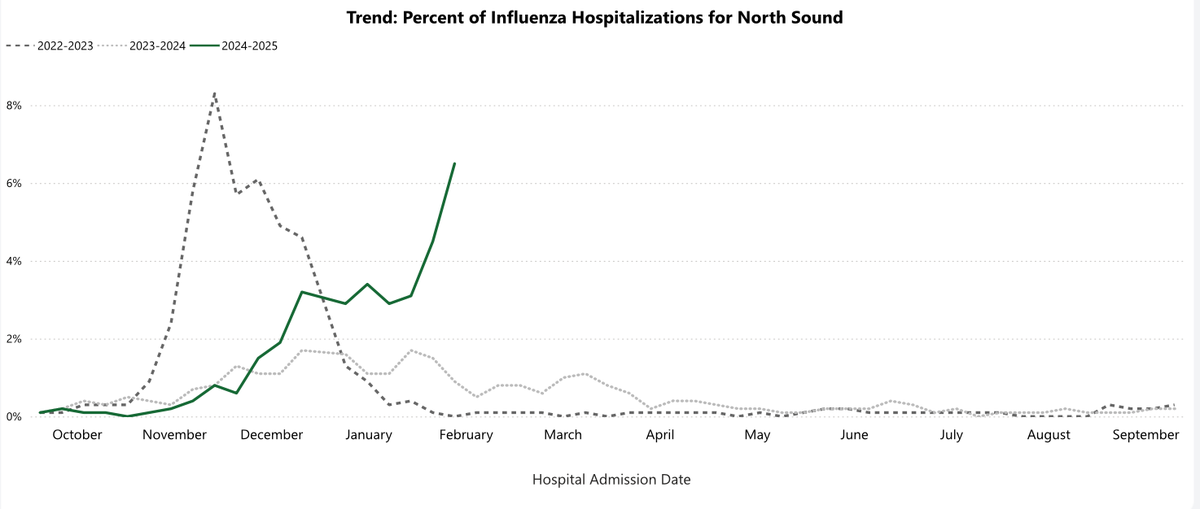
Flu patients also accounted for 8.2% of emergency room visits in the region, up from a December peak of 4.7%.
“Compared to last year, emergency room visits and hospitalizations for respiratory illness, particularly influenza, are higher and are approaching the levels seen in 2022-2023,” Warner said. “However, RSV (respiratory syncytial virus) is trending downward, and COVID-19 rates have remained stable since the beginning of November.”
When will the surge end?
While it’s too early to know when exactly flu cases will peak, there are signs that transmission could begin slowing down soon. The 1,655 cases recorded statewide the week of Feb. 2 represented an increase of 48 cases from the previous week. That figure is much lower than the 468-case increases recorded the prior week and the 316-case increase the week before that.
Similarly, the test positivity rate continues to increase, but at a slower rate than in recent weeks. The percentage of tests coming back positive for the flu increased from 29.1% the week of Jan. 26 to 30.2% the week of Feb. 2, after increasing by over five percentage points in each of the previous two weeks.
What would a high flu peak mean?
The surge could also mean a high death toll from the illness. Through Feb. 8, the state recorded 143 flu-related deaths this year, five of which were in Whatcom County. That’s already higher than last flu season’s total of 132, although it’s still well below the 2022-2023 total of 248.
According to Warner, the February surge means the flu will likely linger in Washington over the coming weeks and months. As a result, while officials typically recommend getting your seasonal flu shot by the end of October, Warner said that the shot could still provide important protection against the illness.
“A high peak means we’ll have high levels in the community for a while, so it’s not too late to get your flu shot,” Warner said. “Getting a yearly flu vaccine is the best protection against flu infection for everyone age six months or older.”
Flu symptoms and prevention
According to the Centers for Disease Control and Prevention, these are some of the most common flu symptoms include:
- Fever or chills
- Coughing
- Sore throat
- Runny nose
- Aching
- Headache
- Fatigue
- Vomiting and diarrhea, although it notes that these symptoms are more common in children than adults
Most cases are mild and can be treated with rest, hydration and over-the-counter medicine. If symptoms begin to progress, Warner said the county recommends contacting a doctor.
“Contact a healthcare provider if you or someone you are caring for is experiencing severe flu symptoms, such as trouble breathing, seizures, severe muscle pain, dehydration, or a fever or cough that improves but then returns or worsens,” Warner said.
This story was originally published February 18, 2025 at 2:01 PM.