Staffing, program cuts possible again for Bellingham schools as $15M shortfall looms
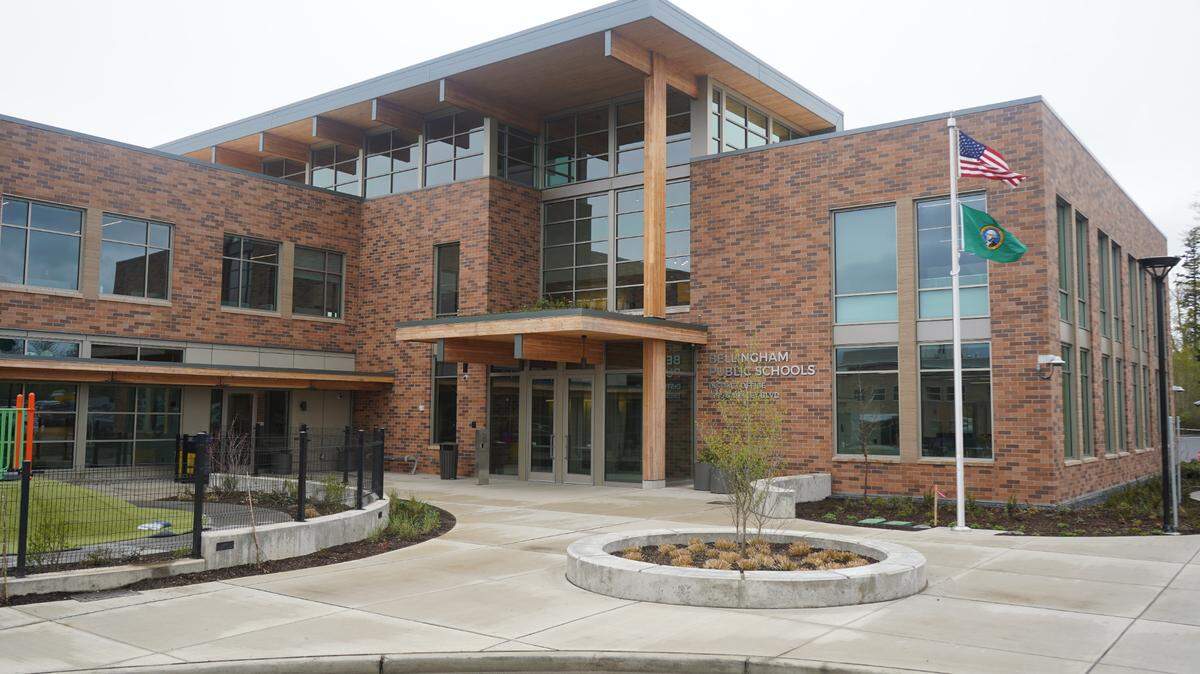
Bellingham Public Schools is facing another significant reduction in state funding almost two years after the district announced that $16 million in budget cuts would impact staffing, resources and class sizes for the 2023-24 school year.
The Bellingham Public Schools 2024-25 expenditures are projected to total more than $230 million, a $16 million increase — 7.5% — from the previous school year.
Next school year, due to expected reductions in allocated state funding, the district faces an approximate $15 million funding gap to continue operating at current levels, according to Bellingham Public Schools Assistant Communications Director Dana Smith.
“Unless the legislature and governor make significant improvements to how schools are funded in our state, we will see challenging times ahead, including likely cuts to programs and staffing,” Bellingham Public Schools Superintendent Greg Baker said in a Jan. 16 message to the community.
The Bellingham district is among several across Washington that are predicting budget shortfalls for the upcoming school year.
“Our fiscal situation is getting perilous in a lot of places around the state,” said State Superintendent of Public Instruction (OSPI) Chris Reykdal in a Jan. 16 press conference on the state of Washington’s schools.
Following state funding
It’s important to know that overall state spending toward education over the last 11 years has actually increased.
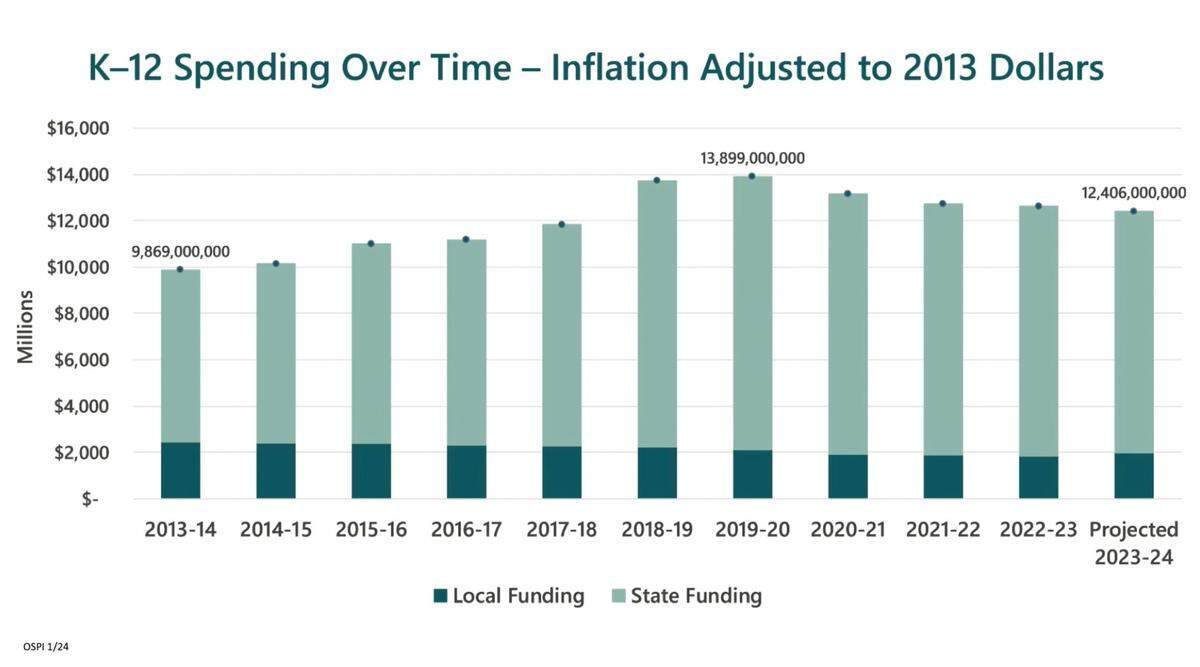
Between state and local funding, Washington schools received $9.87 million in the 2013-2014 school year. That’s up to $17.49 million for the 2023-24 school year, with local funding remaining generally steady and state revenue driving the majority of the increase.
Adjusted for inflation, however, the dollars don’t reach quite as far, showing a noticeable decrease in usable funding over the last five years, according to data from OSPI.
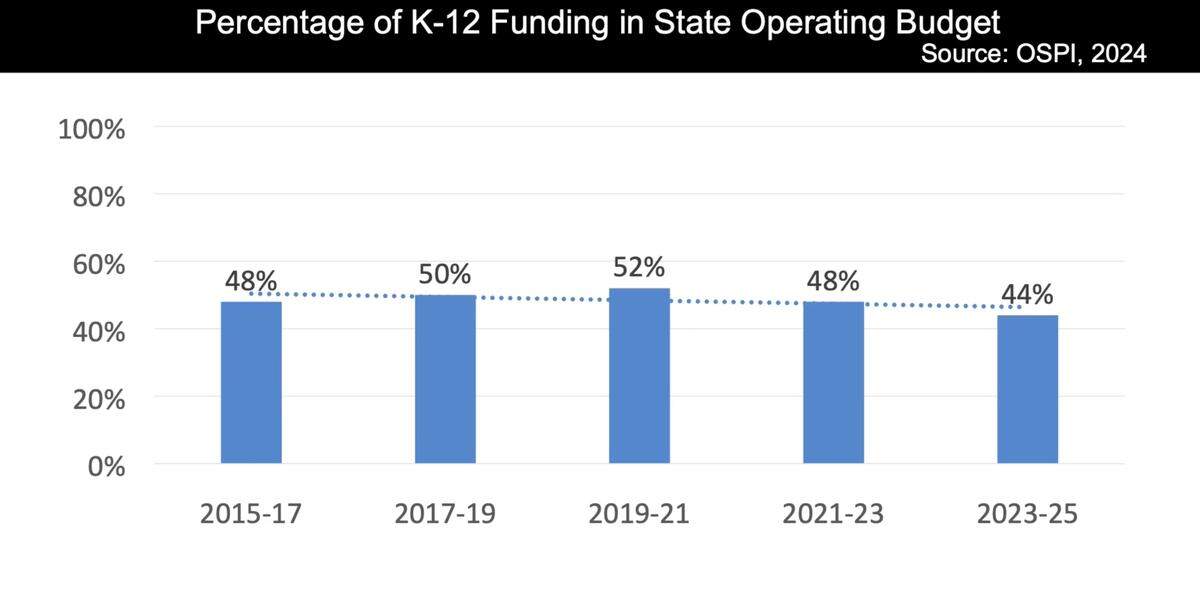
The overall percentage of the state’s budget allocated to education has also been consistently declining over the last five years.
For the two school years between 2019 and 2021, 52% of Washington’s entire budget went toward education. Right now, just 44% of the state’s budget is allocated to schools. That percentage is expected to decline further during the current budget session.
“If (the state legislature) just kept the funding at the same percentage — if they just kept it at 52% — it would probably solve most of the challenges in education right now in our state,” Baker said in a district budget presentation in October.
Washington schools are also seeing a reduction in inflation-adjusted funding per student since the 2019-2020 school year, OSPI data shows.
“Our school districts are down over $1,000 per student from just five or six years ago,” when adjusted for inflation, Reykdal said at the press conference.
Where is the gap?
Washington’s formula for allocating funding to individual districts is based on that area’s cost of living — a formula Baker and OSPI have described as “flawed” and “inadequate.”
Inflation is also to blame for the financial gap school districts are facing, according to Baker.
“Things just cost more than they used to and the money we get from the state doesn’t cover that. So just to maintain what we’re doing is hard to do,” Baker said during the presentation.
BPS utilities and insurance costs have essentially doubled since the 2018-2019 school year while state funding to cover it has effectively remained the same.
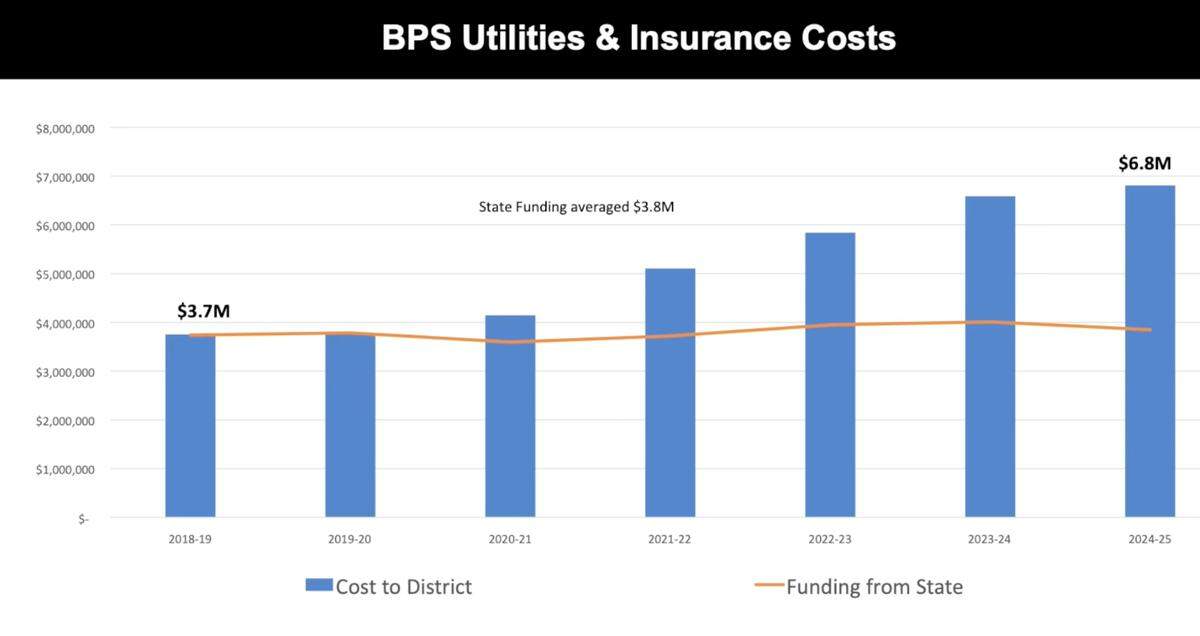
“There’s about a $3 million gap there. And where do we need to pay that from? Our local levy. ... and this is just one example,” Baker said.
School districts have the option to run local levies, which allow county residents to vote to tax property owners to pay for additional staffing and programs. Bellingham Public Schools runs two levies every four years, the Operations Levy and the Technology Levy.
The state caps the amount of extra funding that local jurisdictions can ask for in those levies, however, further limiting districts’ ability to fill in the funding gap.
Restrictions on the way specific allocations of funding can be distributed also mean the district can’t easily move money around to make up for losses. Local bond dollars, for example, can only be used to pay for capital improvement projects like new buildings or renovations — which the state does not fund.
“When budgets get tight, we can’t use bond dollars to solve personnel issues,” Baker said. “We can’t use bond dollars to hire more teachers, more counselors, reduce class size. We only can use that for construction.”
How might districts respond?
Bellingham Public Schools has been pulling from the district’s savings to account for recent funding loss from the state. But that only goes so far before other adjustments are required, according to Baker.
“You either have to decrease your expenditures or increase your revenue,” Baker said. “Districts are waiting to see what Olympia will do. How much will they increase revenue so that you don’t have to decrease expenditures and maintain your services?”
It’s unclear yet how many positions and programs could be reduced as a result of the upcoming anticipated budget shortfall.
Forty-two Bellingham Public Schools teachers were not hired back for the 2023-24 school year as a result of the district’s $16 million budget cut that year. Fifteen more teachers had their hours reduced and returned on a part-time basis. One library media specialist was also not hired back, according to previous reporting by The Bellingham Herald.
Baker proposed additional options to account for funding loss, many of which would require changes to state law. Those include:
- Allowing fewer school days each year.
- Creating four-day school weeks with longer days.
- Raising the lid on local levies.
- Increasing state dollars for education.
The state legislative session to determine Washington’s budget began in January and will continue until April. School districts across the state will learn sometime between April and June of 2025 what their revenue will be for the upcoming school year.
“So this session ... let’s collectively lean into funding our schools,” Reykdal said at the press conference. “Let’s focus on the real challenge which is that this state under-invests in education.”
This story was originally published January 30, 2025 at 5:00 AM.