Whatcom County has released its annual homeless report. Check out these key findings

Whatcom County Health and Community Services, in partnership with the Opportunity Council, released its 2024 Annual Update on Homelessness on Tuesday with a greater focus on providing a comprehensive view of local housing instability.
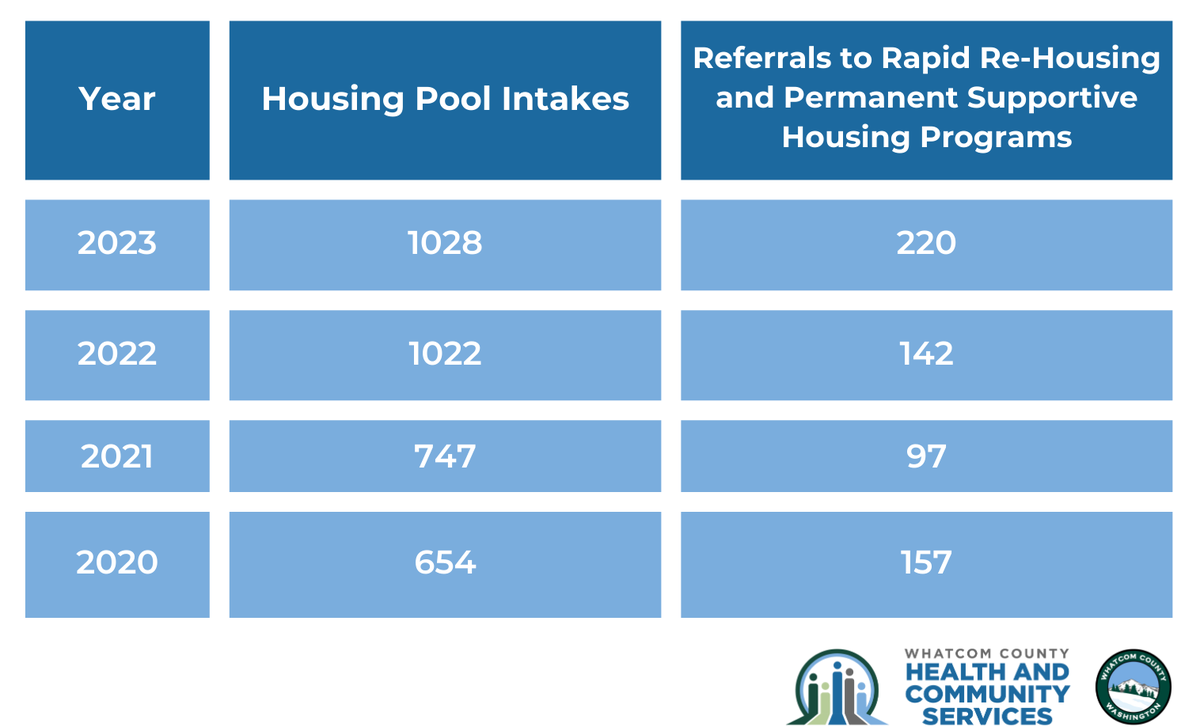
The overall data shows that the state of homelessness locally remained about the same year over year, despite an increase in permanent housing referrals.
“We got more households referred to permanent housing projects this last year than in any year in the past. So it feels like we’re doing more than we ever have. At the same time, we had more people come in looking for services than in any year in the past,” said WCHCS Housing and Homeless Services Supervisor Chris D’Onofrio in an interview with The Bellingham Herald. “So the problem is growing. But our resources are growing.”
Typically, this report emphasizes data collected from the annual Point in Time Count (PITC), a survey of households and individuals experiencing homelessness on a single night in January. While the PITC is valuable, it is often limited and results in an undercount of homelessness.
The 2024 PITC surveyed 671 households experiencing homelessness in Whatcom County, which is a slight decrease from the previous year. However, surveyors reported a higher percentage of people declining to participate in the survey as well as greater difficulty in locating individuals, according to D’Onofrio.
“You’ll see in the report that we shy away from trying to make any claims about the number. We don’t know how many people are experiencing homelessness,” D’Onofrio said. “We can look at some trends. We can look at demographics based on samples. But we really want to look a the Point in Time Count not so much as a count but as a sampling technique.”
Whatcom County’s homelessness report is now highlighting multiple sources of data, including the PITC along with local Housing Pool data, which is gathered by outreach teams over time. Housing Pool data is considered a more reliable data source for unsheltered individuals.
Key report findings
▪ Despite a lower reported PITC number, the overall state of homelessness in Whatcom County remained about the same from 2023 to 2024.
▪ Local housing programs are successfully finding homes for unhoused people, but additional people are becoming homeless as fast as the system can find them available homes.
▪ The most common reason reported for an individual’s homelessness was a lack of affordable housing.
▪ More than half of all Whatcom County renters are cost-burdened, meaning they spend thirty percent or more of their income on housing costs. This makes it harder for them to create an emergency fund. They are at higher risk of becoming homeless when a medical bill, job loss, or other unexpected expense makes them unable to pay rent.
▪ 1,365 households (2,397 individuals) received new or ongoing permanent and transitional housing support from Whatcom County’s Coordinated Entry housing partners.
▪ Whatcom County saw a slight decrease in unhoused families with children and unhoused seniors, which could be an indication that increased resources targeting those populations are working.
▪ Equity continues to be a challenge with people of color over-represented among the unhoused population. 24% of Whatcom County’s total population is non-white while 37% of the Housing Pool population is non-white.
▪ 4% of all pre-K to Grade 12 students in Whatcom County, a total of 972 students, met the definition of homelessness during the 2022-2023 school year.
▪ $25.3 million was spent to operate homeless housing programs in Whatcom County in 2023. 23.2% of that funding came from local city and county funding pools.
The report shows that the demand for homelessness prevention services in Whatcom County continues to grow and currently exceeds the available resources. Households are routinely denied prevention assistance despite being eligible because there is not enough dedicated funding to provide services to all those who qualify, according to the report.
“In some ways, it feels like a really big puzzle and we’re just trying to figure out how to play the pieces and make it work. When you look at homelessness on a community level, it’s discouraging at times. But when you think about every household that does get services, lands into housing and gets a chance at stability, it’s really rewarding,” D’Onofrio said.
“At the systems level, this is an enormous problem, but for all the people we’re serving, it’s really really meaningful,” D’Onofrio said.
This story was originally published August 27, 2024 at 12:06 PM.