Bellingham ballot measures would raise the minimum wage, restrict steep rent hikes
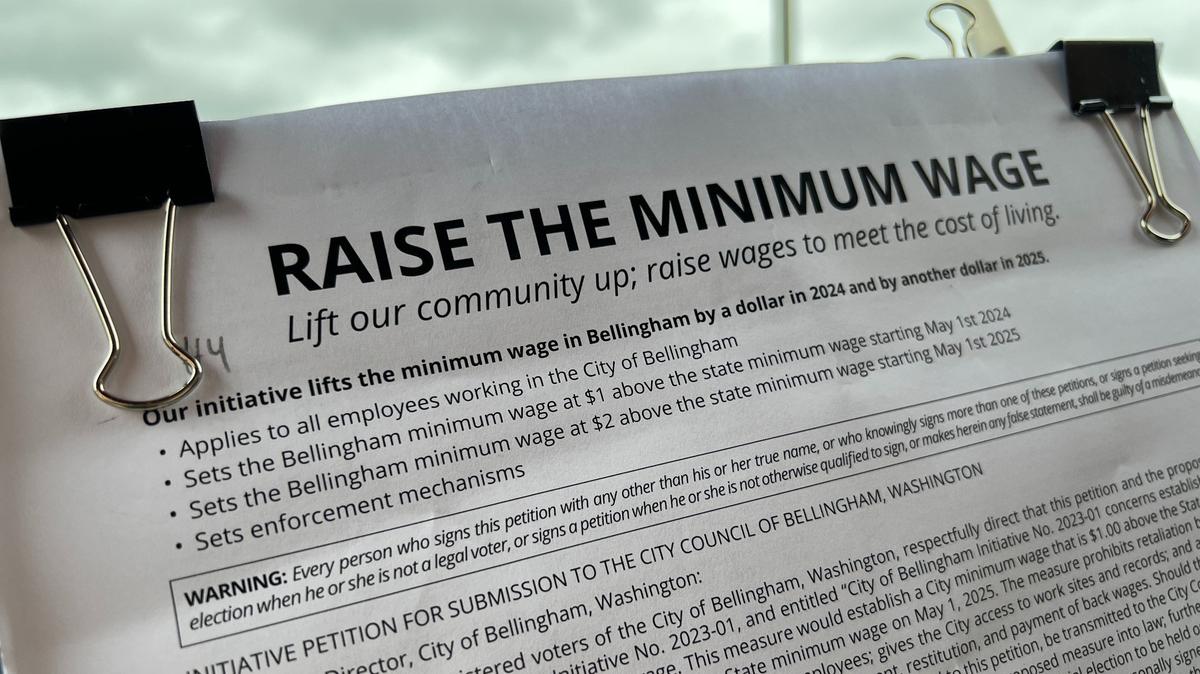
Bellingham voters in the Nov. 7 general election are being asked to decide two initiatives that a grass-roots organization called Community First Whatcom placed on the ballot by collecting thousands of signatures on petitions.
The first measure would set the minimum wage in Bellingham at $1 above the state minimum wage of $15.74 an hour on May 1, 2024, and would increase to $2 above the state minimum wage on May 1, 2025.
That measure would also prohibit retaliation against employees, allow employees to sue for damages, allow the city to monitor compliance, and sets fines for violations of the ordinance. It would not affect the pay of city workers, because city codes prevent that.
The second measure would require landlords to provide a 120-day notice before raising rent by 8% or more a month, and require landlords to pay relocation assistance equal to three times the monthly rent if such an increase is made.
Arguments in support
Community First Whatcom spokesman Jace Cotton, who’s running for Bellingham City Council and led the effort to “cure” ballots that ultimately passed last year’s child care tax, said he believes both measures have broad support.
“I’ve yet to talk to any voter who doesn’t enthusiastically support at least one if not both of these measures. They both attack the same problem from a different angle,” Cotton told The Bellingham Herald.
Both measures are endorsed by the Whatcom Democrats, the Bellingham Tenants Union, and several labor organizations.
Minimum wage: Lexy Aydelotte, a union employee and a master’s candidate at Western Washington University, said the measure will give lower-paid workers more buying power.
“Small and moderate minimum wage increases do not impact employment levels, nor do they significantly impact prices,” Aydelotte told the Bellingham City Club at an election forum.
Further, Aydelotte said that the cost of living — including higher rent, food prices and child care — is hurting every local business.
“When workers receive higher wages, they have more money to spend in their local communities. It’s clear that without a living wage, workers don’t have discretionary spending,” she said.
In their ballot statement, measure supporters point out that the living wage for a Bellingham resident with no dependents is $17.30 an hour, as calculated by the Massachusetts Institute of technology.
Renter protections: Kerri Burnside, president of the Silver Beach Neighborhood Association and a member of the Bellingham Tenants Union, said that many local tenants have faced double-digit rent hikes in recent years.
“This initiative is going after the vulture landlords and property owners,” Burnside said at the Bellingham City Club election forum.
“This policy provides relief for vulnerable tenants, so they can land on their feet after losing their home to an extreme rent hike, as well as a fair and balanced framework for landlords,” Burnside said in a ballot statement that was also signed by Peter C. Pihos and J. Paige Heinen.
Arguments against
The Bellingham Regional Chamber of Commerce opposes the minimum wage measure, but has not taken a stand on the renter protections.
Minimum wage: Guy Occhiogrosso, director of the Bellingham Regional Chamber of Commerce, said the measure is based on affordability but won’t solve that issue.
“In a community that is so heavy on retail, restaurants, and hospitality-oriented businesses, I think the only thing that it’s going to do is make things more expensive,” Occhiogrosso told The Bellingham Herald.
Occhiogrosso and Doug Engerman co-wrote the ballot statement against the minimum wage increase, saying that it will have greater negative effects on local businesses than it will on corporate restaurants and retailers because those businesses can absorb price increases easier.
“As small businesses continue to strike the balance between resolving their pandemic-related expenses and impacts, keeping their prices affordable, and keeping their businesses viable, a $2 and hour wage increase on top of the state’s growing minimum wage will only lead to price increases in basic goods and services and/or fewer hours for employees. Nonprofits will be forced to reduce hours for employees and/or the services they provide,” Occhiogrosso and Doug Engerman said.
“Please reject the idea that mandates on local small businesses and nonprofits should be set at the ballot box, regardless of consequences,” they said.
Renter protections: Perry Eskridge, who works in the real estate industry, told The Herald that he opposes the measure as a private party.
“It’s a short-term solution that will prove harmful to tenants in the long term,” because rent hikes as high as 7.9% are allowed without penalty, Eskridge said.
“Renters need real solutions, they don’t need a gimmick,” he said.
“We have witnessed increased water and sewer rates from the city, increased garbage rates from the city’s contractor, and increased property taxes from the city and county. With climbing mortgage rates, costs in a year can exceed 8%, and limiting providers’ ability to recoup costs and operate rental housing at a potential loss will only harm tenants in the long run,” Eskridge said in the ballot statement he wrote opposing the measure.
Balloting in Washington is by mail and must be postmarked before 7 p.m. Tuesday.
This story was originally published November 1, 2023 at 11:33 AM.