State model, funding restrictions major factors in Bellingham Schools $16M budget cut
A flawed state funding plan, declining enrollment, and the loss of federal COVID dollars are causing Bellingham Public Schools to cut the district’s budget by $16 million, according to Superintendent Greg Baker.
The 7.5% cut will drop school spending back to 2021-22 levels, which will likely mean fewer teachers, larger class sizes and fewer student resources.
“It’s super frustrating and it puts us, as a school district, on this roller coaster year-to-year,” Baker said in an interview with The Bellingham Herald. “The legislature comes into session every year and they change the rules and change the funding. We’re kind of at the mercy of it.”
All of this comes at a time when operating costs are up and staffing is the highest it’s been in years.
Rep. Joe Timmons (D-Bellingham) is on the state’s Education Committee, which considers issues relating to K-12 education. He agrees more needs to be done to manage the challenges school districts are facing.
“We have our work cut out for us as we continue to grapple with the impacts of the COVID-19 pandemic. Our schools are seeing enrollment declines and the end of one-time federal funds,” Rep. Timmons said in a statement to The Bellingham Herald. “The state legislature made monumental investments in special education this session, but we have more work to do moving forward, including examining our funding model to ensure that educators have the resources they need and that all students receive the quality education they deserve.”
State funding model
The state government is required to pay for the public education of every K-12 student in Washington through its general fund. Every district is given a certain amount to pay for a minimum number of staff, including teachers, counselors and custodians, with the expectation that local tax dollars will also partially support staffing.
But the state gets to decide how much staffing it’s willing to pay for. In Bellingham, that’s much less than what the district believes is necessary.
For example, the state’s model says a district of Bellingham’s size should need six school nurses and provides the funding for 4.5 nurses, leaving the district to fund the remaining 1.5 with local taxpayer dollars.
With 22 schools in the district, Baker says Bellingham Public Schools should have one nurse for each school. Currently, the district has eight nurses. But with the budget cut, that staffing becomes even harder to finance.
Another issue Baker cites is a decision by the legislature to finance a 3.7% cost-of-living raise for school district employees.
The state only pays for 70% of Bellingham Public Schools staff, with the other 30% supported through local taxpayer dollars. So, to fund that cost-of-living increase for every district employee, Bellingham Public Schools needs to make up the difference by passing local levies.
The use of regionalization factors, which are meant to provide extra funding to retain educators in school districts with higher property values, is also affecting the budget. Bellingham’s regionalization factor has gone down over the last four years, reducing state funding to the district by an additional $1.4 million, according to Baker.
Loss of COVID funding
Elementary and Secondary School Emergency Relief (ESSER) funding was provided by the federal government during the pandemic and Bellingham Public Schools opted to invest it in staffing. The extra money helped the district avoid layoffs during the pandemic and provide childcare for first responders, according to Baker.
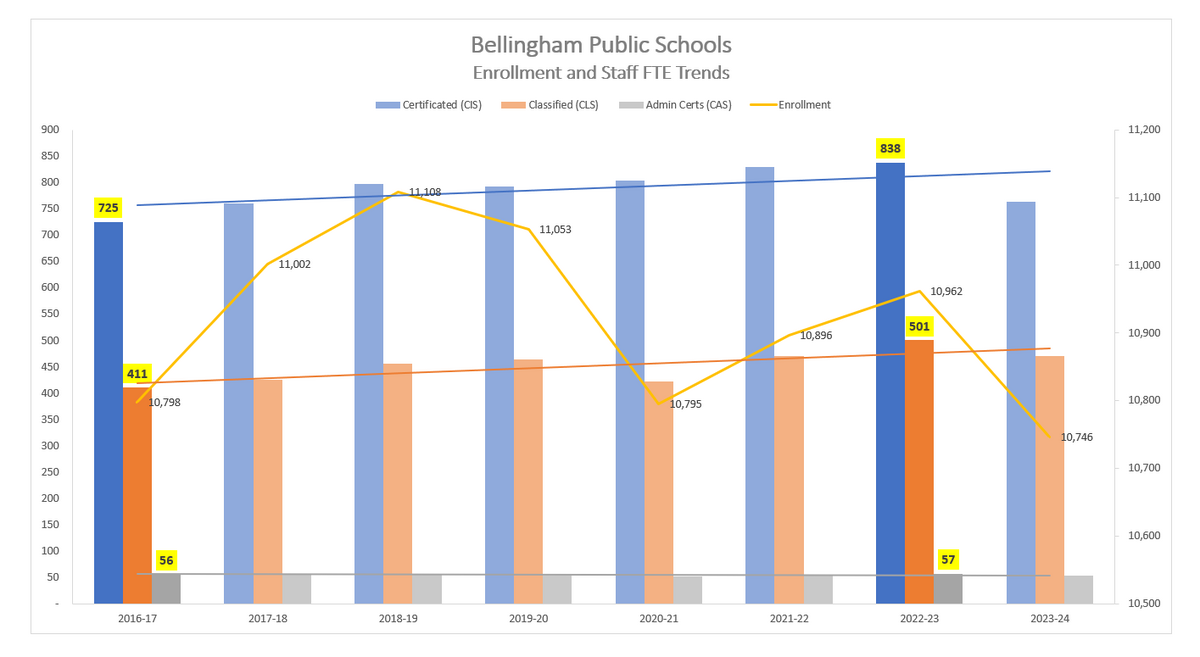
Bellingham Public Schools has added 204 staff positions since the 2016-17 school year, up about 15%. Now that ESSER funding has run out, the district will need to reduce staffing significantly, Baker said, although some positions will be maintained through grants.
The district currently employs 1,396 people.
Low enrollment
Enrollment is a driving factor for how much money the district receives from the state. The district is estimating a loss of students for the 2023-24 school year, though officials won’t know how many until the school year begins. The district’s early predictions estimate enrollment will drop by 2% next year, about 200 students less than the current enrollment of 10,962.
Baker says the district’s predicted low enrollment could be due to continuing effects of the pandemic keeping students at home, a lower birth rate across the state of Washington and in Whatcom County, along with the increasing challenges of the housing market.
Division of funding
Restrictions on the way specific allocations of funding can be distributed also mean the district can’t easily move money around to make up for losses.
“When it’s tough economic times and you’re trying to hire more teachers or nurses, can you just move money from your capital, not build schools and hire people? The answer to that is no — it’s illegal. The state has given certain rules for each of these pots of money,” Baker said.
School districts have the option to run local levies, which allow property owners to vote to tax themselves and pay for additional staffing and programs. Bellingham Public Schools runs two levies every four years, the Operations Levy and the Technology Levy. In 2016, the district also ran a Transportation Levy to upgrade the school bus fleet.
Local districts can also sell bonds, which allow property owners to tax themselves in order to pay for capital improvement projects like new buildings or renovations. The state doesn’t fund the construction of local schools.
“They’ve left that primarily up to local communities to decide when and how to update their facilities, which makes it inequitable across our state,” Baker told The Herald.
This story was originally published April 29, 2023 at 5:00 AM.