
What are king tides? Here’s what causes them an how they affect the Puget Sound
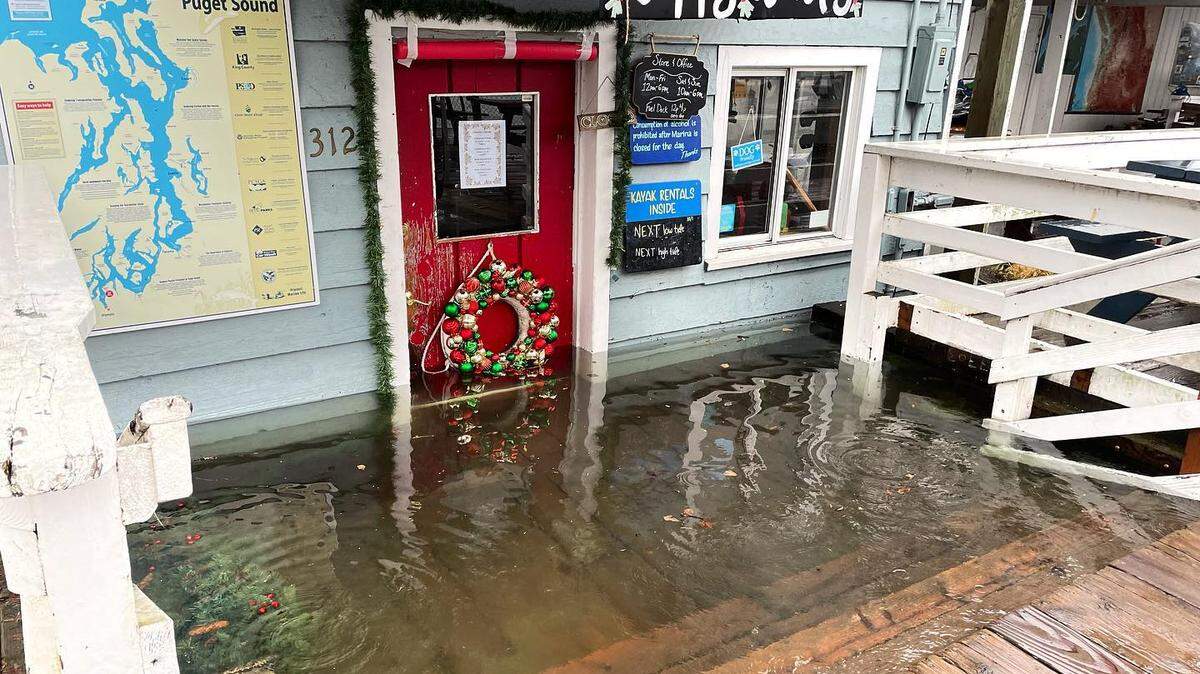
Heavy rains and a king tide brought the worst flooding that Seattle’s South Park neighborhood has seen in years, leaving at least 13 homes flooded Tuesday.
On a much smaller scale, seawater also swamped shore-side parks and homes. Puget Sound is no stranger to heavy rains or king tides (which are continuing this week), but the combination can have dire consequences.
So, what is a king tide?
Also known as a perigean spring tide, they’re the highest tides of the year, reaching up to 13 feet in central Puget Sound and even higher in the westernmost region.
These high tides can impact homes, parks and sidewalks, said Jackson Blalock, community engagement specialist with Washington Sea Grant.
“But there’s also positive sides to it in that king tides and also the low tides that go along with them can create habitats,” he said.
Scientists can also use them to look at what the future of sea level rise may hold.
What causes a king tide?
Higher-than-normal tides usually happen during a new or full moon, when it’s closest to the Earth and when it aligns with the sun, creating a stronger gravitational pull, according to the National Oceanic and Atmospheric Administration.
Tides are waves that occur as the ocean is pulled back and forth when the moon and sun interact with Earth during their monthly and yearly orbits. Other factors such as heavy rains and ocean conditions can influence the height of a tide as well, according to NOAA.
When a storm hits during a king tide, flooding can be significantly worse in some low-lying areas, the agency said. That’s what happened Tuesday when the Duwamish River overflowed into South Park homes.
As sea levels rise due to climate change, NOAA expects king tides to cause flooding more often.
When do king tides happen?
King tides usually happen at least once or twice a year in coastal areas.
High tide days, including king tides, can occur in November, December and January, Blalock said.
“It could be sunny and flooding because of a king tide,” he said, adding that heavy rains can exacerbate flooding.
NOAA catalogs king tides in the U.S. and other tide predictions for states and regions at tidesandcurrents.noaa.gov. The agency also publishes seasonal projections for high tides at oceanservice.noaa.gov/news/high-tide-bulletin.
King tides offer a preview of the future. NOAA is using them to predict how rising seas will affect people living in coastal areas, the land, public infrastructure and private property through the King Tides Project.
In Washington, sea level rise will affect marine water communities and habitats in Puget Sound, the Strait of Juan de Fuca and along the Pacific Ocean coast, said Department of Ecology spokesperson Curt Hart.
“(Tuesday) was a prime example of how king tides demonstrate what sea level rise may look like in Washington in the near future,” Hart said.
Sea level rise makes existing hazards more severe, such as bluff erosion, storm surges, flooding and groundwater intrusion, he said.
More than 14,000 homes and structures could be exposed to coastal flooding in Washington by 2050, Hart said.
Tribal resources and lands – like sacred lands and shellfish beds – also will be affected by sea level rise, he said.
Predicting king tides
While king tides are predictable, weather events such as El Niño, which brings warm water and elevated sea levels to the west coast, can make it difficult to pinpoint them, according to the Department of Ecology.
King tide predictions are based on the position of the earth relative to the sun and moon. Other factors, such as windstorms or atmospheric pressure, are not weighed since they’re difficult to forecast.
Tides in the Puget Sound region often arrive a foot or more below or above than what was projected, potentially turning a normal high tide into a king tide.
The University of Washington’s Climate Impacts Group has developed data projection tools that show community-scale sea level rise projections up to 2150 for 171 different locations around coastal Washington.
The projections account for the varied geography across the state, Hart said.
What can you do?
A state-led project encourages people to upload photos of king tides or other high water events to MyCoast. The documentation helps scientists, local planners and other stakeholders understand how sea-level rise and storm surges affect local infrastructure and ecosystems.
It’s one small step people can take to help prepare for the future.
King tides “give us a glimpse into what is currently kind of on the edge of being damaged or being impacted in some way or another by higher water levels,” Blalock said.