Whatcom isn’t planning to intentionally send floodwater into B.C., Sidhu says
Recent reports in Canadian newspapers that Whatcom County is creating a channel to divert Nooksack River floodwaters away from U.S. cities and into British Columbia are false and misleading, County Executive Satpal Sidhu said.
In a strongly-worded statement Monday, Jan. 31, Sidhu said those news articles contain “significant inaccuracies” that have caused concern among residents of flood-prone areas in Canadian communities north of Sumas.
“Whatcom County is not constructing or creating any new flood channel,” SIdhu said in his statement, which was emailed to The Bellingham Herald and posted to the county’s website.
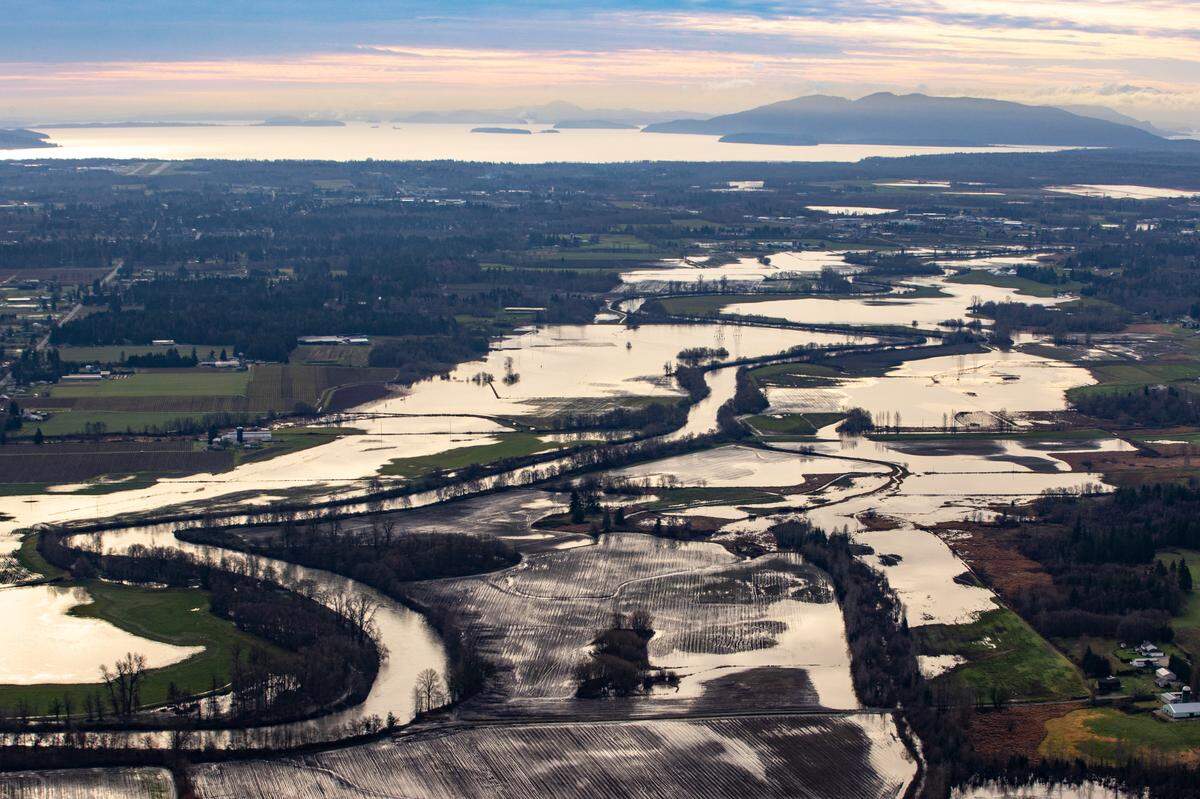
Torrential rain and rapid mountain snowmelt from a series of tropical storms that hit Western Washington and the South Coast of British Columbia in November 2021 caused widespread flooding along the Nooksack River in Whatcom County and in the Fraser River Valley towns of Abbotsford and Sumas Prairie, B.C.
An Everson man died when he was swept away by floodwaters and several hundred flood victims remain displaced from their homes.
Five daily rainfall records were set in November, and Bellingham received nearly triple its monthly rain, according to National Weather Service data.
Damage to homes, businesses, roads, levees and other public infrastructure is expected to top $100 million, Whatcom County officials said last week.
Many Everson residents who suffered damage in November 2021 had not been inundated in previous floods, Everson Mayor John Perry said at a meeting in Sumas with U.S. Sen. Maria Cantwell on Tuesday, Jan. 25.
President Biden has declared Whatcom County a disaster area so that people, businesses and public agencies who suffered losses are eligible for federal aid.
New ‘floodway’ maps
In an effort to prevent future damage from similar storms, the Federal Emergency Management Agency and local authorities are updating their 1970s-era maps of the Nooksack River “floodway” — the route that floodwaters take through towns and across fields, following the topography of the land, Sidhu said.
That new map could be used to limit residential construction in the floodplain and possibly pay homeowners not to rebuild in flood-prone locations.
“FEMA defines a ‘regulatory floodway’ as the channel of a river or other watercourse and the adjacent land areas that must be reserved in order to discharge the base flood without cumulatively increasing the water surface elevation more than a designated height,” Sidhu said.
Nooksack River floodwaters flow into Sumas and neighboring Abbotsford and the dry lake of Sumas Prairie because those areas lie at a lower elevation.
But there are no plans to “send” floodwater to British Columbia intentionally, Sidhu said.
“The Nooksack River naturally overflows its banks during high flow events near the town of Everson, and this water flows downhill through an old river valley north into the town of Sumas and across the border into Canada,” Sidhu said.
“Mother Nature and gravity have been sending water in this direction toward what used to be Lake Sumas for millennia. And communities on both sides of the border have been creating their land-use plans for decades with this knowledge in mind,” he said.
Canadian media reports
Canadian publications such as the Vancouver Sun have published stories with headlines like ”U.S. officials consider plan that would ‘send’ Nooksack River overflow into Canada.”
Harold Munro, editor-in-chief of the Vancouver Sun and The Province, didn’t directly address Sidhu’s comments.
“Quotes from officials are taken directly from the video of the meeting on YouTube that is hyperlinked in the story,” told The Bellingham Herald in an email.
Another publication, the Fraser Valley Current, altered its headline after The Herald inquired.
Searching for solutions
Whatcom County officials have been searching for solutions for Nooksack River flooding since the U.S. Geological Survey first began recording floods in 1936, said Roland Middleton special programs manager for the Whatcom County Public Works Department.
Nooksack River water goes from Mount Baker at nearly 11,000 feet to sea level at Lummi Nation in 75 miles, a relatively short distance for a river, Middleton told The Herald.
It’s carrying more sediment as the volcano’s glaciers recede because of climate change, a fact that’s compounded by stronger and more frequent storms.
And the river is home to several species of salmon, the Northwest’s iconic fish.
“We can’t just turn the Nooksack into the (Los Angeles) River and make a chute for floodwater,” he said.
“Water knows no political boundaries. It flows downhill,” Middleton said. “Major flooding on the Fraser River would flood Sumas too,” he said. “A few hundred years ago, the entire Nooksack flowed into the Fraser River.”
International effort
Meanwhile, a cross-border panel has been seeking to solve flooding in the Fraser River lowlands — which includes part of Whatcom County — since a major flood in 1990.
“Whatcom County remains committed to working with our local, state, federal, and tribal partners to maintain an open dialogue and cross-border communication with our Canadian counterparts,” Sidhu said. “We welcome the opportunity to strengthen dialogue on this topic through the Nooksack River International Task Force, and we will continue the important work of engaging all stakeholders through our existing flood planning processes. There is no single solution that will magically fix this problem. It’s only when all stakeholders work together that meaningful and comprehensive change can happen.”
Middleton said he understands that British Columbia residents are afraid of what might happen in future floods.
All three representatives of Whatcom County’s 42nd Legislative District are working to get funds to continue talks between Washington state and the British Columbia provincial government, he said.
“I’m not saying that (Canadian residents’) concerns aren’t valid. But in no way are we planning to do that to people,” he said.
This story was originally published January 31, 2022 at 8:00 AM.