The Nooksack River is in “grave danger,” warns Whatcom scientist with numbers to back it up
The Nooksack River is in “grave danger” of experiencing irreversible changes and ecosystem collapse if Whatcom County doesn’t rapidly reform the way it manages nearby human activity.
That was the warning that Western Washington University environmental sciences associate professor John McLaughlin gave at the annual environmental caucus meeting for the Water Resource Inventory Area #1 on Monday, Jan. 10. The Water Resource Inventory Area #1 is the watershed designation for the Nooksack River system.
If we continue along the path we are on, Chinook salmon are “virtually certain” to go extinct by 2050, water will become even more scarce for farmers and flooding will continue to devastate our communities, he said.
“We are risking severe, irreversible consequences,” McLaughlin said in his presentation. “That means this should be a full stop — stop what we are doing.”
He has the numbers to back this warning up. In 2017, McLaughlin identified six variables that indicate river health. The state of these variables are within Whatcom County’s control. They include forest area in the river basin, riparian forest cover along the river, stream flow during the dry season, phosphorus influx to the water supply, nitrate in the groundwater and the area of impervious surfaces in the river basin. (Impervious surfaces are hard areas that prevent water from absorbing into the ground, such as roads, parking lots and roofs.)
McLaughlin conducted a deep dive into each variable to determine at what limit does irreversible change or collapse happens.
What he found was alarming: We have exceeded the safety boundaries for five of the six variables.
McLaughlin didn’t sugarcoat his point in the presentation: “It should be a wake-up call.”
A river in danger
McLaughlin compares the boundaries he’s set for each river health variable to guardrails — we need to stay within the guardrails to maintain safety.
If there’s one guardrail we’ve crashed through at the highest speed, it’s instream flow during the summer dry season. In 2016 and 2017, there were no days where the flow in the river met the requirement that the state Department of Ecology deemed is necessary to support fish, McLaughlin said. The long-term snapshot isn’t much better: Between 1986 and 2017, only 26% of summer days saw instream flow levels that met the state requirement.
Development in the Nooksack River basin, which is the swath of land from which water drains into the Nooksack and its tributaries, also presents ecological and safety problems, McLaughlin said.
Almost 16% of the basin is covered in hard surfaces, significantly more than the 10% boundary his and other research has determined is necessary to prevent the river from becoming irreversibly altered and unstable.
“Pavement is forever,” McLaughlin said to The Bellingham Herald. “It’s hard to restore that.”
Riparian forests — the trees along the edge of the Nooksack’s channel — aren’t doing much better. On average, the Nooksack’s riparian forest cover is at 50%. That figure drops to about 33% of riparian forest cover along the more developed main stem of the river, which meanders from where the North, Middle and South forks meet up toward Lynden and then down into Bellingham Bay.
Riparian forests are critical elements of healthy river habitat. They filter sediment and pollutants out of stormwater, prevent riverbank erosion, keep water cool by offering shade and contribute woody debris to the river.
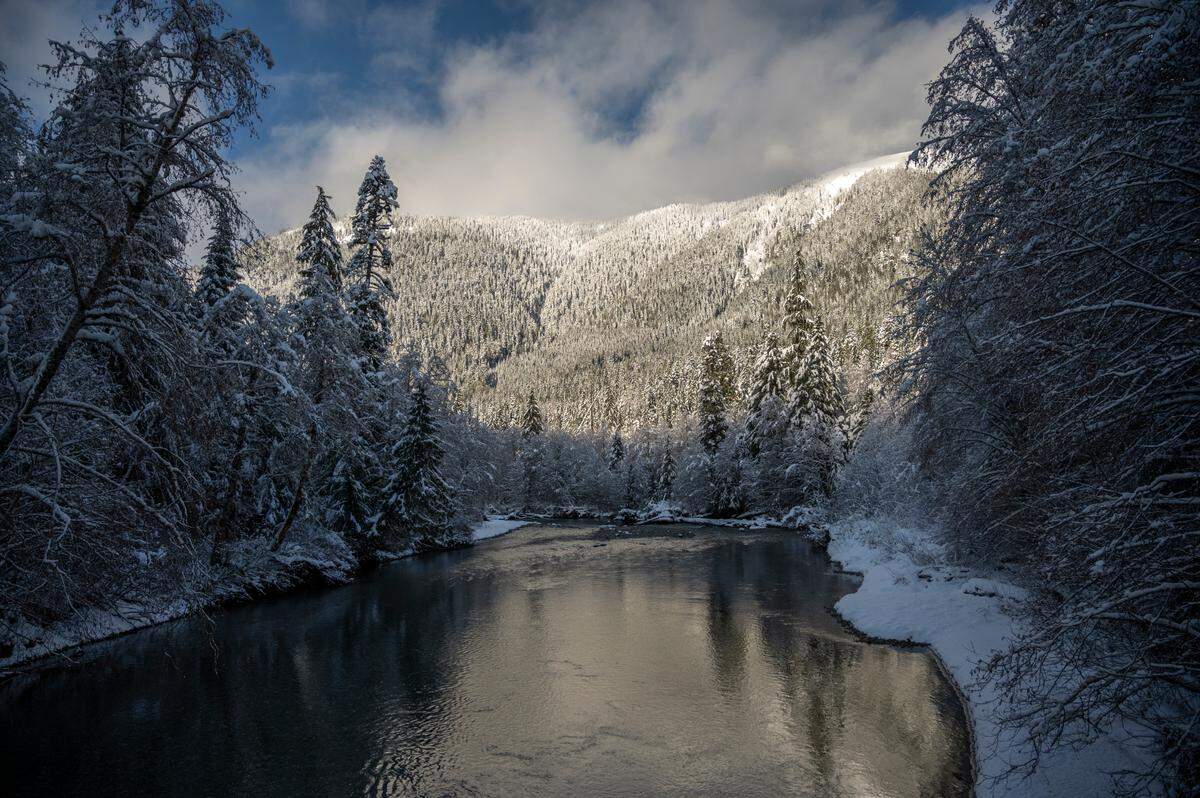
Thin, incomplete riparian forest cover and stretches of impervious surfaces don’t just pose a problem for fish, McLaughlin said. They also worsen the impacts of flooding.
“The flooding we experienced last month was more severe than it would have been if we maintained safety,” he said in his presentation.
That’s because impervious surfaces send precipitation gushing directly into the river, overwhelming the channel and leading to flooding like the type we saw in the final months of 2021. When rain falls on forested land, it makes its way to the ground much slower, dripping through a maze of canopy and seeping into the ground. The groundwater slowly trickles into the river, lowering flood risk in the winter and increasing stream flows in the summer.
To put it simply, forests are the memory of the river system, McLaughlin said.
“When you destroy memory in a human, we call that dementia,” he said in his presentation. “We call that brain damage.”
Nutrient levels in the Nooksack and its tributaries have also surpassed safety boundaries, McLaughlin found. Whatcom residents are polluting the water with phosphorus and nitrogen — these nutrients occur naturally in aquatic ecosystems, but when levels creep up too high, they create algal blooms, kill fish, contaminate drinking water and impact the economy. The U.S. Environmental Protection Agency describes nutrient pollution as “one of America’s most widespread, costly and challenging environmental problems.”
Phosphorus contamination is a primary reason why Lake Whatcom, the drinking water source for more than 100,000 people, is designated as an impaired water body by the state Department of Ecology. It can come from leaky septic tanks, fertilizers, fuel runoff and timber harvest in the watershed. Much of the excess nitrogen in the Nooksack basin comes from poorly managed manure from dairy operations, McLaughlin said.
“Some do a really good job, and others don’t,” he said.
The only boundary Whatcom has not exceeded is the one regarding forest area in the entire river basin. (This is different than riparian forest area because it spans beyond just the trees lining the edges of the Nooksack and its tributaries.)
But it wouldn’t take much to tip the scale and send the forest area variable into dangerous territory: About 60.7% of the Nooksack basin is forested, less than a percent more than McLaughlin’s determination that safety can be maintained with a forest cover of 60% or more.
“We are right at the edge,” he said. “We can’t afford to lose any more.”
What do we do now?
It’s not too late to nurse the Nooksack River back to a healthier state, McLaughlin said.
But it will require a shift in Whatcom land management and human activity, he said.
“We have a choice here,” McLaughlin told attendees at Monday’s environmental caucus meeting. “By default, we are choosing the worst possible outcome. But we can make a different choice.”
Making that choice doesn’t require starting from scratch, he said. The state and county already have rules and processes in place meant to prevent development from sprawling into rural areas and to protect critical habitat.
The problem is that we don’t enforce these rules or follow these processes in ways that could restore safety in the Nooksack basin, McLauglin said.
He points to Whatcom County’s comprehensive plan as an example. This is a document that guides growth in unincorporated areas of the county. Rather than applying the plan to restrict impervious surface areas, McLaughlin said it allows more impervious surfaces to be added to the basin in coming years.
We should be following tribal leadership, McLaughlin said. He is a proponent of the Northwest Treaty Tribes tribal habitat strategy, which is rooted in traditional ways of protecting the land and water.
There has been increasing recognition that nature managed by Indigenous Peoples is declining less rapidly than in other places.
The time to act is now, McLaughlin said — he believes that if we are willing to help our community members recover from the impacts of flooding, we should put in the same effort, if not more, to prevent it from happening in the first place.
“We are in a very perilous state,” he said in his presentation. “We need to muster the same creativity and ingenuity to restore safety to those neighbors before they get flooded out.”
This story was originally published January 17, 2022 at 5:00 AM.