New Whatcom company sells this ‘trashy’ service to fund ocean plastics cleanup
A new Ferndale-based company sells virtual greeting cards, but its intentions go further than than bringing a smile to people’s faces on special days.
Trashy Greetings, which launched in November, helps fund efforts to clean up ocean plastic in the Philippines. The more money you pay for an e-card, the more trash clean-up the company funds — $1 removes one pound of trash from the ocean, $2 removes two pounds and so on.
“The goal is to clean up a million pounds of trash a year, and I think that’s pretty doable,” said Greg Dayley, the Ferndale resident who co-founded the company to help fund his ocean clean-up initiative Pavati Ocean Pickup. “Honestly, it would cost less than a million dollars to do that.”
At least 14 million tons of plastic enter the ocean annually, according to the International Union for Conservation of Nature. This trash can strangle and suffocate marine creatures. Plastic doesn’t decompose completely, instead breaking down into tiny pieces called microplastics.
When you buy an e-card through Trashy Greetings, you choose how much ocean clean-up you want to fund, input the recipient’s contact information and personalize the card with a message. You can schedule when you want it sent.
The card designs are appropriately trashy — a slice of birthday cake with a cigarette as a candle, a message in a bottle floating in the water, a raccoon donning a Santa hat and carrying a sack full of garbage.
Dayley became interested in ocean trash removal nearly seven years ago, when he lived in Hawaii. He was free-diving in one of his favorite spots when he saw a plastic bag jerking through the water. His eyes moved to the left, and he noticed the bag was hooked to a fishing line tangled around the back of a sea turtle.
“I told myself I had to do something about it,” Dayley said. “It was horrible.”
For years, that meant changing his own personal habits, making an effort to reduce his consumption and choosing paper bags over plastic. But when the pandemic hit, Dayley and his friend Annie Jenkins, who lives in Maine, challenged themselves to pick up a thousand pounds of ocean trash.
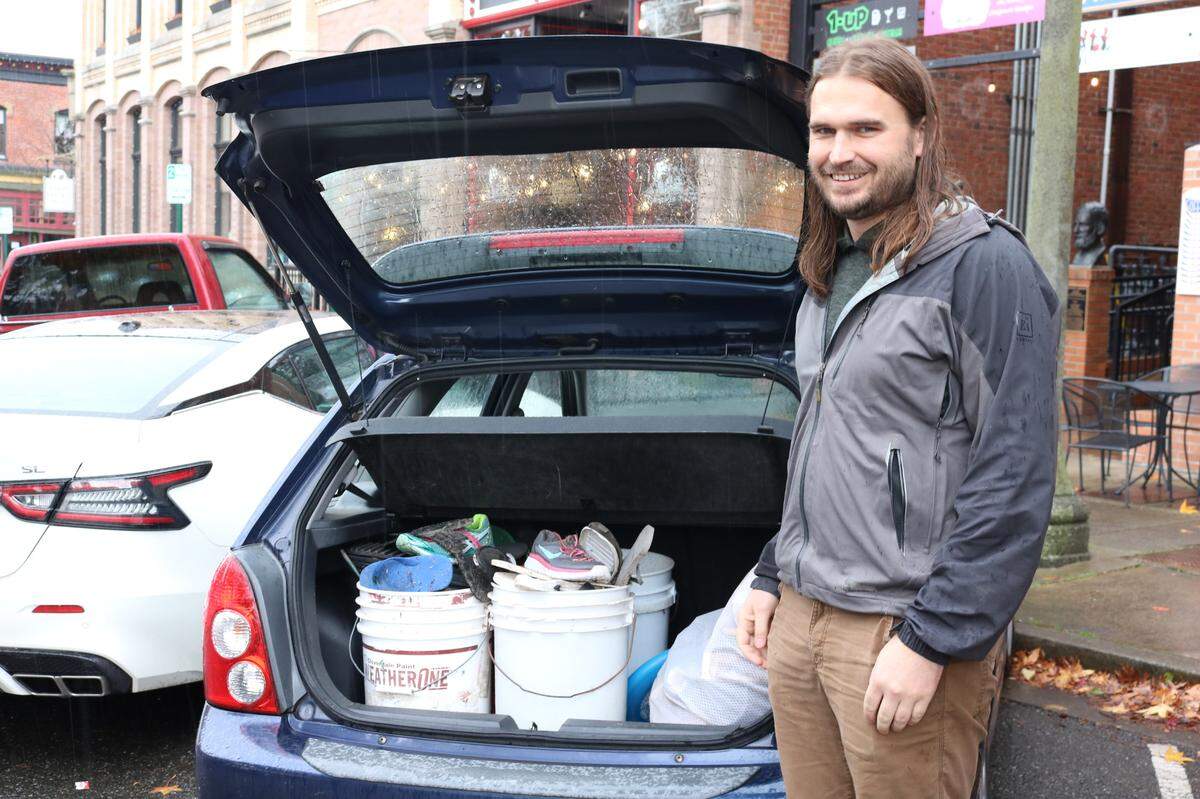
Dayley typically picks up trash once a week where the Nooksack River meets Bellingham Bay, finding bottles and cans, fishing nets, fire extinguishers, life jackets, tennis balls, tires and a shocking number of shoes.
“There’s so many shoes,” Dayley said. “I’ve been saving them to do a montage picture with them.”
His sister posted on Facebook in 2020 about Dayley’s goal, and her friend from the Philippines reached out to him looking to help. The Philippines is the world’s third-largest contributor of plastic in the world’s oceans, according to the World Bank Group.
Dayley was in — he and Jenkins sent money to help with the effort in the Philippines, and in the first week, the team there picked up 30,000 pounds of trash.
“Ultimately, most trash that ends up in the ocean comes from communities without trash disposal,” he said. “The idea is to go to those communities and give jobs to not have the trash there in the first place.”
But Dayley and Jenkins couldn’t continue to fund the effort out of pocket, so he founded companies to financially support the teams in the Philippines. In 2020, Dayley founded SeaBar, a hair product company that sells low-waste, natural shampoo and conditioner bars. SeaBar has funded about 1,100 pounds of ocean plastics cleanup in the Philippines through Pavati Ocean Pickup — not as much as Dayley would like, but the effort is still gaining steam, he said.
Then came Trashy Greetings, in the second half of 2021.
Both companies not only fund ocean clean-up but help reduce the waste going into the environment in the first place, Dayley said — SeaBar products are lower-waste than traditional haircare products, and e-cards are a zero-waste alternative to paper cards.
“There’s a lot of pointless waste in both those industries,” he said.
But Dayley is passionate that clean-up is not the solution to our ocean trash woes. What we really need to do is reduce our consumption, he said.
“You can go out and pick up a couple thousand pounds of trash, and that’s amazing,” Dayley said. “But you probably produce many thousands of pounds of trash a year. We need to stop letting ourselves off the hook by saying ‘Oh, I recycle.’”