How new Lake Whatcom data could help predict the region’s next big earthquake
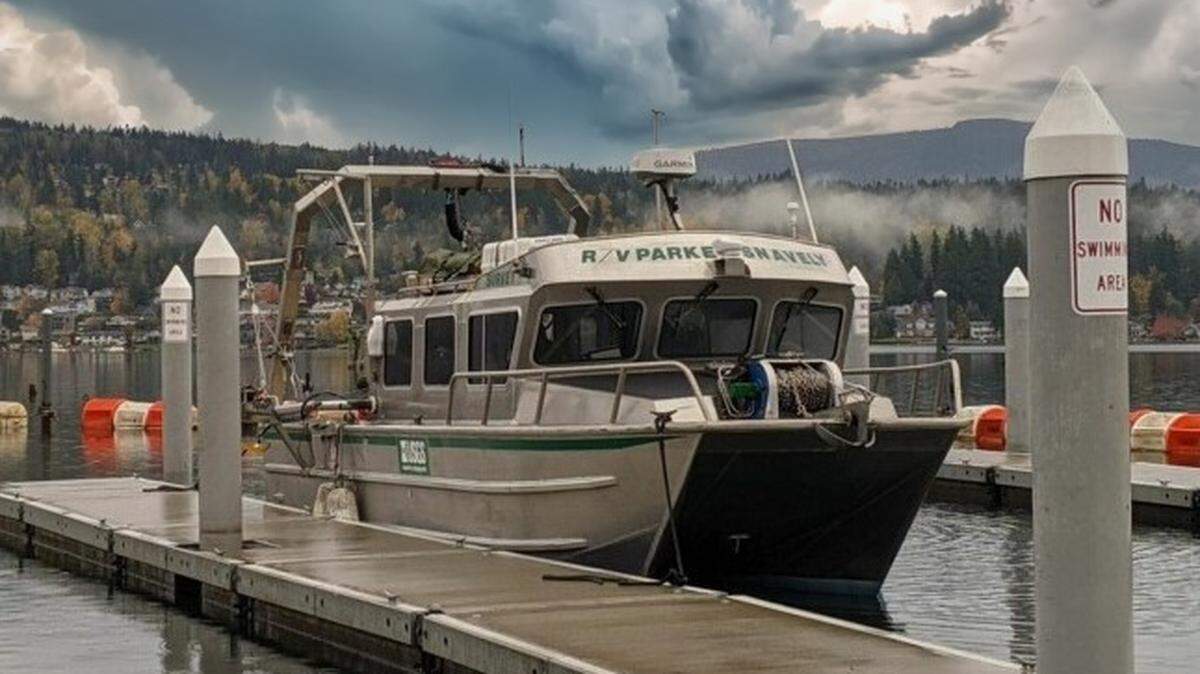
A 34-foot vessel cruised Lake Whatcom near Bloedel Donovan Park last week — but the mission of the researchers onboard was anything but recreational.
The team of U.S. Geological Survey scientists scrutinized the bottom of the lake for evidence of historic earthquakes in an effort to better predict when future ones could occur and how they will impact certain areas of the Pacific Northwest. Armed with this knowledge, communities can better prepare for earthquake events.
“It’s like weather,” said Danny Brothers, a research geophysicist for the U.S. Geological Survey, or USGS, and one of the lead scientists for the region-wide project. “If you don’t know anything about the history of weather in a particular place, you have no way to forecast the weather in the future.”
And yes, the results could shed more light on the “big one,” a hypothetical high-magnitude earthquake that could devastate the region and send a tsunami hurtling across the Pacific Ocean.
Our region is home to the Cascadia Subduction Zone, a fault that runs from northern California to British Columbia and has the capacity to generate an earthquake with a magnitude of over 9.0, according to the Oregon Office of Emergency Management. “Megathrust” earthquakes like this are predicted to occur here roughly every 400 to 500 years, Brothers said. The last one occurred in 1700.
There are also several smaller faults that run throughout Washington state.
Since earthquakes happen relatively infrequently compared to a human lifespan, there is little data available to experts that allows them to understand patterns, Brothers said.
Luckily, the murky depths of Lake Whatcom tell a vivid story: By examining sediment layers, researchers can determine when underwater landslides triggered by earthquakes took place.
Lake Whatcom is the third lake that the USGS team has surveyed in the region over the course of three years, following Lake Ozette and Lake Crescent. Lake Whatcom is an ideal place to look for evidence of underwater landslides and earthquakes because it’s deep and has a steep underwater drop-off along the shore, Brothers said.
“If you shake a steep slope underwater, the sediment of the slope falls off and creates an underwater landslide,” he said.
Over the course of five days in early November, Brothers and his small team collected sediment samples and imagery of Lake Whatcom’s sedimentary layers using sonar technology. The scientists detected records of many underwater landslides in Lake Whatcom, ranging in scale from small to large, Brothers said.
Back at the lab, they will attempt to figure out exactly when the underwater landslides occurred, using a process called radiocarbon dating. Radiocarbon is an isotope of carbon, and scientists can determine a sample’s age by measuring how much radiocarbon it contains.
The scientists will then compare the timing of these underwater landslides with existing records of earthquakes, allowing them to understand how far-ranging the impacts of certain earthquakes were. Were the landslides triggered by a Cascadia Subduction Zone earthquake or a rupture on a nearby fault system?
“Lake sediment is almost like a tree ring,” Brothers said. “It’s very sensitive to changes in water, changes in climate and shaking from earthquakes.”
This is a fairly new method in the realm of earthquake research, he said.
“Some of the concepts have been around for decades, but the technology we use to do the mapping and imaging is new,” Brothers said. “And we can do that in much more detail.”
Technical challenges remain, however: It can sometimes be difficult to tell if an underwater landslide was actually caused by an earthquake or some other event, like a large flood.
Underwater slopes don’t tend to fail randomly — they’re constantly saturated with water, which is different than hillsides that are vulnerable to a landslide triggered by precipitation, Brothers said.
There are efforts underway to develop better methods to discern the cause of an underwater landslide, said Brian Sherrod, a research geologist and regional coordinator for the USGS Earthquake Hazards Program.
“People are looking into it and trying to figure out if there’s a particular sediment signature for a specific type of earthquake or a flood rather than an earthquake,” Sherrod said. “It’s a developing area that we will learn about by doing more of these studies.”
Brothers said the research team will likely return to Lake Whatcom to collect more samples in the future.
USGS will share the data they collected last week with the city of Bellingham, which it will use to update its Geographic Information System database, said Gina Austin, project engineer at the Parks and Recreation Department.
This federal work to better understand earthquakes was partially motivated by a magnitude 7.0 earthquake that hit Anchorage, Alaska, in 2018.
In the coming months, the team plans to collect similar data at Lake Sammamish near Seattle and at more lakes on the Olympic Peninsula. They currently have a list of roughly 20 lakes throughout the Pacific Northwest and British Columbia where they’d like to collect data.
“We really want to understand the entire plate boundary and how each region responds to shaking,” Brothers said.