Whatcom amphibian experts untangling mystery of the red-spotted newt. They need your help
There’s a new newt in town, and local amphibian experts are worried about what its presence could mean for Whatcom’s ecosystems.
“The red-spotted newt is an adorable little critter, but everyone’s freaked,” said Vikki Jackson, program manager for the Whatcom County Amphibian Monitoring Program, a local citizen science initiative.
Since 2019, the group has been monitoring the presence of this salamander species on a roughly 2-square-mile patch just south of Everson, after Jackson stumbled upon a 2016 recording of the newt in the area on the biodiversity tracking app iNaturalist. It’s the first record of the species being found outside of its native habitat, which encompasses much of eastern North America, according to University of Georgia’s Savannah River Ecology.
What could go wrong? A lot — or nothing at all, say local amphibian experts. Since it’s the first time the newt has been recorded away from home, nobody knows quite what to expect from this small invader. Time and careful monitoring will tell.
“The worst thing would be that it actually has an effect on native species,” said Stephen Nyman, lead scientist for the Whatcom County Amphibian Monitoring Program. The species is known to prey on the eggs of other spring-breeding species in the eastern U.S., and there is the potential for that to happen here as well.
There’s also the concern that the red-spotted newt will eat native invertebrates living in the soil, which could have “big ecosystem impacts,” said Max Lambert, aquatic research section manager at the Washington Department of Fish and Wildlife. The newt could also serve as a vector for diseases that may impact native species.
“It’s kind of a whole new ballpark,” he said. “There’s no real precedent to go off of.”
The red-spotted newt is a unique creature, Lambert said. Many amphibians have a two-phase life cycle, spending some time on land and some in the water. (The word “amphibian” is derived from the Greek word for “double life,” according to the National Wildlife Federation.)
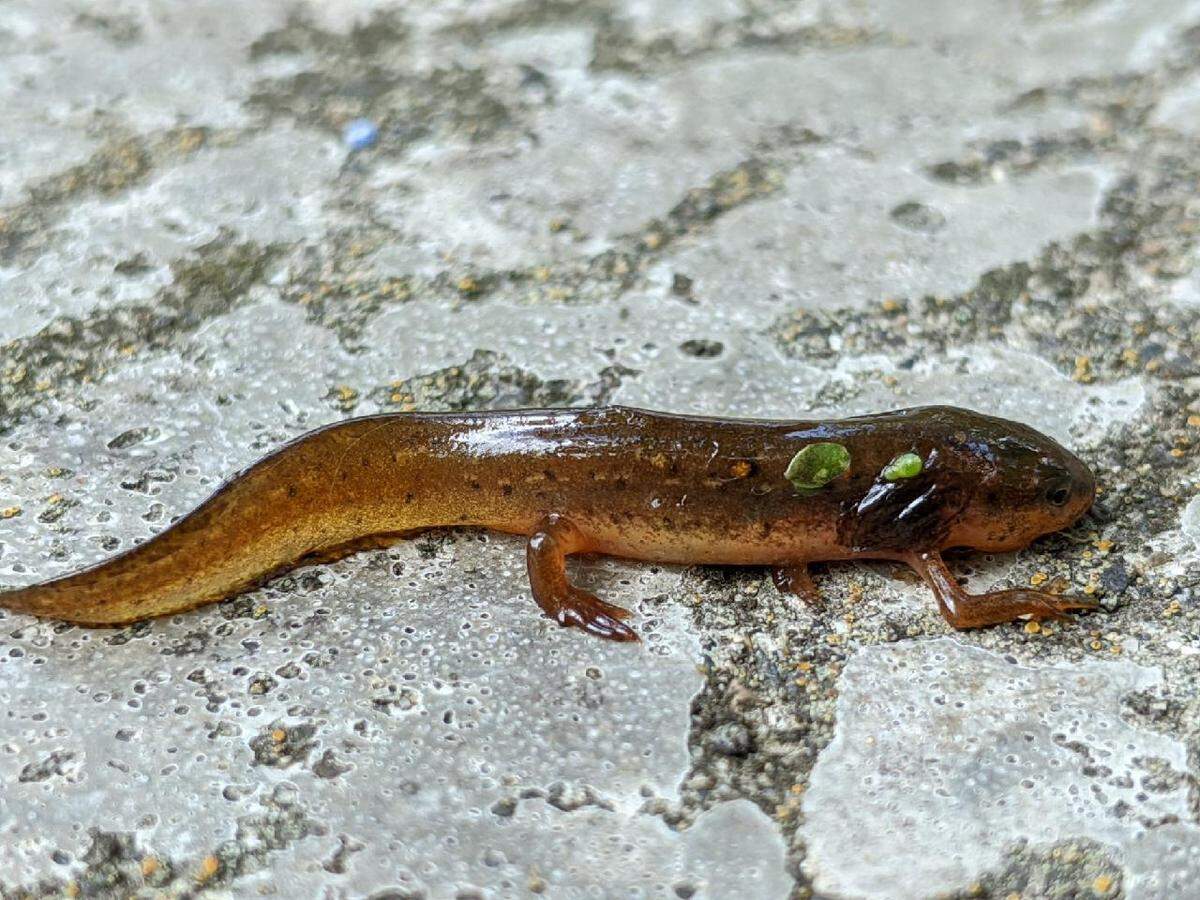
The red-spotted newt, however, has three life phases, Lambert explained. The species’ eggs and larvae grow in the water, and the juvenile newts — bright orange critters known as red efts — spend about one to three years living on land. The adult red-spotted newt then develops smoother greenish skin and returns to the water to live out the rest of its days in an aquatic habitat.
Is it breeding here?
There’s one thing local herpetologists, or reptile and amphibian experts, do know: The species is breeding here. Since they began monitoring it in 2019, there have been a handful more newts spotted in the same area near Goshen, and larvae was found in a nearby pond last year by members of the Whatcom County Amphibian Monitoring Program.
Lambert suspects that the species was introduced to Whatcom through the pet trade. Although red-spotted newts aren’t common pets, he has seen them advertised online. There’s a chance they’ve been here for years, and the area simply hasn’t proven to be a welcoming habitat for them, keeping their population small.
But there’s also the chance that the species is newly introduced and this is the beginning of the population’s explosion.
The recorded sightings are close to the Nooksack River, and the red-spotted newt could potentially spread to a very large area if it was able to take advantage of the long river corridor, posited Nyman, lead scientist at the Whatcom County Amphibian Monitoring Program. The species’ average lifespan is 12 years to 15 years, allowing the newts plenty of time to breed, according to the Amphibian Monitoring Program’s website.
For now, local experts are keeping a wary eye on the red-spotted newt population near Everson. Members of the Whatcom Amphibian Monitoring Program want to continue surveying ponds, but the water is often muddied and taken over by vegetation, making running a net through it extremely difficult, Nyman said.
That’s part of the reason why the monitoring team needs the community’s help, he said.
Citizen science critical
“We want to figure out how large these populations are,” he said. “Citizen science is going to be critical.”
If community members see a red-spotted newt, they should try to collect them in a ventilated jar if possible and contact the Whatcom County Amphibian Monitoring Program at vikki@whatfrogs.org. A member will come and collect the newt. Nyman also urges people to snap a photo and log the sighting on the app iNaturalist.
The state’s game plan for addressing the red-spotted newt is still materializing, but ideally, the species would be removed from the area, Nyman said. This will only be possible if the population hasn’t spread too far or gotten into nearby Lake Fazon — that body of water is so deep that the only way to kill the newts would be poison, which would likely also harm native creatures, Nyman said.
The Whatcom County Amphibian Monitoring Program and state Department of Fish and Wildlife will continue their hunt for the spotted-red newt next spring, as the region warms once again.
“Rather than ignoring the red-spotted newt, we are monitoring it,” Nyman said. “The best time to deal with a species is when it’s first introduced.”
This story was originally published November 2, 2021 at 5:00 AM.