Ericksen: ‘If this keeps up, it is only a matter of time before someone is hurt or killed’
A week after a federal agency blamed last year’s oil train derailment and fire north of Ferndale on safety lapses and “possible” vandalism, state Sen. Doug Ericksen is renewing his call for legislative hearings on the disaster.
And BNSF could be fined or otherwise penalized over the incident because the rail carrier and its crew ignored steps that might have prevented the derailment — even if sabotage was the cause.
Ericksen, a Ferndale Republican who represents northern Whatcom County, cited last week’s Federal Railroad Administration report on the derailment and the conviction of a woman for an attempted terror attack on BNSF tracks through Bellingham as evidence that hearings are needed.
“Legislators need to be aware this is happening, and that the threat is real,” Ericksen said in a statement. “Activism that turns to sabotage invites tragedy. This new trend in left-wing protest warrants the strongest condemnation from elected officials and responsible environmental organizations. If this keeps up, it is only a matter of time before someone is hurt or killed.”
In all, more than 40 incidents of sabotage have been reported since January 2020 as part of an apparently politically motivated attempt to disrupt rail traffic through Whatcom County, according to the Department of Justice.
FBI officials are still investigating the Dec. 22, 2020, incident, where 10 tank cars loaded with highly flammable Bakken crude oil jumped the tracks at Portal Way and Main Street in Custer as the BNSF train headed toward the Phillips 66 refinery at Cherry Point.
Three tank cars caught fire, and 120 nearby residents were evacuated for several hours as firefighters brought the blaze under control.
No injuries were reported.
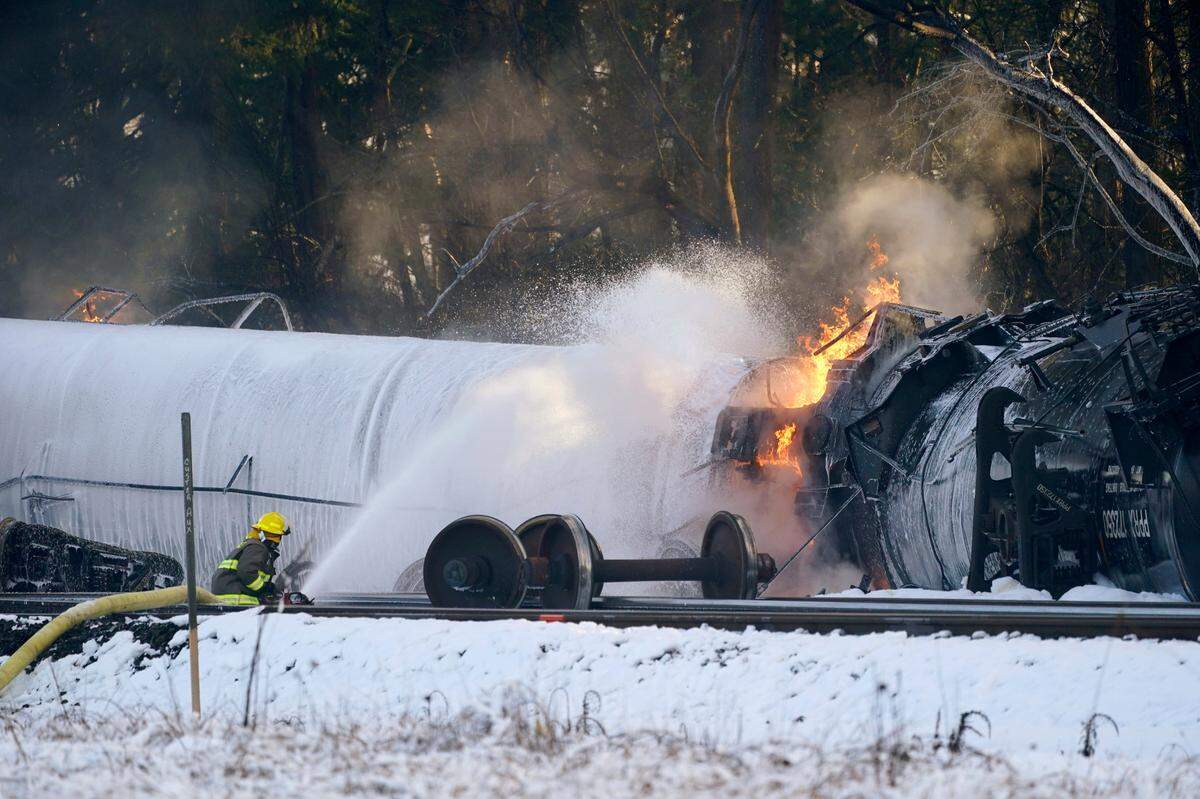
In its report issued Thursday, Sept. 9, the Federal Railroad Administration said the 106-car train carrying oil tankers broke in two because the couplers between two cars apparently were released and their brake lines appeared to have been cut.
When the train split in two, the two locomotives in back pushed the rear of the train into the front part, which was being pulled by two locomotives at a slower speed.
Damage from the crash kept investigators from being certain about their conclusions, the report said.
That report also criticized BNSF and its workers for leaving the train unguarded at a siding for three hours during a crew change, and for failing to check the brakes before starting toward the refinery.
BNSF was further faulted for failing to tell its train crews about recent vandalism attacks.
Recordings of 911 calls after the derailment, obtained by The Bellingham Herald, show that at least one witness saw two people near the train as it sat idle before the derailment.
Neither BNSF or the SMART union that represents at least one crew member responded to a Herald request for comment.
A Federal Railroad Administration official told The Herald that a fine or other penalties over the incident would be announced later this year.