An iconic tree is dying off in Whatcom — what’s causing it and how can you help save it?
The grim reaper is coming for the region’s Western redcedar.
Across the Pacific Northwest, a concerning number of the species are dying, forest health experts say. And they’ve determined a likely culprit: climate change, caused by the massive amounts of greenhouse gases humans have pumped into the planet’s atmosphere.
“Once you start looking for it, you won’t be able to stop seeing it,” said Joey Hulbert, program director of community science program Forest Health Watch, of unhealthy Western redcedars.
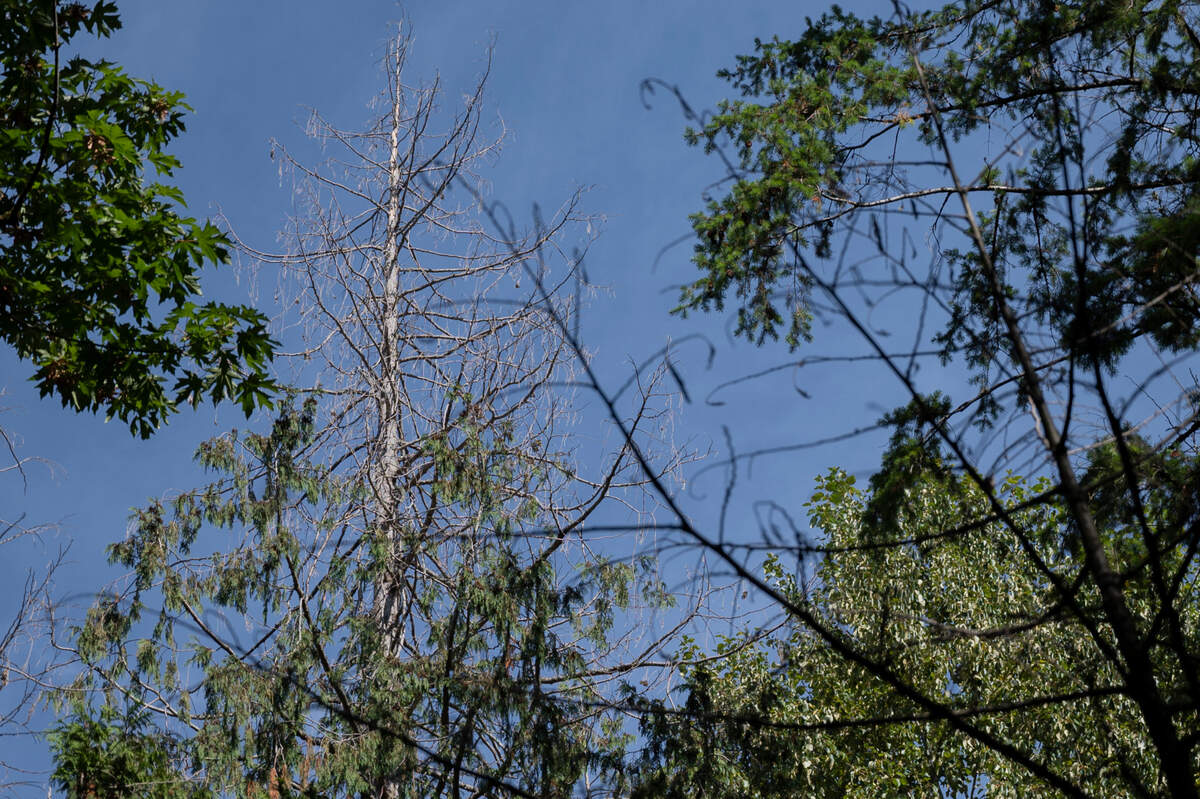
When the tree is dying, it has thinning foliage, bare tops and a brown, rather than green, canopy. It is normal, however, for older, interior foliage to brown in early autumn, according to foresthealth.org.
“In Whatcom and Skagit counties, there’s a ton of dieback,” Hulbert said. “When you drive around to pick berries or go up to Lynden, there is a lot of dieback out in between the fields.”
The Western redcedar is not just any tree.
It’s one of the region’s dominant conifer species, alongside Douglas fir and western hemlock, and it holds incredible cultural significance for coastal tribal communities in the Pacific Northwest, according to foresthealth.org. Its rot-resistant wood has been used to make items such as totem poles and canoes, and it’s often referred to as the “Tree of Life.”
They’ve been recorded to live for more than 1,500 years and can continue serve as wildlife habitat for hundreds of years after they die.
The Western redcedar also is important to the local economy, as one of the region’s more expensive timber species.
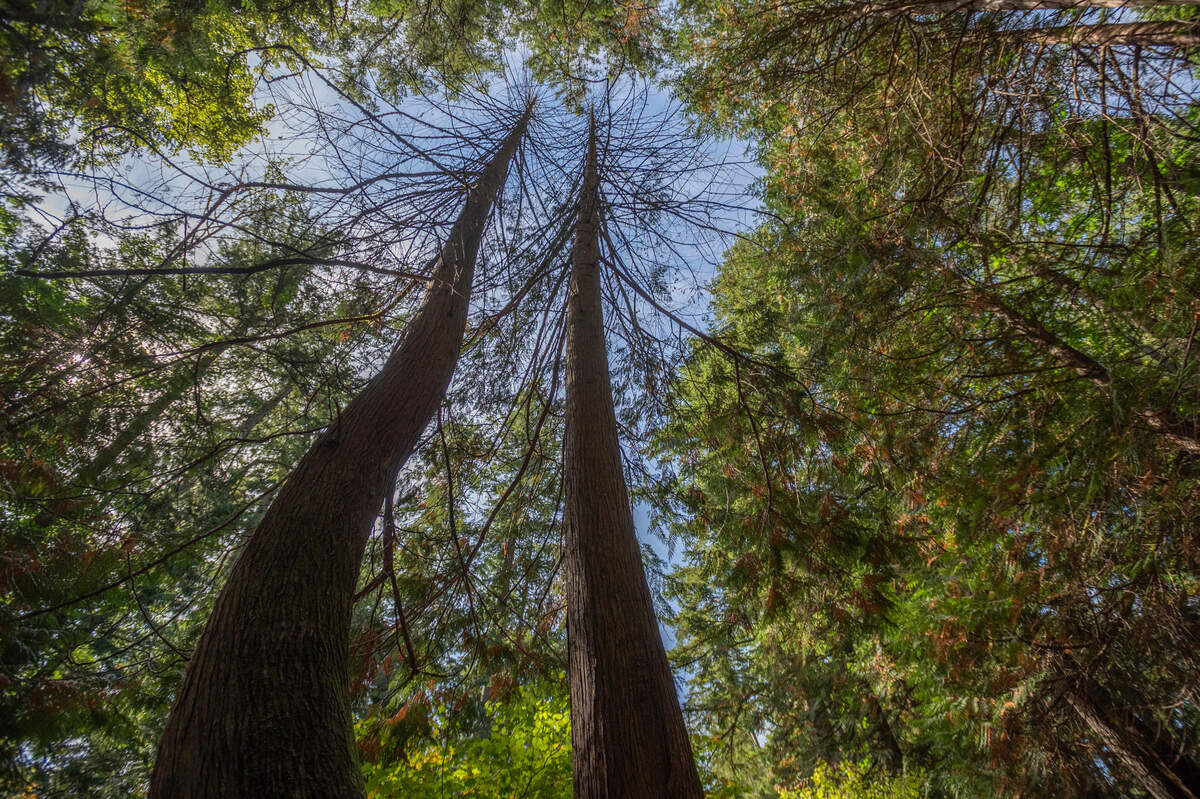
Western redcedar die-off has significantly worsened since 2015, when a severe drought hit the region, Hulbert said. That’s what makes him and other experts suspect climate change as a factor. The Western redcedar is a moisture-loving tree, and climate change results in more frequent, longer droughts, such as this summer’s.
“It seems like it’s the first tree species in our region to feel the heat of climate change,” Hulbert said. “It’s an indicator of what could come.”
There were no Western redcedar seedlings found in a recent forest inventory of a Lummi Island Heritage Trust preserve, according to the Trust’s Scott Josiah.
“We think our high deer populations are eating all the cedar seedlings,” Josiah told the Herald in an email. “This is of concern since cedar should be a major component of the future forest as it moves toward old growth.”
Even Western redcedars near bodies of water can struggle during droughts, said David Peterson, a professor at the University of Washington’s School of Environmental and Forest Sciences. The species doesn’t have a very deep taproot, so it can be challenging for it to draw enough water all the way to its topmost branches.
“One drought year isn’t a big deal,” Peterson said. “But when you get two or three, that starts to compound.”
How you can get involved
More research is needed to confirm that climate change is indeed responsible for the die-off, and to understand exactly where and how Western redcedar populations are struggling.
That’s where you come in: The Western Redcedar Dieback Pilot Project is a community science effort created by Hulbert late last year to gather much-needed information about the species. Through the mobile app iNaturalist, locals can log observations and photos of Western redcedars in their area, adding to the body of data experts need to develop smart conservation plans.
“We don’t have a very good understanding about how trees are affected in Whatcom County,” Hulbert said.
More information about how to get involved with the project can be found at www.foresthealth.org/redcedar.
Currently, the project has garnered just over 1,000 observations. That’s roughly half of the number of observations Hulbert hopes to have by the end of the year. A majority are logged in Western Washington’s urban areas, and more data points are needed to get a fuller picture of the die-off, Hulbert said.
“If things continue as they have, by this time next year we should have enough information to figure out which environmental parameters are important for the Western redcedar,” Hulbert said.
A possible measure that could be taken to conserve the Western redcedar is to identify drought-tolerant populations and plant those in vulnerable areas, Hulbert said. Another idea is to clear out competing species in places where Western redcedar is struggling.
What Hulbert doesn’t want is for people to write off the Western redcedar as having no future in a warming world, choosing to plant other species instead. There are a number of ongoing initiatives focused on tree-planting, such as King County’s goal to plant 3 million trees between 2020 and 2025, and Hulbert would be saddened if Western redcedar was left out of those plans.
“Already, a lot of people want to plant other species,” Hulbert said. “But I think it’s too early to give up on the redcedar.”
This story was originally published September 13, 2021 at 5:00 AM.