Kelp is struggling in central and south Puget Sound. Are Whatcom’s kelp beds next?
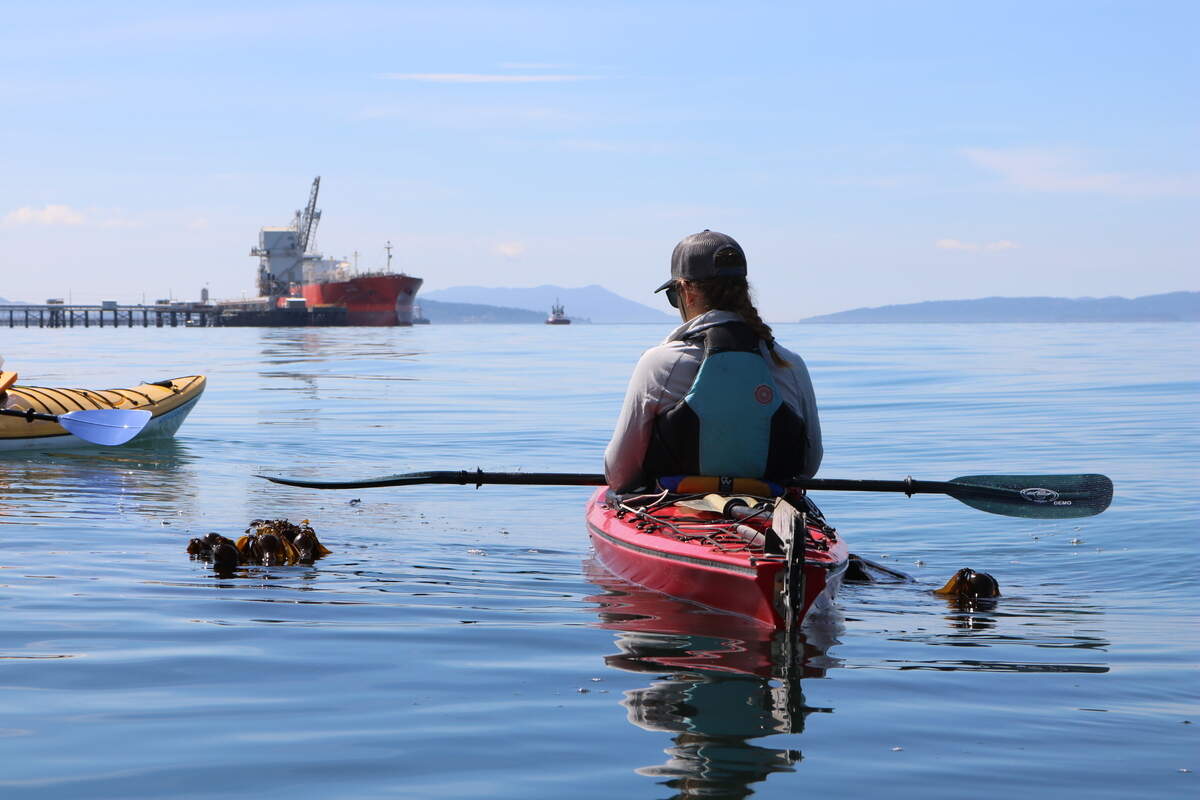
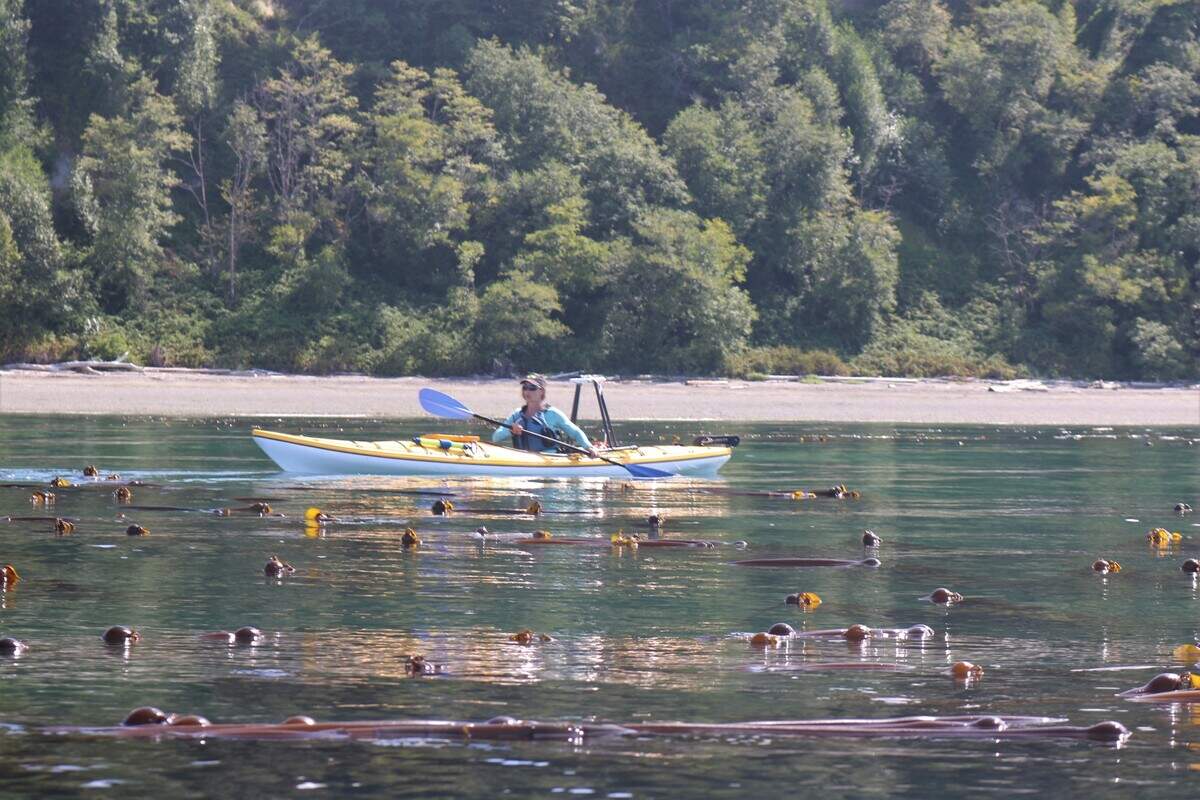
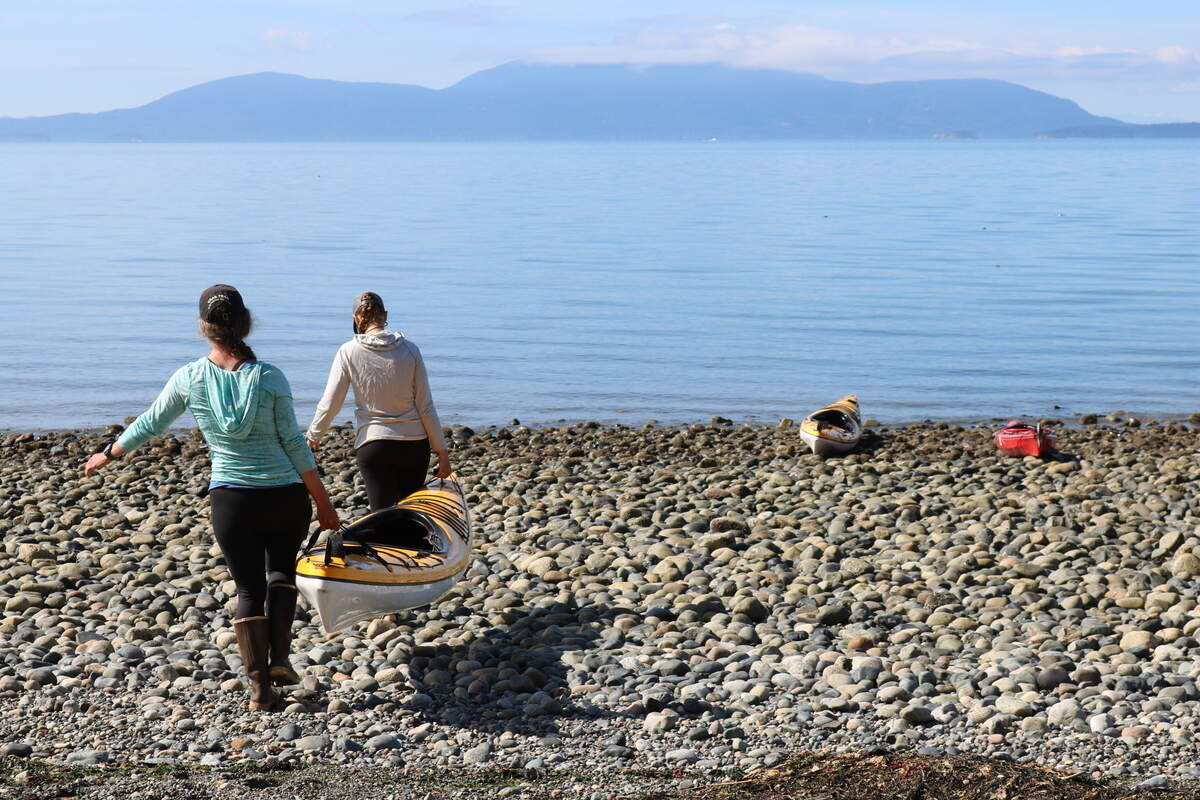
On a clear day in early August, three women stood next to their kayaks on the rocky shore of the Cherry Point Aquatic Reserve. It was a beautiful day for a paddle, but the group of community volunteers wasn’t there for recreation. They made the trip to monitor the health of a nearshore bull kelp forest for the fifth year in a row.
“See that reddish-brown patch of water over there?” said Eleanor Hines, chair of Whatcom County’s Marine Resources Committee and leader of the endeavor. “That’s where we’re going.”
It’s a humble mission, entailing hours of slowly paddling around the perimeter of the kelp forest, jotting down the water’s depth and temperature. But the data collected from local kelp monitoring feeds into a regional effort to preserve the entire Salish Sea ecosystem, including Southern Resident orca whales and salmon. The results give experts insight into whether bull kelp populations are declining at troubling rates, which happened off the coast of California in the mid-2010s, and can light the path toward effective restoration.
“Sometimes we notice these things when it’s too late,” Hines told The Bellingham Herald. “So we want to be proactive about this.”
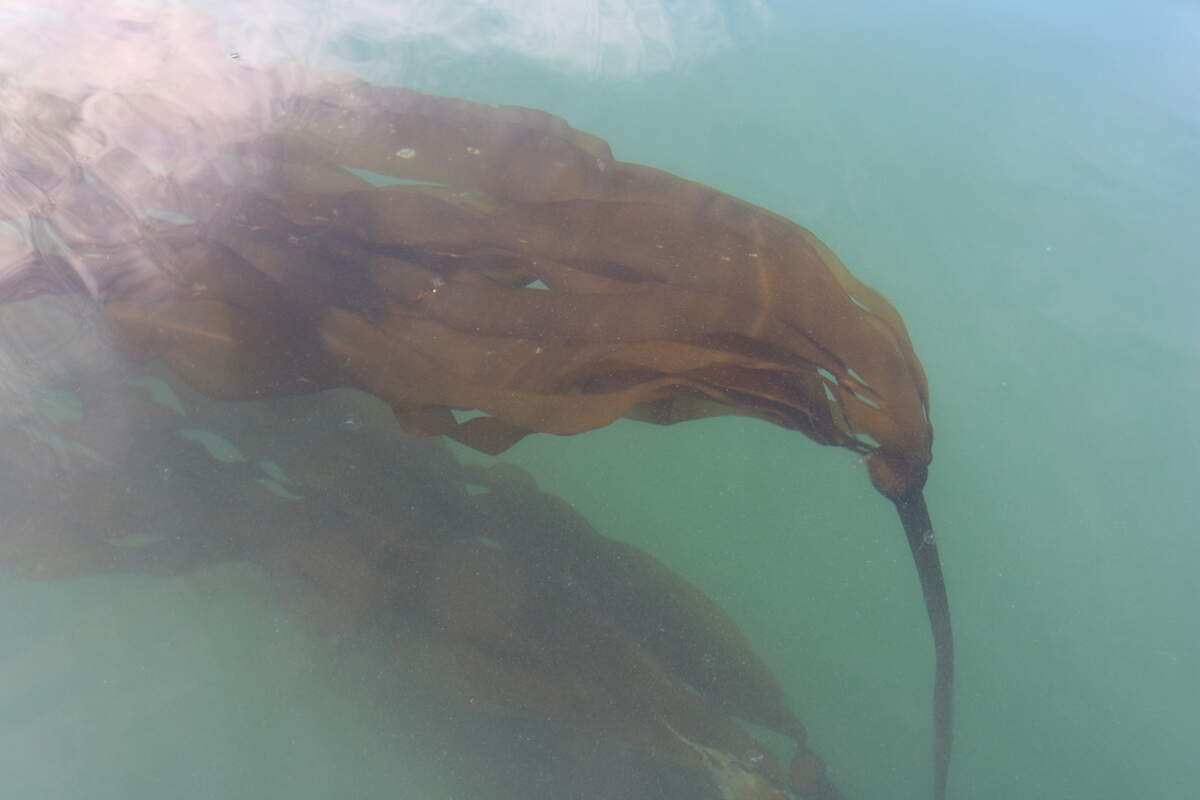
Bull kelp is one of Puget Sound’s dominant kelp species. It boasts thick, hardy stems that end in a floating bulb and long, translucent blades. Kelp forests serve as a vital three-dimensional habitat for species at the bottom of the food chain, like forage fish and mussels, connecting the underwater vegetation to the entire ecosystem, said Helen Berry, a marine ecologist at the Department of Natural Resources who studies nearshore habitat.
“I think of it as an unsung hero,” said Berry. “Kelp beds are one of the main primary producers that fuel the food chain.”
Thriving bull kelp can also soften the blow of climate change, with Washington state’s bull kelp forests absorbing 27 to 136 metric tons of carbon each day, according to the Puget Sound Restoration Fund. Over the course of a year, that offsets the emissions of approximately 2,000 to 10,500 vehicles. The species is also culturally important to tribes in the Pacific Northwest, and the Samish Indian Nation has been researching populations in Skagit and San Juan counties since 2016.
The Whatcom Marine Resources Committee monitors five bull kelp forests off the county’s coast: Alden Bank, Aiston Preserve, Southwest Lummi Island, Point Whitehorn and, of course, Cherry Point. The citizen-run committee is one of seven working under the umbrella of the Northwest Straits Commission, established by Congress in 1998. But even with the Whatcom committee’s valuable work, there needs to be more monitoring done in the northernmost reaches of Puget Sound, Berry said.
“North Puget Sound is one of the areas that has the lowest number of sites monitored,” she said. “We have very few sites from Lummi Island north to the border.”
It takes at least five to ten years of data to detect trends in kelp health, since beds can naturally vary from year to year, said Dana Oster, marine program manager with the Northwest Straits Commission. So, while the five sites monitored in Whatcom County appear relatively stable since citizens began monitoring them five years ago, Oster is still “very concerned” about how kelp will continue to fare in local waters.
“We know there is documented decline in central and south Puget Sound, and we are starting to see it in Snohomish County,” Oster said. “There’s no indication that this wouldn’t continue to happen progressively further north into Skagit and Whatcom counties.”
A stressful decade for kelp
Bull kelp health can be negatively impacted by factors such as poor water quality, but the biggest threat to kelp is warming waters fueled by climate change, said Hines, the Whatcom Marine Resources Committee chair. The Salish Sea’s average temperature is projected to rise 1.5 degrees Celsius by 2095, according to a 2019 study from the Pacific Northwest National Laboratory. That’s not good news for bull kelp, which thrives in colder water. Climate change and marine heat events can also disrupt the equilibrium of food webs, resulting in increased stress on kelp beds.
In the waters off Northern California, for example, a perfect storm of bull kelp stressors decimated the species in recent years. In 2013, a disease killed massive numbers of sea stars all along the Pacific Coast. Without sea stars hunting them, sea urchin populations exploded. Soon, kelp beds were overrun with copious amounts of grazing purple urchins. Both the sea star wasting disease and kelp vulnerability were worsened by the “blob,” a warm pool of water in the Pacific Ocean that stretched from Alaska to Mexico between 2013 and 2016.
The area of kelp forests off the coast of Northern California has plummeted 95% since then, according to satellite imagery, and recovery will be difficult, Berry said. When a small amount of kelp begins to grow, starving urchins devour it almost immediately, she said.
Washington’s bull kelp populations suffered the impacts of the “blob” as well, Berry said, with forests in the straits along the outer coast shrinking to half their original size in 2014. The difference here, however, is that many of the beds recovered quickly in 2015. Off Cherry Point, recovery didn’t happen until 2018, Berry said. That’s because the area, situated at the entrance to the Strait of Georgia, experiences warmer water temperatures and is further from turbulent oceanic mixing.
Those are the same reasons Berry is particularly concerned about the long-term health of kelp beds near Whatcom County.
“In Puget Sound, since every location is unique, we aren’t worried about all locations. The Deception Pass area is well-mixed and has strong currents,” she said. “We do worry most in places that don’t experience really strong currents and are distant from strong mixing areas.”
What it takes to restore a kelp forest
Kelp restoration experts have come a long way in the race to revive disappearing kelp forests in south and central Puget Sound, but significant hurdles lie ahead.
Last summer, Northwest Straits unveiled the Puget Sound Kelp Conservation and Recovery Plan, which provides a suite of potential actions that could help restore kelp. And the state Legislature recently allocated $1.5 million of the budget between 2021 and 2023 toward bull kelp restoration efforts.
The Puget Sound Restoration Fund and its partners have a seed bank of kelp from throughout the region, curated to save the genetic material of these populations before it’s too late. Researchers will then propagate the stored seed and settle the resulting microscopic pieces of bull kelp on a thin nylon twine in the water, said Jodie Toft, deputy director of the Puget Sound Restoration Fund.
Once the pieces of bull kelp have grown larger, there are two potential next steps: The seeded line can be wrapped around large concrete pyramids on the floor of the ocean, from which the kelp grow upward, or the line can be wrapped around thicker twine on the ocean floor, resulting in curtains of kelp.
For the past two years, researchers with the Puget Sound Restoration Fund have been able to grow bull kelp off Point Jefferson in Kitsap County. There’s one big caveat to that success, however — they haven’t yet figured out how to grow kelp that will return annually.
“It’s not actually hard to get kelp to grow,” Toft said. “It’s hard to get it to come back year after year.”
The Puget Sound Restoration Fund hasn’t done any bull kelp restoration in the waters off Whatcom County, but Toft hopes it’s just a matter of time. Kelp is the “newer kid on the block,” she said, and it’s going to take time to figure out where efforts should be focused. That’s part of the reason why local monitoring of kelp beds is so important.
“The biggest challenge is our capacity. Puget Sound is huge,” Toft said. “Where do we want to try for restoration success? Where do we want it most? Where do we have the confluence of partners, funding and permitting?”
This story was originally published August 30, 2021 at 5:00 AM.