This popular Whatcom Spanish-language church is an example of the need for translation help
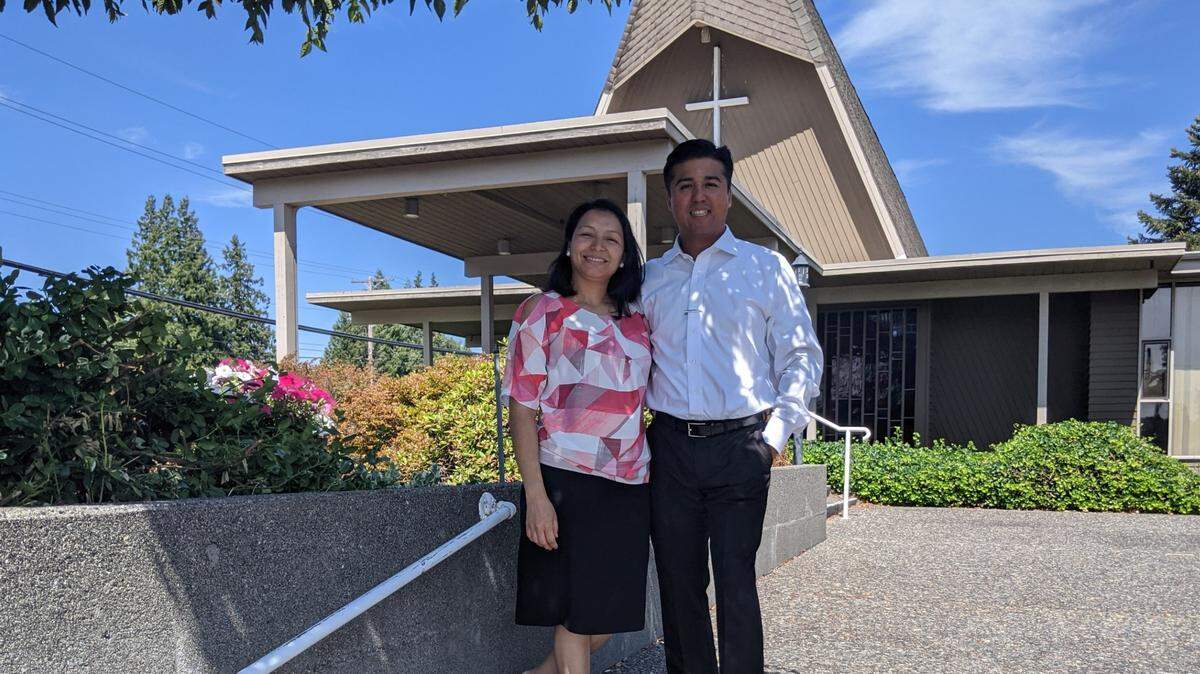
Edward Reyes’ Bible study group began like many others, with the pastor inviting community members to his Ferndale home. Each Sunday morning, people would trickle in, the children were corralled and the adults congregated in the living room to discuss Bible excerpts and bask in the comfort of shared spirituality.
But Reyes’ group is different than the vast majority of Whatcom County religious gatherings in one crucial way — it is conducted entirely in Spanish.
Since it was conceived nearly two years ago, the study group has exploded, garnering dozens of members. The community eventually outgrew Reyes’ home and in early July began worshiping in Lynden’s Hope Lutheran Church. Today, what used to be a casual gathering has grown into one of the county’s few Spanish-language evangelical churches, Iglesia de Toda Nacion.
“It was not in our thoughts to start up a church,” Reyes said. “We felt a calling to do something because demographics have definitely been changing in Lynden slowly.”
He’s right. Between 2010 and 2019, the number of Hispanic or Latino individuals in Whatcom County grew from 7.8% of the county’s population to 9.8%, according to one-year estimates from the U.S. Census. In the same time span, the percentage of Whatcom County older than age five that speaks Spanish has ticked up from 5.3% in 2010 to 6% in 2019. Iglesia de Toda Nacion’s growing numbers are representative of the increasing Hispanic presence in the region and, to some, highlight the need for more Spanish interpretation and translation services offered in communities across the county.
“Whatcom County, even with its growing demographic of Hispanic Latino population, is lagging behind in Spanish services,” said Australia Tobon, a Whatcom County promotora at Bellingham-based social justice organization Community to Community.
‘Why can’t they just speak English?’
This shortcoming can be observed in services across the board, Tobon said, including policing, education, courts, city and county departments, and medical institutions. And the consequences of lacking Spanish services can be grave, she explained, such as community members not knowing their rights or how to exercise them, severe interactions with the police, parents feeling alienated from their children’s educational journey or medical wishes not being respected.
She has heard stories from women who feel like they were not fully consulted before doctors gave them C-sections during birth. She remembers another community member who contracted COVID-19 and couldn’t attend a municipal court date in a rural area. When he called to notify the court, the person who picked up the phone didn’t speak Spanish and hung up on him. He told Tobon that he tried to call back multiple times, but nobody ever picked up.
“It’s very impersonal. Our general Whatcom community doesn’t even know how to work with an interpreter,” Tobon said. “It’s a very cold interaction.”
These sorts of exchanges make Latino community members feel unwelcome — the opposite effect as the Lynden Spanish-language church — and discourage them from attempting to use services again, Tobon said. Unfortunately, the burden of translating often falls to children who are often more fluent in English than their parents. Tobon empathizes deeply with these children. She was one.
“I felt like there was crucial information I was missing, and I was only 10,” Tobon shared. “A lot of places ask you to fill out paperwork. It’s very demanding.”
Although she has seen an increasing number of local businesses and organizations offering Spanish services, Tobon said there’s still a long way to go. Too often, it is assumed that all members of the Latino community speak Spanish as their first language. In reality, many grew up speaking Mesoamerican Indigenous languages, such as Awaketeco, Chalchiteco and Mam. These are often mistaken as dialects of Spanish, but they are actually discrete languages.
In Tobon’s experience, Bellingham has better Spanish services than more rural areas of the county. She attributes this to the city’s larger population and better access to funding.
“Let’s just say the rural areas are not a welcoming environment,” Tobon said. “I’ve been there with community members, and people are like ‘Why can’t they just speak English?’”
Making Whatcom more inclusive
When Spanish services are offered, it is often assumed that the individual using them is fully fluent and literate in Spanish, but this isn’t always the case, Tobon said. She believes there needs to be a deeper focus on interpretation, rather than just direct translation. Her organization often uses images and videos to convey messages.
“When we speak with an English speaker, we are assessing whether they know what we are talking about,” Tobon said. She does not often see the same courtesy extended to Spanish speakers.
Tobon recalls a moment she observed in court where a Spanish-speaking woman did not understand what probation meant because there isn’t a direct translation of the concept between English and Spanish.
“The attorney didn’t go into depth on what probation means, what it does,” Tobon said. “You need an advocate, someone on the receiver end to comb through the Spanish being shared.”
The best solution in Tobon’s eyes is not just for organizations to offer more Spanish translation but for business and government leaders to encourage a multilingual workforce outside of translator positions. Native Spanish or Mesoamerican language speakers should also be offered a pathway in their endeavors to become community interpreters, she said. For undocumented immigrants, that could mean financially compensating them for the time they take to learn to translate.
Reyes, the pastor at Iglesia de Toda Nacion, has seen firsthand how inclusive, multilingual environments can bring recent immigrants out of their shells. Reyes grew up in Everson, but his wife Dina is from El Salvador, and she is able to connect with and comfort recent immigrants who are often overwhelmed with the transition. The only thing that separates his family from those who have recently arrived is time, he said.
“They look at our face, they look at our color,” Reyes said. “And they feel like they can approach us.”
This story was originally published August 10, 2021 at 5:00 AM.