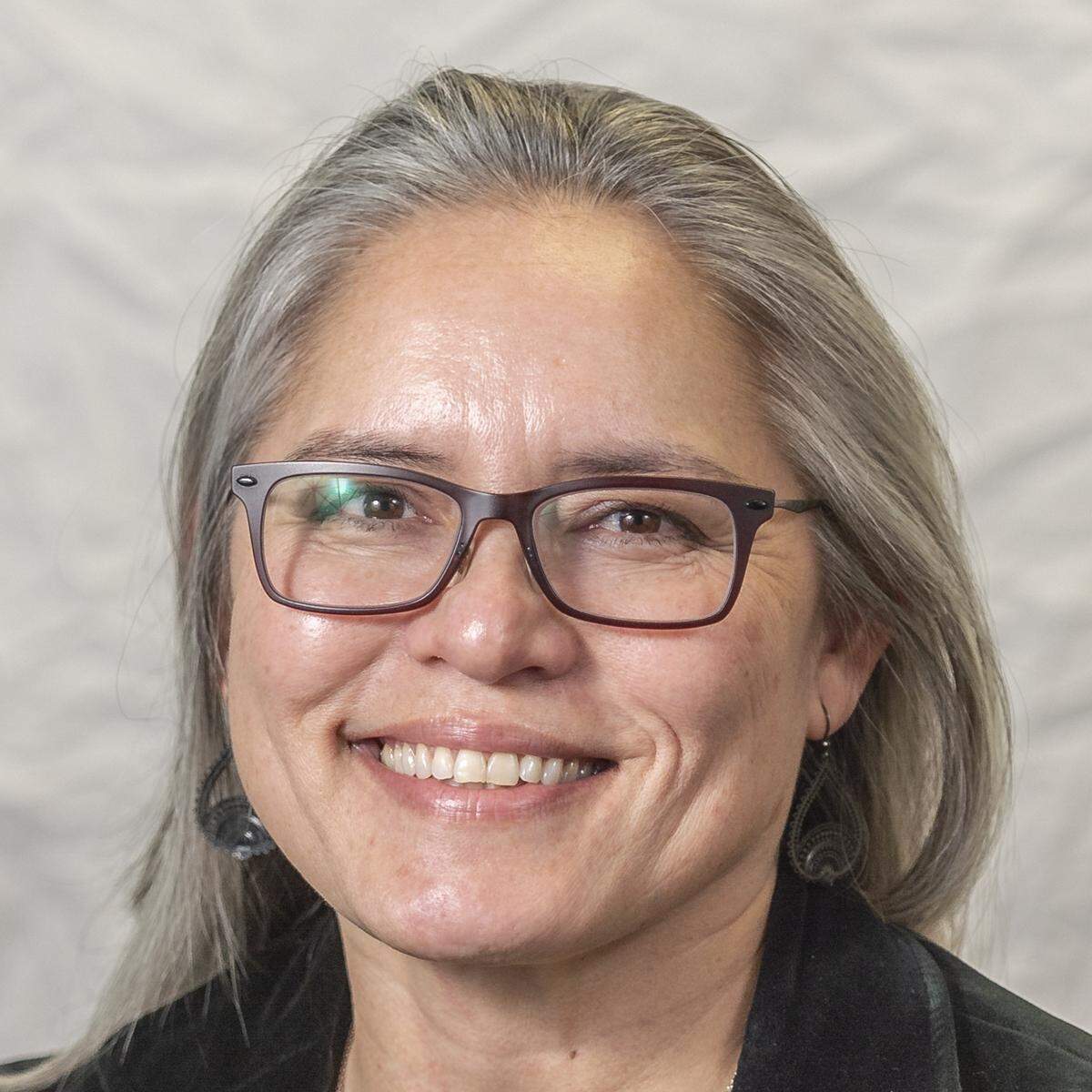
State’s new poet laureate and Lummi tribal member talks about ‘innate music of language’
Rena Priest, the Bellingham writer and member of Lummi Nation who is Washington state’s new poet laureate, is the first Native American in that role and hopes “to be the first in a long line of many.”
Gov. Jay Inslee appointed Priest, 42, the state’s sixth poet laureate. Her two-year term began Thursday, April 15.
Priest succeeds Claudia Castro Luna, a Seattle resident.
The state’s poet laureate program is a joint effort of the Washington State Arts Commission and Humanities Washington.
Priest’s literary debut, “Patriarchy Blues,” received the 2018 American Book Award. Her most recent work is “Sublime Subliminal.”
In a Q&A with The Bellingham Herald, the Lummi (Lhaq’temish) tribal member talked about the legacy of her grandmother, also named Rena, what inspires her, and poetry as a kind of team sport.
What role does poetry have in today’s world? Does it teach us, amuse us, placate us, soothe us?
Priest: Hopefully it does all those things and more. Poetry can be an anchor and a solace to hang onto during hard times. It can also be a way to connect to a situation or a moment in time. Of course, it’s a fabulous amusement. It’s also just a wonderful way for us to express our humanity by doing this amazing thing of making music with nothing but our thoughts and human voice.
Who or what inspires you?
Priest: I am inspired by people who keep trying. When things seem truly difficult, I think of the extraordinary people I know who’ve overcome great obstacles in order to lead happy fulfilled lives.
I also think of how salmon must swim thousands of miles and return home against swift-running rivers, sometimes even defying gravity to surmount waterfalls and cascading rapids — how they use their strength and instinct to complete their life’s journey.
You have said that as a child, you would lie in bed at night and “whisper pleasing word combinations. It was the best thing I knew how to do. It’s still the best thing I know how to do.”
What makes for a pleasing word combination?
Priest: “Alliteration, rhyme, meter; any aspect of the innate music of language makes for a pleasing word combination. I think it was a natural progression to go from loving and seeking out these naturally occurring patterns in language to writing them down in poems.”
What sparks a poem for you? For example, “Inner Life of the Water Glass” in “Sublime Subliminal” starts in a cupboard and ends in the sea with a jellyfish. How did this poem start?
Priest: A poem can start with an image that strikes me, or a string of words that go well together, or a wish to describe a sound or feeling. Other people’s art and writing is always a good place to start. “Inner Life of the Water Glass” started with me reading a book in the bathtub to keep warm.
The book was “The Hidden Messages in Water,” by Dr. Masaru Emoto. After I finished the book I found that for days I was thinking a lot about how magical water is and how we take it for granted. I was also knee-deep into writing this collection of poems that would become “Sublime Subliminal,” and I decided to write one about water and how expansive and versatile it is.
You said that “Sublime Subliminal” is playful and that you wrote the book with the feeling that words should be celebrated. Are words celebrated these days, or have they become utilitarian?
Priest: I think what sucks up most of people’s attention in the media is fairly utilitarian, but there are people making poetry and music at a dizzying rate, so it’s really all about where one focuses their attention. Language is a bridge between the human spirit and the physical world. How we name things is how we are in the world and it’s how we connect to each other.
If you can only speak one language you can only connect with people who speak that language and you can only connect to concepts that are contained by that language. I was feeling limited by my confinement to English, and I wanted to find a way to branch out.
I was learning Spanish when I wrote “Sublime Subliminal” as well as trying to add to the little bit I know of Xwlemi Chosen. The one way I know to expand beyond the limitations of a language is to add music and metaphor. This gives language the ability to dance and to make associative leaps into new realms.
(Xwlemi Chosen is the Lummi language.)
Your grandmother self-published a small chapbook of poetry, and you said that and Shel Silverstein’s book “Where the Sidewalk Ends” were “among the finest gifts I’ve ever been given.” What makes them so?
Priest: My grandmother’s book is special because it gives me a lineage. For me, it’s very important to be able to trace this urge to write poems. It’s not something anyone else in my family does and I feel that it connects me to her. It’s also very special to have her words and hear her voice in these poems now that she’s no longer with us.
The Shel Silverstein book was the first “huge” book that I read from cover to cover in one sitting. It was given to me when I was 8. I still have it.
The poem, “Put Something In” says, “Draw a crazy picture, / Write a nutty poem, / Sing a mumble-gumble song, / Whistle through your comb. / Do a loony-goony dance / ‘Cross the kitchen floor, / Put something silly in the world / That ain’t been there before.”
I took all that to heart.
You said that one of your main goals as poet laureate will be to celebrate poetry in tribal communities in the state. How will you do that?
Priest: I’d like to host open mics and build community anthologies.
Do you hope that your presence and your recognition as the state’s poet laureate will create interest in budding poets who are Native?
Priest: This is my greatest hope for my time in this position. I love how when people learn that I’m a poet, they will tell me of someone from their family who loves to read or write poetry. Writing is solitary but building skill in writing is also reliant on having a supportive community of writers around you. I was lucky to be included in a monthly community reading series and open mic called Kitchen Session Bellingham.
I feel that my time in that circle helped me to grow as much as my time in accredited creative writing programs.
Being a part of a writing community requires vulnerability and trust, and good relationships with people. These are all skills that I’ve developed in tandem with my writing that have enriched my life immeasurably. Being part of a writing community is like being a part of a team and poetry can be like a team sport for poetic kids who like the sounds of words more than running and sweating and “chasing the sports ball” (my nephew’s phrase).
The only difference is that it’s not as celebrated in communities or schools as athletics. I’d love to see that change, even in a small way. I know there are poets writing alone and in secret like I did. I’d love for them to have more opportunities to see each other and build a team.
Learn more
Additional information about Rena Priest and her other online events in April can be found at humanities.org and renapriest.com.
This story was originally published April 20, 2021 at 5:00 AM.