Hate hearing train horns in Bellingham and Whatcom? There may be some relief in sight
Residents near railroad tracks in some parts of Whatcom County should be hearing fewer train horns, thanks to several recent and ongoing projects to create “quiet zones” at neighborhood crossings.
Engineers normally are required to sound the locomotive horn when a train approaches a crossing where people, bicyclists or cars might be approaching.
But such quiet zones add safety improvements to those crossings, allowing engineers to use their horns less frequently.
“These quiet zones are a section of a rail line where locomotive horns are no longer routinely sounded because of alternate safety measures,” said Marie Duckworth, spokeswoman for the Whatcom County Public Works Department.
Whatcom County recently completed quiet zone work and received federal approval in residential neighborhoods along Cliffside Drive at the north end of Bellingham Bay, and Cove Road near Chuckanut Drive north of Larrabee State Park.
“In close collaboration with the neighborhoods, we in Public Works negotiated and constructed safety improvement projects for both neighborhoods as part of this quiet zone process,” Duckworth told The Bellingham Herald in an email.
It costs about $50,000 per crossing to create a quiet zone by installing “candlestick” barriers that divide lanes and LED warning lights, among other steps, Duckworth said.
“It keeps people from going between the railroad crossing arms,” she said.
“It doesn’t mean the train horn would never sound,” Duckworth said. “It just means it wouldn’t be routinely sounded.”
Train fatalities
One person was hit by a train and killed last year in Whatcom County and two were killed in 2019, according to the Washington Utilities and Transportation Commission.
In 2020, the death was listed as trespassing.
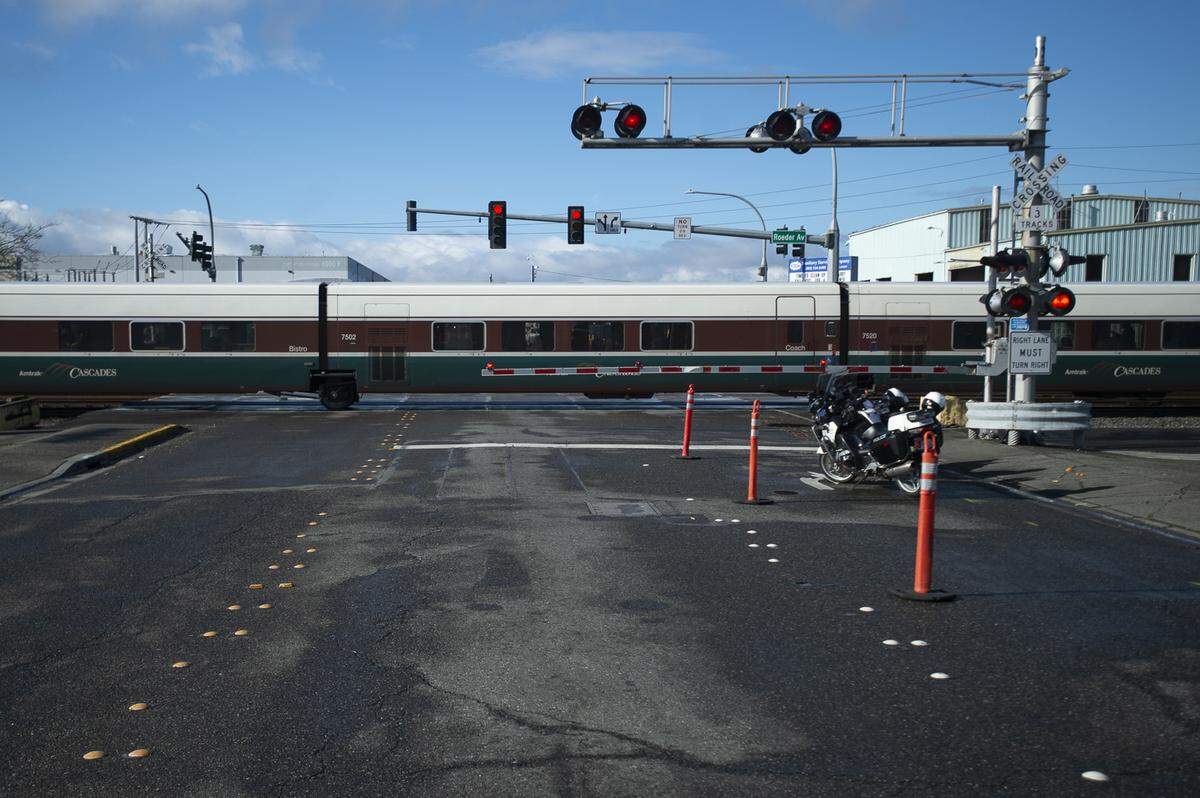
But both the people killed in 2019, a bicyclist and a pedestrian, died at “grade crossings” — at Bayview Drive in Boulevard Park and at F Street and Roeder Avenue.
Since 2015, a total of six people have been killed by trains in Bellingham, with only the two deaths in 2019 at grade crossings, according to the UTC.
Quiet zones
Bellingham started to examine quiet zones in 2007, prompted by neighborhood concerns and a change in federal law, said Chad Schulhauser, city engineer.
Noise from train horns remains loud for residents uphill from the tracks, and carries farther at night, according to several studies the city has conducted.
After years of discussion, two quiet zones were established in 2014, one for the Fairhaven area and one along the Bellingham waterfront, where there are 11 total crossings, Schulhauser told The Herald in an email.
“The process is long and expensive. We are making progress annually towards this goal,” Schulhauser said.
Total cost of the two quiet zones was estimated at $2.7 million to $5.6 million, according to the city of Bellingham website.
Work on all the crossings in a quiet zone must be complete before the new designation takes effect, he said.
Further, both BNSF and the Federal Railroad Administration must give their approval.
Working with the port
Three of the five crossings in the Fairhaven zone — possibly the closest to completion — are on Port of Bellingham property, and the port and the city are working together to reduce noise.
Work is set to start in February — depending on BNSF’s schedule — on the railroad crossing at the Bayview Drive entrance to Boulevard Park, part of the Fairhaven zone, Schulhauser said.
New safety features have been installed at the pedestrian crossing on the north end of Boulevard Park.
“There are three remaining crossings in the Fairhaven quiet zone — Harris Avenue, Alaska Ferry access road, and a private crossing — all of which are on Port property. The Port is currently finishing construction on the Harris Avenue crossing and in design on the Alaska Ferry access road crossing and will look to get a construction agreement in place with BNSF (Railway) once design is complete,” Schulhauser said.
Mike Hogan, spokesman for the Port of Bellingham, said quiet zone work is complete for the crossing on Harris Avenue near the Bellingham Cruise Terminal, and work is progressing on the two nearby railroad crossings on port property.
“Establishing quiet zones has been a priority for the port and the city for a number of years, but it remains a challenge to provide an accurate timing estimate for completion because of the process with BNSF requiring agreements, coordination, and implementation,” Hogan told The Herald in an email.
Duckworth said the federal approval process often takes time.
Remaining work
Meanwhile, safety improvements must still be made to four crossings in the waterfront quiet zone, Schulhauser said.
Those projects — crossings at F Street, Central Street, Cornwall Avenue, and Pine Street — remain part of the city’s six-year transportation improvement program.
Grant funding has been secured for the crossing at F street with construction slated for 2022, Schulhauser said.
So it likely will be several years before the construction and paperwork required for quiet zones will lessen train noise through Bellingham.
“Even when a quiet zone is established, Federal Railroad Administration rules require BNSF to sound horns when railway workers are present and when the locomotive engineer believes an unsafe condition is present,” Schulhauser said.
This story was originally published January 24, 2021 at 5:00 AM.