Bellingham city budget plan deals with COVID revenue shortfalls, calls to defund police
Mayor Seth Fleetwood released the city’s first COVID-era budget Thursday, Oct. 1, a $664 million spending plan for the next two years that avoids layoffs and service cuts, eliminates one police officer position, reassigns three other officers to mental-health response, and anticipates a discussion of funding for a new unarmed 911 responder program.
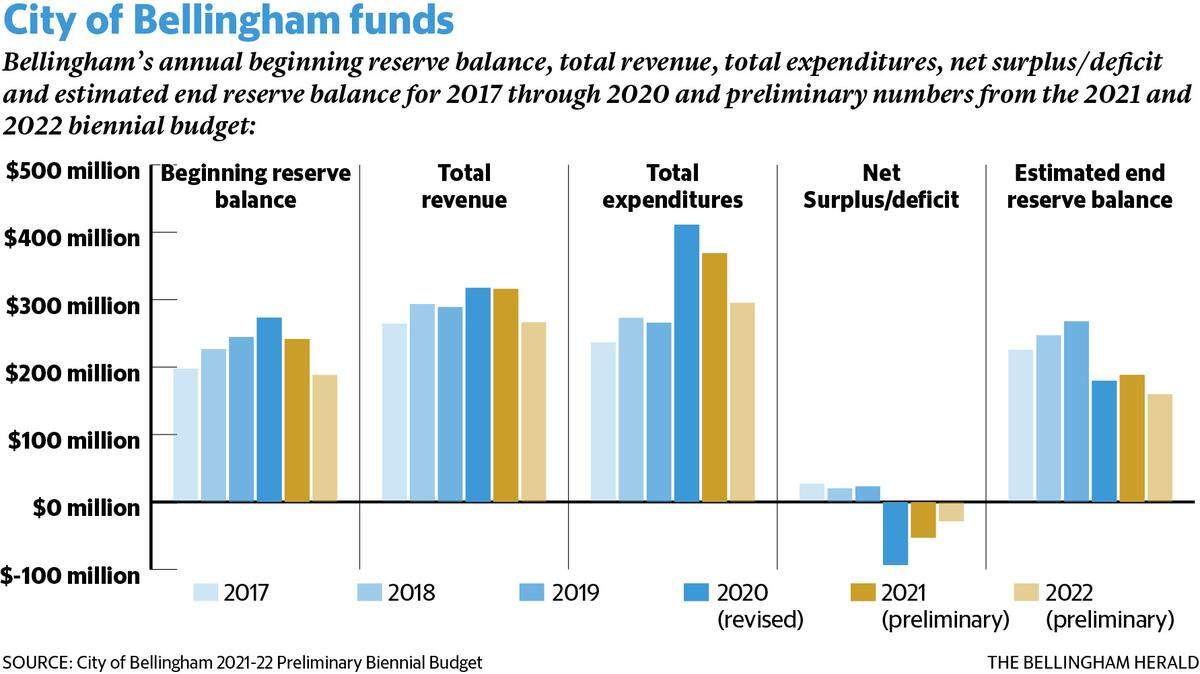
Fleetwood’s proposed 2021-2022 budget dips into the reserve fund and takes other steps to offset revenue shortfalls from the economic downturn caused by the new coronavirus pandemic.
City Council members will review the budget plan starting next week and two hearings are scheduled for public comment before it is enacted.
“It was written effectively as a one-year budget with the expectation that we will be monitoring and making changes next year,” Fleetwood told The Bellingham Herald in an interview.
“There’s a lot of fear and uncertainty right now in the community and the nation,” Fleetwood said. “I’ve certainly never experienced anything like this year before.”
Fleetwood and key city administrators met online with Herald reporters and editors this week to discuss the preliminary 2021-2022 budget document before its official release, and the city provided The Herald with an advance copy.
“As we all know, this is an unprecedented economic experience,” said Forrest Longman, the city’s deputy finance director. “We essentially had a recession and a recovery in three months.”
Longman said “it was really challenging” to make budget forecasts amid such economic uncertainty.
Fleetwood said the budget’s main goals were to keep services at current levels and retain employees.
“Our workforce is the city’s strongest and most important asset,” Fleetwood told The Herald. “This budget has prioritized keeping that staff intact.”
Other budget priorities include addressing climate change and the housing crisis, funding mental health and domestic violence programs — and confronting social justice inequities as part of a countywide response to systemic racism.
Mayor’s first budget
This two-year budget is Fleetwood’s first since he took office in January.
He said conservative spending over the eight years of previous Mayor Kelli Linville’s administration left the city in a strong financial position to fight the pandemic and resulting recession.
“The assumption was that it was going to be a normal budget-making year,” Fleetwood said. “The result has been very different. As you know, we spent much of the spring in direct emergency response dealing with the effects of the pandemic.”
By June, department heads were asked to prepare their 2021-2022 budgets that reflected cuts of 5%, 10% and 15%, because no one knew how bad the economy would get.
In addition to providing staff for Whatcom Unified Command, the multi-agency group that’s fighting the pandemic, Bellingham officials administered federal relief programs aimed at helping local businesses and nonprofits.
“We’ve taken a conservative approach to this budget. It preserves our ability to maintain a high level of service,” Fleetwood said.
Revenues from fees, taxes and other sources were down about 7% through July, he said.
Public comment
Once the 2021-2022 budget is presented, the City Council will examine it in detail during work sessions that will be streamed online, beginning 2 p.m. Monday, Oct. 5.
That meeting will include an introduction to the budget and a work session of the Police Department budget, according to a city email.
Local residents will have a chance to comment in writing or at two online public hearings before the budget is adopted, most likely in December.
Look for information on how to watch or participate at the city’s website, cob.org, in the City Council section under the “government” heading.
Fleetwood said that the budget will allow him and Whatcom County Executive Satpal Sidhu to continue their joint efforts to promote cultural understanding and fight systemic racism.
“We’re hoping that it’s a comprehensive statement that gets at what we’re doing and why,” Fleetwood said. “We feel like we’re working thoughtfully and diligently on the anti-racism work.”
Part of that requires building relationships with communities of color, Fleetwood said.
“There’s considerable distrust in some areas of the community,” he said. “The only way we can overcome that is over time.”
Police Department
Many Bellingham residents have demanded changes in law enforcement since the Defund the Police movement gained traction after the killings of unarmed Black people such as George Floyd, Breonna Taylor and others.
Black Lives Matter and other groups have participated in marches, rallies and other events where supporters sought change within the Police Department.
In September, the City Council said the 2021-2022 budget should include funds to create an unarmed 911 program to send crisis responders, nurses and community health workers to behavioral health-related emergency calls.
Fleetwood said one police officer position will be eliminated by not replacing an employee set to retire, and that $120,000 annual salary and benefits savings is being redirected to GRACE, the Ground-Level Response And Coordinated Engagement program for those who are high users of emergency and criminal justice systems. GRACE is a partnership funded by the city of Bellingham, PeaceHealth and Whatcom County, and the $120,000 doubles the city’s funding.
Bellingham’s 2021-2022 budget shifts three police officers to behavioral health response.
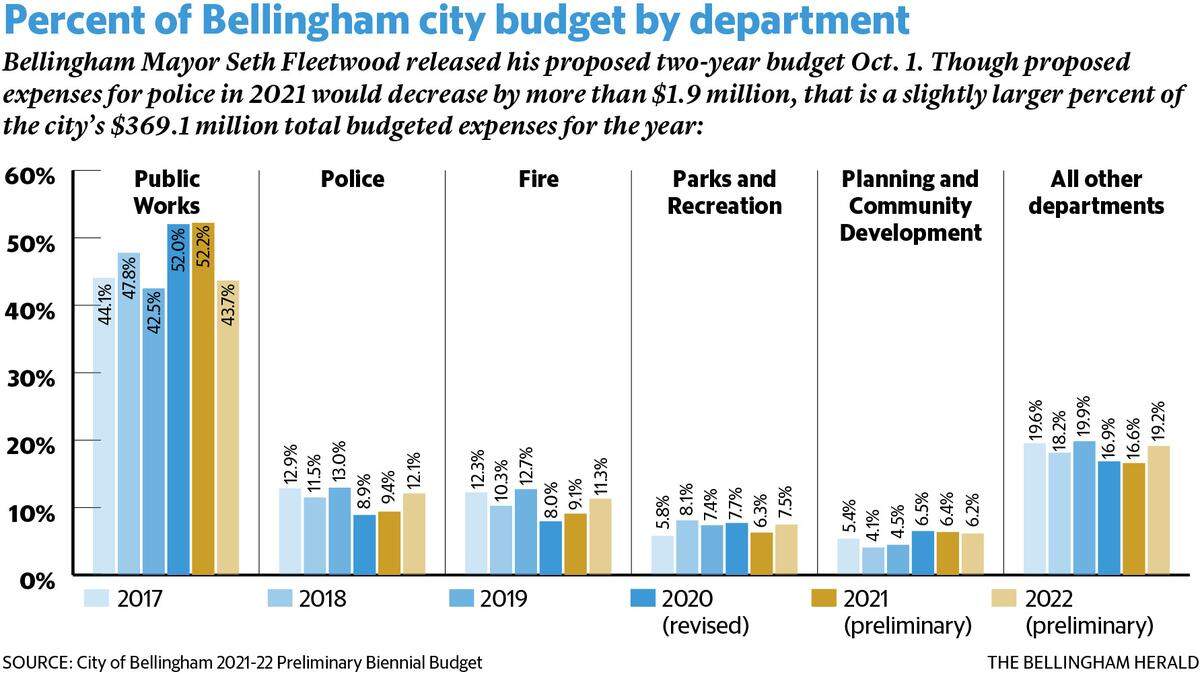
Total Police Department spending for 2020 was $36.6 million, and the proposed budget reduces that to $34.7 million by 2021 and rises to $35.8 million in 2022.
When compared to citywide spending, the Police Department had 8.9% of the overall 2020 budget.
Budget projections for 2021 show police with 9.4% of the overall budget in 2021 and 12.1% in 2022.
But the annual Police Department budget remains about one-third of the $172 million general fund budget.
Budget reaction
Councilman Dan Hammill told The Herald that he was pleased to see the budget’s extra emphasis on mental health issues and council’s move toward possible citizen oversight of police.
Hammill, who was an architect of the GRACE program, chairs the council’s Public Health, Safety and Justice Committee and sits on the countywide Incarceration Prevention and Reduction Task Force.
“I think the mayor’s budget as it’s proposed right now is a step in the right direction in response to our community’s mental health needs. The creation of the 911 co-responder program is exactly what I asked for,” Hammill said.
“(But) I want to see a commitment to a racial-equity committee and a racial-equity toolkit on the administrative side,” he said.
And he said he wants to see a greater commitment to Whatcom County’s Government Alliance on Race & Equity and Law Enforcement Assisted Diversion programs.
He said he’d like the city to look further at some of the reforms sought by Black Lives Matter and the Defend Bellingham Police organization.
“What I’ve heard overwhelmingly from people of color, and the Defund movement is that people want to see more resources for people who are having mental health issues,” Hammill said.
Additional funding for social programs is difficult to find in the midst of a pandemic and economic crisis, he said.
Neither the Bellingham Police Guild, the union that represents rank-and-file officers, or the Defund BPD, responded immediately to Herald requests for comment.
At its website, Defund BPD urged an $835,000 cut in the police budget.
And a Bellingham real estate agent and Black activist said she was disappointed that Police Department cuts didn’t go further.
Kristina Michele told The Herald in an interview that she expected more of the community’s concerns would be addressed, especially after she and others spent considerable time over the past few months talking to city and police officials about racial issues.
“The budget for the city is the most important policy document,” Michele said. “It tells us what the politicians think the problems are or aren’t. With this budget, it seems our concerns are falling on deaf ears.”
She urged Bellingham residents to write the council, follow the budget discussions, and demand police accountability.
“If we want to have any change in the whole of America, we have to start in our home community,” Michele said.
“(This budget) ensures that the system will keep continuing,” she said. “It’s not even slapping a Band-Aid on the problem. It’s smoke and mirrors.”
Cutting costs
Salaries, wages and benefits are the largest single budget expenditure, amounting to $157.6 million for salaries and wages and $66.7 million for benefits over the two-year cycle, according to the proposed budget.
To reduce expenses, a citywide hiring freeze is in effect with 17 positions left vacant, and many workers are being asked to take three or four unpaid furlough days per quarter.
Police officers, firefighters and some Public Works employees will be exempt because those positions have daily staffing requirements and the overtime required to fill those positions would cancel any savings, Fleetwood said.
“Should things improve, we’d like to be able to cancel some of those (furlough days),” Fleetwood said.
Furloughs still must be negotiated with the approximately 800 employees who are union members, Fleetwood said.
Bellingham has 882 “full-time equivalent” positions but has more employees than that because some are filled by seasonal or part-time workers.
Reserve funds
To make up for projected revenue shortfalls over the next two years, Fleetwood said his budget taps budget reserves that aren’t restricted by state law.
Beginning general fund budget reserves were $23.7 million in 2020 and about 30% of the balance will be dawn over the next two years, leaving a projected $16.5 million.
This story was originally published October 1, 2020 at 4:17 PM.
CORRECTION: An updated version of the city budget was uploaded at 8:15 p.m. Thursday, Oct. 1, 2020.