Bellingham’s ‘overwhelmingly white’ demographics reflected in city hiring
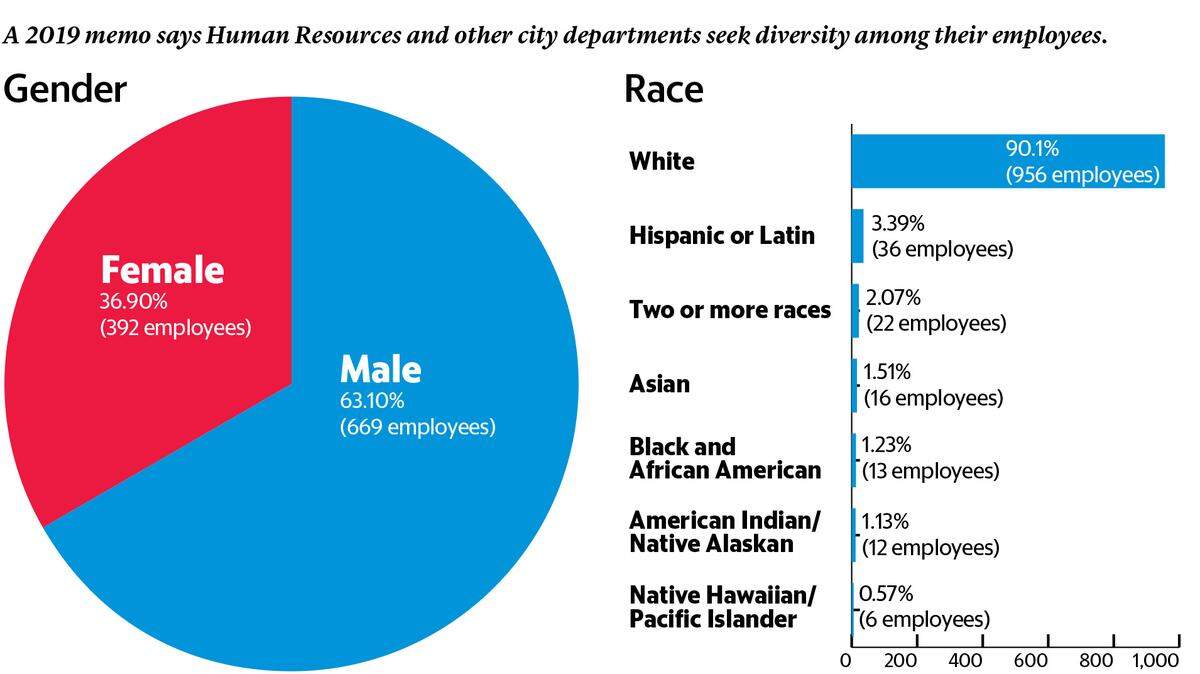
Workers employed by the city of Bellingham’s are mostly white and male, according to new demographic information from the Human Resources Department.
Bellingham’s 1,061 city employees are 90% white and 63% male, according to data through June 2020 provided to The Bellingham Herald.
Bellingham’s most recent U.S. Census population estimates show that Bellingham’s 92,314 residents are nearly 83% white and 51% female, according to the 2019 data.
Of the city’s 14-member leadership team, seven are female.
Elected female officials include four of the seven-member City Council and Municipal Court Judge Debra Lev.
“Generally speaking, when you look at our applicant pool, the vast majority of our workforce comes from the community,” Deputy Administrator Brian Heinrich told the City Council during a Committee of the Whole meeting Monday afternoon, Sept. 14.
“We are an overwhelmingly white community, and that is slowly changing,” Heinrich said.
Bellingham city employees who identify as Latino or Hispanic are 3.9% of all workers, 2% are biracial, 1.1% are Black or African American, 1.5% are Asian, 1.2% are Native American or Alaska Native and 0.6% are Native Hawaiian or Pacific Islander.
In the city as a whole, census data show 9.3% of residents are Hispanic or Latino, 4.9% are biracial, 1.6% Black or African American, 6.6% are Asian, and 1.3% are Native American or Alaska Native.
City officials want to recruit more diverse employees, but those applying for city jobs are mostly white men, Heinrich said.
“As our community changes and as they become workforce-eligible, we would expect to continue to hire the majority of our workforce from here locally,” he said. “As that local population changes, we would expect our own city workforce to change as well.”
According to an August 2019 memo included with the City Council’s Sept. 14 agenda, Human Resources and other city departments seek diversity among their employees.
“We use blind application reviews in our processes to remove identifying information to reduce bias in the review and assessment of application materials,” the memo said.
More than ‘colorblind’
Councilman Michael Lilliquist praised the Fire Department’s recent efforts to diversify along racial and gender lines, and emphasized that police officers across the nation are facing increased scrutiny over race.
“If you look into recruiting for diversity, being colorblind alone really isn’t going to change things, it’s really not going to bring you the diversity you want,” Lilliquist said.
“Recruiting for diversity has to be more active than just saying, ‘We accept all candidates.’ It’s more sophisticated than that,” he said.
“Right now, with the issues of policing as it relates to this, racial justice, there’s also the question of what is the diversity of our Police Department,” Lilliquist said.
Police Department
Both the police and fire departments were asked to provide the council with more detailed information about their racial and gender makeup.
“When I started here 36 years ago there were three female officers that worked in this department,” Police Chief David Doll said. “Right now there are 20. Females encompass every level of command staff at the Bellingham Police Department.”
That includes Assistant Chief Flo Simon, who was the department’s second Black officer.
Bellingham Police have 119 commissioned officers, and 20 of them are women, Doll told the Council.
The department staff is 83% male and 17% female, according to personnel data provided to The Herald.
Women are 17.6% of police and sheriff’s patrol officers nationwide, according to 2020 data from the U.S. Bureau of Labor Statistics.
A breakdown by race shows the department is 88% white, 2.5% Black, 2.5% biracial, 2.5% Native Hawaiian or Pacific Islander, and 2.5% Hispanic or Latino.
There’s one Native American or Alaska Native officer — making up less than 1% of the department.
“We are actively looking for ways to broaden the requirements on civil service positions to be more inclusive while following the merit-based process,” the 2019 memo said.
“For example, we realized the (experience) requirements for police officer excluded applicants with tribal experience. We are currently in the process of requesting a revision to this classification.”
Fire Department
Bellingham Fire Department has 153 uniformed firefighters, including chief-level officers, Chief Bill Hewett told The Herald in an email.
“A couple of years ago, we changed the way we were doing our testing and hiring process here at the Fire Department to try and encompass a larger or more diverse group or pool to get into the interview process,” Hewett said at the council meeting Monday.
“After we made those changes, it significantly opened things up,” Hewett said. “Just making those adjustments in the hiring process opened up dramatically the availability of candidates from diverse backgrounds that we didn’t have before.”
Before the hiring practices changed, job candidates were 94% male and 92% white, and afterward, candidates were 86% male and 77% white.
Recent recruit classes of new firefighters are more diverse, too, he said, especially among women.
Of 12 firefighters hired earlier in 2020, four were women, and a recruit academy of five that started this week has one woman, who is a person of color.
Data given to The Herald shows the Fire Department is 94% white, 2% Black or African American, 1.3% Latino, 1.3% Native American or Alaska Native, and 0.7% who consider themselves biracial.
Some 9% of Bellingham firefighters are female, more than double the 4% of career firefighters who are female, according to 2018 data from the National Fire Protection Association.
“This is not something we are able to change overnight,” Hewett said. “But with these changes, we are headed in a positive direction.”