Here’s what Bellingham’s mayor has committed to protesters calling for police defunding
A march to defund police Monday, June 15, in downtown Bellingham led to two impromptu community discussions between protesters and Bellingham Mayor Seth Fleetwood.
Fleetwood told the protesters in City Hall Monday and again downtown that night that he is working with the City Council to schedule a Bellingham community listening forum. The forum will be a place where elected officials can hear more about how to build equity and justice that makes safety, dignity and humanity of all people a priority, Fleetwood said in an email to The Bellingham Herald Wednesday.
More details about when that forum might take place have not yet been released.
The march, where speakers of color shared their pain, fear and stories of being targeted and harassed by police worked its way from Holly Street and Railroad Avenue, through downtown Bellingham streets and into City Hall where Fleetwood came out and spoke with the crowd. After that, protesters went back to Holly and Railroad where they barricaded three blocks of Holly Street off and attempted to set up an ongoing occupation similar to Seattle’s CHAZ/CHOP. Nearly six hours after the protest and march began, Fleetwood spoke to the crowd for a second time.
Several people of color shared their experiences. Many white people also spoke about possible reforms for Bellingham police, such as defunding the police, creating a civilian oversight board or joining the 8 Can’t Wait campaign surrounding use of force techniques.
A Mexican-American woman told the crowd of roughly 100 standing in the rain Monday that she’s been afraid of the police her entire life. She said when she was 7 years old, she was in the car with her father and a few of his friends. The police pulled them over and grabbed everyone out of the vehicle, she said.
“It traumatized me to my core because they didn’t tell them what the charges were. They were just arresting everybody, they were telling me to go over there and I was alone … Nobody was there for me. … It was just the police and they were just screaming and had guns for no reason and they just didn’t give us any information,” she said. “Throughout my entire childhood, the police have terrorized my family solely because of the color of our skin.”
The woman said she isn’t the only person this experience has happened too, and that she’s sick of it. She said she was tired of being scared, and wants a change.
Christopher Tramble said understands that fear. Tramble, who is Black, said he understands that people are worried and that systemic racism has been going on far too long.
“Folks should not be afraid to call 911. If you’re in danger, if you’re in trouble, you should call the police and you should be safe. You shouldn’t have to worry about getting murdered … It should be something that’s a given,” he said.
Tramble said there is so much fear in the world right now. He said people are afraid to come to the protests, or to speak about how they’re really feeling, for fear of being targeted. He urged the white people in the crowd to educate themselves and to make spaces safe for people of color to discuss systemic racism and their experiences.
“There’s people who are afraid to try to make a change because it’s comfortable keeping things the way they are,” he said. “I just hope we can try to humanize the situation and try to think about it. What would you do if you called the police and your son was killed? How would you be reacting? It wouldn’t be a conversation.”
Tramble said he appreciated that there has been nationwide attention on the subject.
“It’s visualized. You can’t turn away, you have to look at it right in the eye and understand that man just died. And that’s uncomfortable. … That’s what I want people to feel because I’ve been uncomfortable this entire time,” Tramble said.
Fleetwood said Wednesday he looks forward to taking necessary actions that respond to Bellingham’s unique needs, and has committed to the protesters that he will engage with people of color to address the issues of systemic racism present in Bellingham.
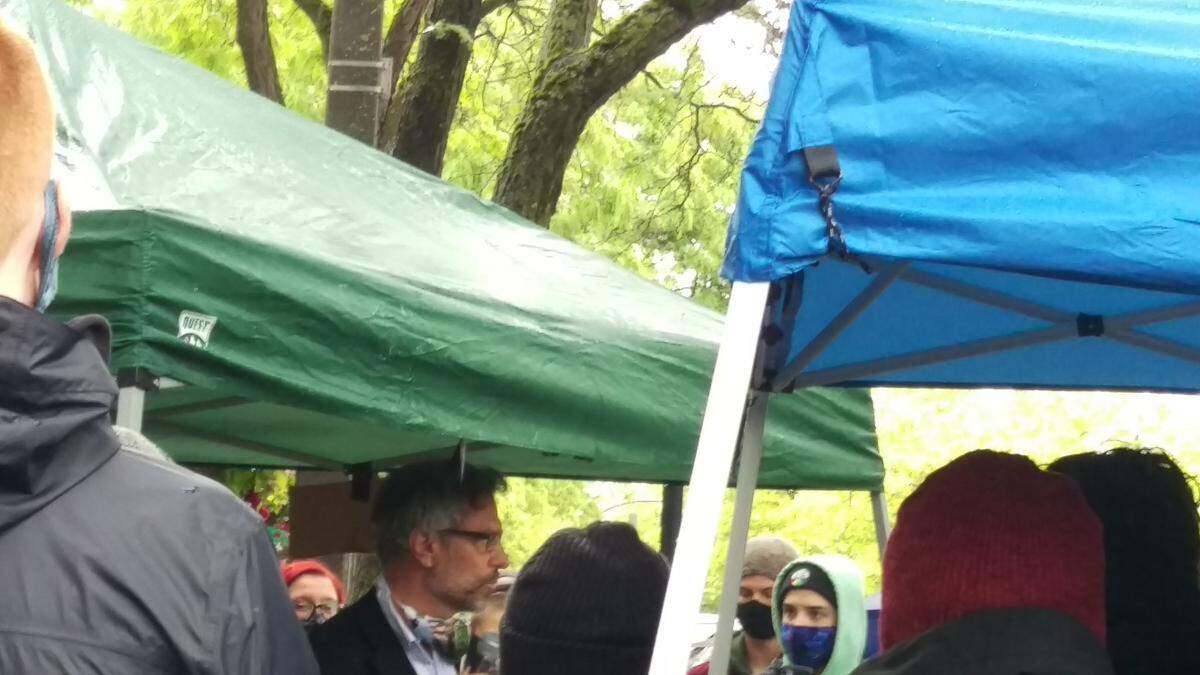
“There is much that was said by the demonstrators that I fundamentally agree with and for which I want to make meaningful progress,” Fleetwood wrote to The Bellingham Herald Wednesday, June 17. “Lots of speakers said they are tired of feeling fear. Others wish for more kindness. Others spoke to specific changes they would like the city to make. In my education on these issues, I have come to learn that “defund police,” to many, means better reallocating resources to emphasize social services, focus on de-escalation, and provide better responses to people in ways that don’t provoke fear. Those of us who are hearing these calls for action are gaining new appreciation of the extent to which people of color live with constant fear and anxiety. That has to change.”
Fleetwood said while there have been moments of discomfort, it is necessary as it’s part of the opportunity to change. Fleetwood said the community must work together to turn protesting into action, and that people must stop being judged for the color of their skin.
“I am committed to listening and learning, to promoting awareness, to facilitating dialogue, to building equity and social justice that makes the safety, dignity and humanity of all people our priority,” Fleetwood said.
Terrance “Teejay” Morris said he wants people to get involved and support the organizations in Bellingham and Whatcom County that have been doing the work for decades to dismantle systemic racism. Morris, who is Afro-Caribbean, said by not joining those groups or trying to lead the charge themselves, white people are often erasing people of color’s efforts.
He said over the past several weeks people have been discussing white privilege. Morris told the crowd to use that privilege, rather than just talking about it. He also told people to educate themselves and encouraged white people to read the book “White Fragility” by Robin DiAngelo.
“Don’t just show up at these marches and complain to the mayors and things of that sort. Get behind the people who have been doing this damn work and ask them how do you get involved, how do I do this,” Morris said. “I’m calling for solidarity, equality, not just for black lives but for all lives.”
Morris said he’s heard about the symbolic knee pressed on Black people’s necks his entire life, but after George Floyd, who was Black, was killed when a white Minneapolis police officer kneeled on his neck for nearly nine minutes, it became a visual representation for him. Morris asked the crowd to think about how they will do things differently in this movement so that change actually happens.
“How am I going to take down these signs and show that every day that a black life matters?” Morris asked the crowd, again telling them to get behind the people already doing the work. “It’s a hard burden to live in Bellingham when you’re 1%.”
Roughly 82.5% of Bellingham’s 87,000 people are white, according to the U.S. Census Bureau. Roughly 1.6% are Black, 1.3% are American Indian or Alaska Native and around 6.4% are Asian, according to the Census data.
Morris then called on Fleetwood to set a personal meeting between the two of them this week to discuss racial justice and equality. Fleetwood scheduled a meeting.