Slurs, symbols and stereotyping aren’t criminal, but allies fight racism. Here’s how
It happens on the street, in the supermarket, at school.
It happens to people with brown skin and black. To transgender people, to Native Americans, to Jews, to women, to Sikhs.
For Derrick Watson of Ferndale, it was a racist remark at Fred Meyer. For Becky Kobel of Bellingham, it was a swastika in a library book. For the Rev. Bobbi Virta of Ferndale, it was watching a dark-skinned Canadian family endure taunts at Costco. For Anikó Folk of Bellingham, it was the gas chamber jokes in high school. For Kersey Ordos of Kendall, it was the students who dumped milk on her children.
Learning to be an ally is particularly important at a time when FBI crime statistics and several recent surveys have shown that hate crimes and white supremacist organizing are rising in Bellingham and across the United States, according to Alex Czopp, an assistant professor in the Department of Psychology at Western Washington University, and others.
Czopp studies stereotyping, prejudice and discrimination — and what happens when bigots are confronted.
“There isn’t a single reason why people are racist,” Czopp said.
“It’s a very difficult situation,” he told The Bellingham Herald. “We’re not usually in situations that are so awkward. And there’s concerns of personal safety to be aware of.”
Scholars and others who study the issue said there are many ways to be an ally to someone who’s targeted for their race, religion or sexual orientation.
It could be a sympathetic glance or a kind word, but it also could be attending a protest, reporting harassment to teachers or police, ripping down racist posters, making a cellphone video, or participating in an anti-hate meeting.
In interviews and emails with The Herald compiled since August, several Whatcom County residents discuss bias and bigotry of all kinds, and ways they have helped others.
How to react
WWU professor emeritus Larry Estrada said bigotry flourishes if it goes unchallenged.
“We have to learn to address things on the spot,” Estrada told The Herald. “It doesn’t mean you have to be hostile or uncivil.”
Czopp said it’s important to speak up — even if there’s no victim present.
“It doesn’t have to be a harsh accusation of racism or anti-Semitism,” Czopp said. “That doesn’t go over well. It could be as simple as saying, ‘I disagree.’ You have a very short window to create a counter-narrative.”
He said the point isn’t necessarily to change the aggressor’s beliefs, but to engage bystanders or let victims know they’re not alone.
“Chances are, there are other people who feel the same way,” Czopp said. “All of a sudden, people are agreeing with you, and you’ve got this group dynamic.”
For those who can’t intervene directly, Czopp suggests making eye contact with the victim as a way to show solidarity.
Insults in a checkout line
No one helped Watson about year ago when a woman walked past and gloated that his son was wearing cast for a broken ankle in a checkout line at Fred Meyer.
“I was paying, she said something to the effect of, ‘That’s what your black (slur) gets,’” Watson told The Herald.
He called police, but there was nothing the officers could do because it wasn’t a hate crime, Watson said.
“She’s got free speech,” Watson said. “They can say whatever they want as long as they aren’t threatening you,” he said.
Bellingham Police spokeswoman Lt. Claudia Murphy, in an earlier Herald story, said that state law defines a hate crime as malicious harassment — including an assault or property damage — against victims targeted because of their race, color, religion, ancestry, national origin, gender, sexual orientation, or mental, physical, or sensory handicap.
It’s a Class C felony, carrying a sentence of up to five years in prison and fines up to $10,000.
“Sadly, being a racist is not illegal,” Murphy said in an interview with The Herald.
‘Casual anti-Semitism’
Folk, a 2019 graduate of Bellingham High, described the pain of frequent “casual anti-Semitism” at school, even from people she knew.
“People would say, ‘You’re a Jew? Oh, you don’t look like a Jew,” Folk told The Herald. “It wasn’t like anyone was drawing a swastika on my locker.”
Although someone did do that on a notebook — and he was expelled, she said.
Folk said what hurt most was knowing that even people she liked and respected held onto anti-Semitic tropes that date back centuries.
Jay Jordan, the director of teaching and learning at Bellingham Public Schools, said the district has a new program of equality, diversity and inclusion that’s aimed at helping students see how bigotry is hurtful.
“For groups that have been marginalized, we are being explicit in that we care for them,” Jordan told The Herald.
Taunts at Costco
Virta, who is pastor of the United Church of Ferndale, described an incident about 18 months ago at Costco when she saw a white man heckling a family of brown-skinned people who she thought were visitors from Canada.
“He was telling them to go home, telling them to leave,” Virta said. “I heard it so I turned around and looked at him in the eye and put one little finger up and said, ‘Be kind.’”
She had to say it a second time.
“I said it in a kind, respectful manner,” Virta said. “They were saying to me ‘It’s OK.’ They didn’t want me to engage anymore.”
Next, Virta said the man made the symbol of a pistol with his thumb and forefinger.
“That’s when I turned my back and talked to the (family),” she said. “I wasn’t going to just stand there and let him do that, stand there and do nothing.”
American genocide
Candice Wilson couldn’t believe an October 2019 email from the WECU credit union that wished its members a “Happy Columbus and Indigenous Peoples’ Day.”
To Wilson, who is former vice-chairman of the Lummi Indian Business Council, Columbus symbolizes European colonization of the Americas and the slaughter of its native inhabitants.
“It’s so insulting to me as an Indigenous person,” said Wilson, who is also a former member of the Ferndale School Board. “I’m trying to educate them that this is genocide.”
WECU later issued an apology, and Wilson said she hoped it could become a teachable moment.
In contrast, she praised the Ferndale School District for honoring the Point Elliot Treaty of Jan. 22, 1855, and for posting a video on the school website that explains the significance of Treaty Day, which is a school holiday in Ferndale where many students who live on Lummi Reservation attend school.
Should you speak out?
Watson said that people of color and others in targeted minority classes must consider what to do when they are confronted by a bigot.
“I can speak only as an African-American man, but I think all people of color would agree, people of color need to know how to react,” Watson said.
“There’s a not a pathway, there’s nothing for me to do except take it. It’s cool for people to intervene, but it’s not always prudent,” he said. ”(And) turning the other cheek isn’t always prudent too.”
Watson said parents and schools must encourage frank talk about racism.
“I really believe that the majority of white America doesn’t want to be racist,” he said. “But I believe that there’s no education on what that looks like.”
BEHIND THE STORY
MORECovering hate
Bellingham Herald journalists would like to hear from you if you have been the victim of or witnessed a hate crime or experienced hate speech. We’d also like to know if you have information about hate groups operating in Whatcom County.
You can email us directly at newsroom@bellinghamherald.com or use the online tip form if you wish to protect your identity. Here’s a step-by-step guide on how to communicate with reporters and editors as safely and securely as possible.
While in some cases we may ask to use your name in a news report, we would not do so without your permission.
Children bullied in school
Kersey Ordos of Kendall recalled how her biracial children were harassed at Nooksack Elementary during the 2018-2019 school year.
“It was multiple issues last year,” Ordos said in September 2019 after contacting The Herald through Pro Publica’s “Documenting Hate” project.
“I went in front of the school board and they refused to address it,” she said. “Both my kids had a carton of milk dumped on them and (school officials) said ‘You don’t know the whole story.’ I don’t need the whole story. That’s never acceptable.”
Ordos said she pulled her kids out of school temporarily, but they’re back this year.
“Oh, it’s been a lot better with the new principal but they have a ways to go,” she emailed on Friday.
Swastika in library book
Rebecca Kobel said she found anti-immigrant literature and a swastika tucked into a book at Bellingham Public Library in September 2019.
“I was actually shocked at it,” Kobel wrote in an email. “I’m used to seeing religious pamphlets being shoved in library books, so I thought this was what it was and when I saw it my stomach immediately dropped. I felt sick. I knew I had to do something about it.”
Kobel took a photo and reported it to librarians at the circulation desk.
“As I was walking away I heard, ‘This is worse than we usually find, who wants to make the report?’ ” Kobel wrote. “I found it important because we must speak up against hate. Especially in the current climate of political unrest.”
It takes courage
Being an ally takes fearlessness and determination, said Meg Warren, an assistant professor in WWU’s College of Business and Economics.
Warren, an organizational psychologist, studies workplace diversity, equity and inclusiveness, and how people can be allies.
“There are a lot of different ways to be an ally. It takes a lot of courage to do it,” she said. “But not all lack of allyship is because people don’t care.”
Like Czopp, Warren said that it’s important to address the situation in the moment, if possible.
“If no one’s saying anything, the perpetrator will think ‘Maybe it’s OK what I just did.’ Be sensitive to the fact that this is an act of unfairness and it calls for action.”
She said bystander hesitation is sometimes linked to an idea that the victim should be given a chance to react.
“Many of us feel like it’s up to the person who is targeted to say something,” Warren said. “But there’s so many reasons that they might not say something.”
‘How gay I can be’
Ryan Castle, who’s on the board of PFLAG — a support network for LGBTQ+ people, their friends and families — said he’s never experienced discrimination that he’s aware of, but he’s seen straight people use gay pantomime in a way that makes him uncomfortable.
Castle, a Bellingham lawyer in private practice, said he worries about social interactions.
“I’m pretty cognizant when I’m in public of how gay I can be,” he said. “Should I hold hands with my husband?”
In addition, he wonders how much of an ally he should be to others.
“Walking down the street with my trans friends, what am I going to say? Should I take over the situation and come to the rescue? What’s the goal of the harasser? Is it humiliation? It’s hard to give a definitive answer. Am I going to be stepping on someone’s toes that doesn’t need defending?”
Election hate crime
Racism surfaced during the fall 2019 race for Whatcom County executive, when candidate Satpal Sidhu found his campaign signs targeted for repeated vandalism, including one incident that was investigated as a hate crime.
Sidhu, a Sikh who was born in India and immigrated to the U.S. from Canada, made Sheriff’s Office reports. But he said several times during the campaign that he remained optimistic.
“I got elected in this county. This county is not racist. But there is a racist element,” he told the League of Women Voters during an election event.
Acts of defiance
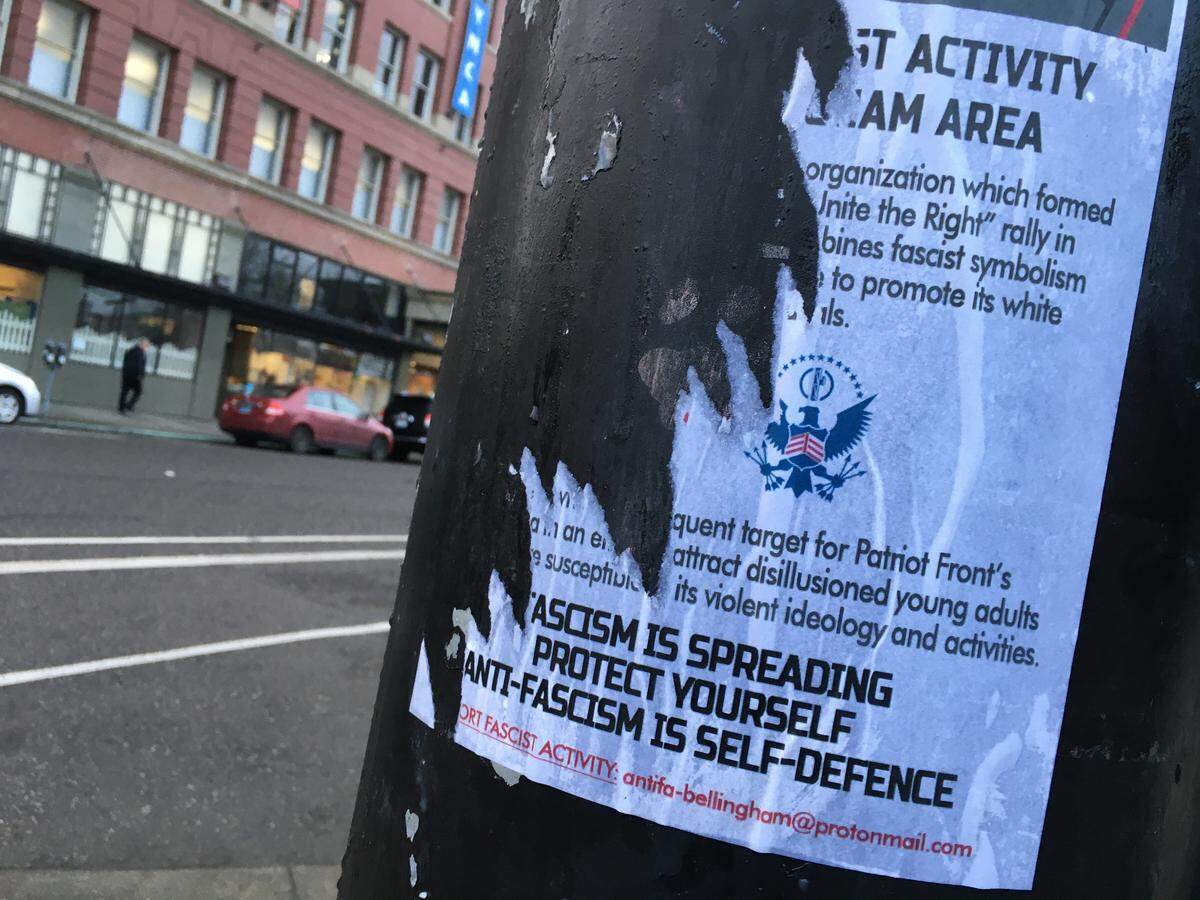
In Whatcom County, the white supremacist group Patriot Front has been distributing its literature from Ferndale to Lynden to Bellingham — and all across the Puget Sound region over the past several months.
Many people have been removing the literature and uploading photos to social media in defiance of the group.
“I couldn’t stand to see it. I just tore it down,” said Phil Wolff of Fairhaven.
In Ferndale, Dan Marshall did the same thing.
“We went down there with a spackle knife,” he said. “I consider it a public service. I consider myself a supporter of free speech. But I don’t like having stickers for that plastered over my town.”
Such white supremacist literature is meant to “terrorize and antagonize,” said Miri Cypers, regional director of the Anti-Defamation League’s office in Seattle.
“It’s important that people are sensitive to that and that we have a community that pushes back,” Cypers told The Herald. ”There’s a need to push back against hateful messages that are meant to incite fear.”
Warren said she’s hopeful for social change.
“I do believe that there are a lot more good intentions below the surface waiting to come out, if only we had more tools,” Warren said. “We often assume that behind the silence is apathy, or worse, bigotry, but sometimes, behind the silence is not knowing how to help.”
This story was originally published February 17, 2020 at 4:18 PM with the headline "Slurs, symbols and stereotyping aren’t criminal, but allies fight racism. Here’s how."