Slide that closed I-5 one of 17 unstable slopes WSDOT monitoring in Whatcom corridor
Those hills that help make the Interstate 5 drive between Bellingham and Burlington so enjoyable when the sun is out can create huge headaches or even become dangerous when rain saturates the region, as it did last week and is forecast to do into this weekend.
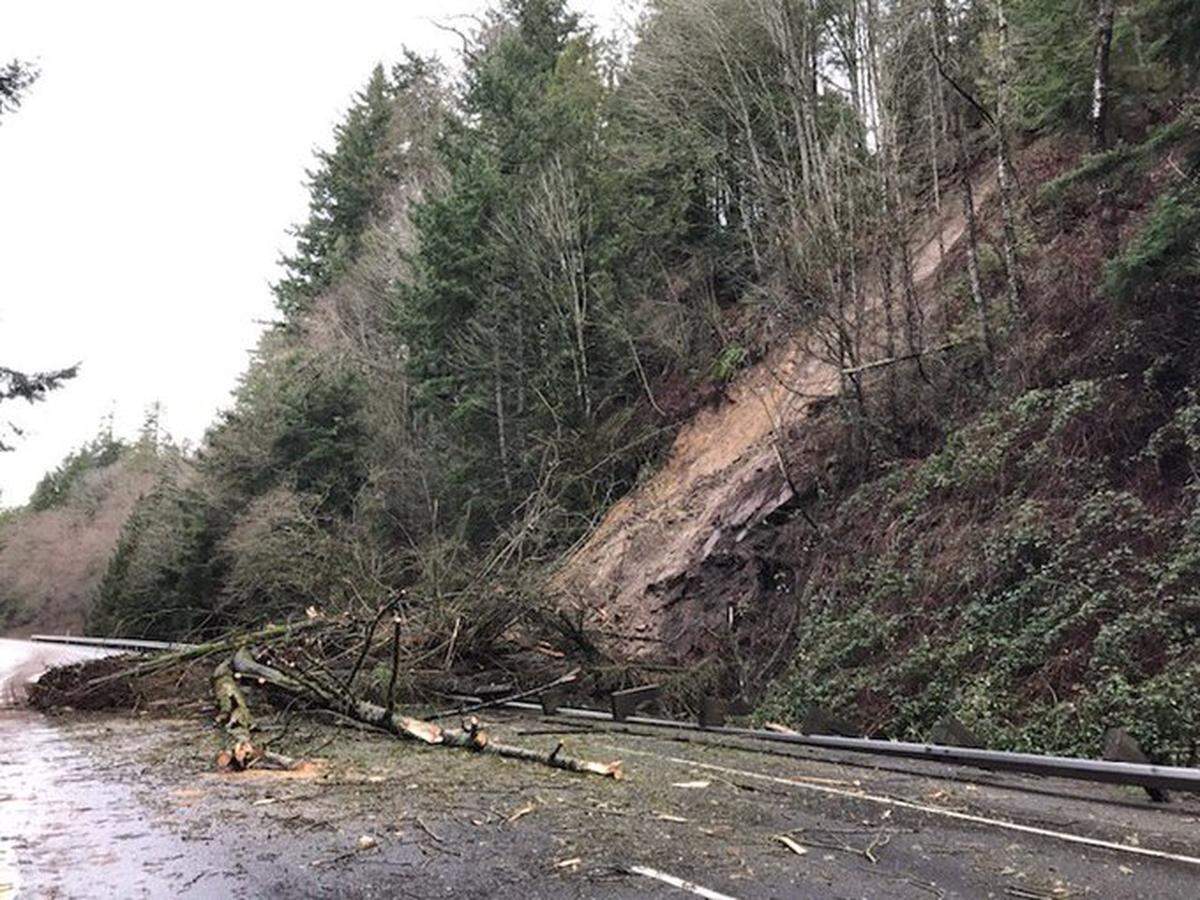
Drivers attempting to head north Saturday, Feb. 1, received a reminder of how big a problem those slopes can create when they’re soggy, as a hillside above a section of northbound I-5 north of the Nulle Road exit slid, bringing rocks, trees and mud down onto the freeway and breaking a 200-foot section of guardrail along the roadway.
Both northbound lanes in the area were closed for more than eight hours Saturday, while Washington State Department of Transportation geotechnical engineers surveyed the hillside to make sure it was stable enough to allow crews in to clean up the debris and traffic to resume.
Even after I-5 was reopened, WSDOT had to close the right lane during daylight hours for three more days to allow crews to return and remove more than 100 yards of debris and replace the damaged guardrail, according to a news release.
“The weather keeps WSDOT maintenance crews busy this time of year,” WSDOT spokesperson Andrea Petrich wrote in an email. “Not only are they working closely with forecasters and monitoring the forecasts for their areas, they work certain stretches of highway and are constantly monitoring those areas to catch any changes that heavy rains or freeze thaws might be creating.”
That monitoring helped prevent what could have been a tragedy in late 2016 a little further north along northbound I-5 near the North Lake Samish exit, when WSDOT crews noted a change in the landscape, Petrich wrote. WSDOT closed the right lane and brought in a contractor to remove loose rock and clean up the catch basin before most of it came down on its own.
In all, there are 17 known unstable slopes in the I-5 corridor through southern Whatcom County between mileposts 242 and 250 that WSDOT is actively monitoring, including the slope that slid on Saturday, Petrich reported. A handful of other Whatcom slopes along the Mount Baker Highway, Chuckanut Drive, the Valley Highway and the North Cascades Highway also are under WSDOT’s eye.
Managing slopes
Since 1995, WSDOT’s Unstable Slope Management Program has monitored approximately 3,400 unstable slopes that pose potential risk to Washington’s state highways, according to a January 2018 WSDOT information packet on the program. Approximately $300 million over 20 years was targeted for the program.
Each identified unstable slope is scored in 11 criteria to identify the hazard and potential risk factors to the highway, according to the packet. Each slope’s Unstable Slope Management System score is based on:
▪ Soil type.
▪ Rock type.
▪ Average daily traffic.
▪ Sight distance.
▪ How much of the roadway could be impeded by a slide.
▪ The average risk to vehicles.
▪ Pavement damage.
▪ Frequency of failures.
▪ Annual maintenance costs.
▪ If there are detours and how long they are.
▪ Number of accidents in the past decade.
Scores for each slope are compiled and range from 33 to 891, with higher numbers representing higher risk.
The WSDOT proactive slope management program then uses those scores to help determine the most cost-effective ways to mitigate the risk the most unstable slopes pose to highways, according to the packet. Projects are all-or-nothing, the packet said, and intended to last at least 20 years if they’re not permanent fixes.
Whatcom’s I-5 corridor
WSDOT has worked to mitigate some of the 17 slopes with slope management scores in I-5 corridor between Bellingham and Burlington, Petrich wrote, including work in 1999 to reduce the risks of the slope that fell Saturday.
The slope that caused Saturday’s problem has a 237 slope management score, which is considered good, Petrich reported, adding that approximately 70% of the slopes the state monitors have a good rating. The 237 is also near the middle of the 17 Whatcom County slopes, as slope management scores for those range from 147 to 408.
If any of those slopes do slide onto the freeway, they could end up having a big impact, just as Saturday’s landslide did.
Though WSDOT doesn’t track the value of freight transported on the portion of I-5 between Burlington and Bellingham, Petrich wrote that freight trucks move an estimated $389 billion (in 2012 dollars) in Washington state, according to the Federal Highway Administration’s Freight Analysis Framework.
The 2018 annual average daily truck volume between State Route 20 in Burlington and 36th Street in Bellingham (mileposts 230 and 253) was 3,300 trucks, while annually nearly 17.5 million tons are transported through that section of I-5, Petrich wrote.
The cleanup costs from Saturday’s slide have not yet been calculated, according to Petrich.
Petrich recommended travelers plan ahead and stay engaged with WSDOT by using the department’s app, on social media through Twitter (@WSDOT_north) or subscribe for email updates to keep informed during unexpected situations.
This story was originally published February 7, 2020 at 5:00 AM.