Border train derailment exercise helps ‘get crews operational as soon as we can’
It’s almost too inviting to pass up.
One step you’re standing in the United States, the next you’re in Canada — the only ways you’d know you’re crossing an international border are the cameras positioned atop a large pole watching every move you make and the border agents ready to greet you should you try.
It may be invisible, but in many respects, there really is a large wall separating the U.S. and Canada.
Especially when it comes to managing an emergency that affects both sides of the border. Each country has its own law enforcement, fire and government agencies on the local, state and federal levels.
“They’ve got their way of doing things, and we’ve got our way,” Whatcom County Sheriff’s Office Division of Emergency Management Deputy Director John Gargett told The Bellingham Herald. “Though we’re both trying to accomplish many of the same things, there are some slight differences in the way we get there.”
To help work through those differences, the Division of Emergency Management helped stage an exercise in what it might be like if an emergency — such as a derailed freight train and hazardous materials spill — occurred right at the border. More than 200 people at 20 locations, including Seattle and Toronto, participated in the Grey Fox Train Derailment and Hazardous Material Exercise centered in Sumas.
Simulated evacuation
In the exercise, which was held Oct. 16, a southbound train, was struck by a semi truck in Abbotsford, B.C., causing seven cars to derail just across the border in Sumas. One of the rail cars carrying chlorine spilled, causing a toxic cloud and forcing the evacuation of Sumas and parts of Abbotsford and a lockdown and eventual evacuation of Nooksack Valley High School.
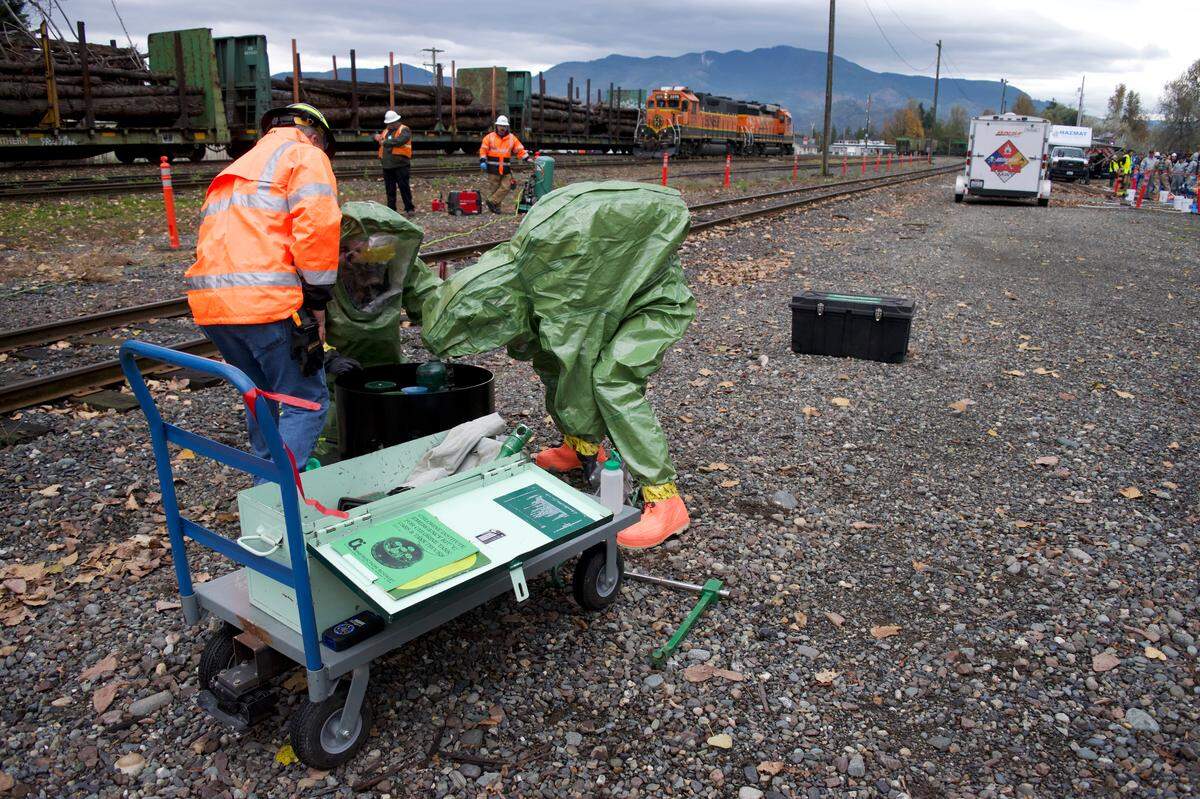
“The exercise itself was really a chance to be able to look at how the resources each country has would work together in the event a major event occurs at or near the U.S./Canadian border,” Gargett said. “When you have a large event like that, there are some pretty big obstacles that you need to clear.”
One of the biggest, obviously, is getting the proper emergency personnel across the border quickly.
“Obviously, Canada and the United States control the access in and out or their countries, as they should,” Gargett said. “The movement of emergency equipment and personnel for something like this exercise requires more coordination up front. We have worked with the CBSA (Canadian Border Security Agency) and our own Customs and Border Protection to streamline that process.”
Some of making that process quicker, Gargett said, has involved making lists of emergency personnel who might respond on both sides of the border and collecting their Nexus or passport information so that processing through inspection sites goes quicker.
Staging equipment
Another aspect, Gargett said, was creating a bag full of equipment responders would need to work on each side of the border.
“For example, the connections to fire hydrants used on each side of the border are different,” Gargett said. “So we’ve developed a bag that has adapters, radios and equipment they would need and put them in the border inspection booths at Sumas, Meridian, Blaine and Point Roberts. When the Canadians come down here, they just pick up the bags they need as they’re going through. Same thing when we got up there.
“We want to do everything we can to make sure we get crews operational as soon as we can.”
In that respect, Gargett said, the exercise was a success.
“I would say, overall, the exercise met its objective,” Gargett said. “We got to simulate a large response that affected both sides of the border and got the crews working together and becoming more familiar with each other. I think you learn each other’s strengths and weaknesses then. Communication is always challenging when you’re dealing with something this size, but I think we made some big steps forward in that regard and found some other opportunities to focus on.”
Gargett said training for a hazardous materials spill also was a big part of the exercise.
Derailments are not all that common in Whatcom County.
Whatcom train derailments
Department of Transportation records show the county has had 11 derailment incidents since 1975. Though none of those reports showed any cars involved in a derailment released any hazardous materials, a July 3, 1995, incident near Bellingham did result in the evacuation of 200 people when four cars carrying hazardous materials were damaged in a derailment.
“Rail accidents are rare,” Gargett said. “It should be noted that BNSF (Burlington Northern-Santa Fe) was a big part of the exercise. They don’t want anything like what we were training for to happen either, and they put out a lot of resources to train more than 100 responders the week before on how to react to an incident like this.
“When you have the support of BNSF and them training our responders and the commitment from everyone who was involved on both sides of the border, it helps keep us at the forefront and makes our community more prepared.”
This story was originally published October 27, 2019 at 5:00 AM.