Here’s where people turn for groceries when they’re feeling broke in Bellingham
Broke in Bellingham: This is the first in an occasional series about coping with family finances in Whatcom County.
-----
Whether you have a full-time job or are cobbling together a living in the gig economy, with rising home costs and rental rates, the cost of child care and college or credit card debt, it’s easy to feel broke in Bellingham.
You aren’t alone if you do.
About 39 percent of Whatcom County households struggle to afford basic necessities that include child care, food and housing, according to United Way’s ALICE report. In Bellingham, 44 percent of households struggle to do so.
The report delved beyond traditional federal poverty guidelines to include a group that was “asset limited, income constrained, employed.”
There’s a lot of room to feel broke between the federal poverty level of $24,300 for a family of four in 2016 and Pew Research Center data for the same year that put entry into the middle class at a household income of $52,000 for a family of four in Bellingham.
Another indicator?
About 40 percent of American adults said they wouldn’t be able to cover an unexpected expense of $400, or would have to sell something or borrow money in order to do so, according to the Federal Reserve’s “Report on the Economic Well-Being of U.S. Households” that was released in 2018.
Cost of groceries
The United States Department of Agriculture food plans peg weekly food costs for a family of four with children 6 to 11 at $147.40 to $293.80.
As people struggle to stretch their dollars, some look at food as a part of their budget that has some give. They’re turning to the Bellingham Food Bank, and more have been doing so over the years.
People living on fixed incomes because they’re retired, disabled or unemployed have traditionally used food banks, according to Mike Cohen, the Bellingham Food Bank’s executive director.
But there’s another set of people in need of food, and it’s growing.
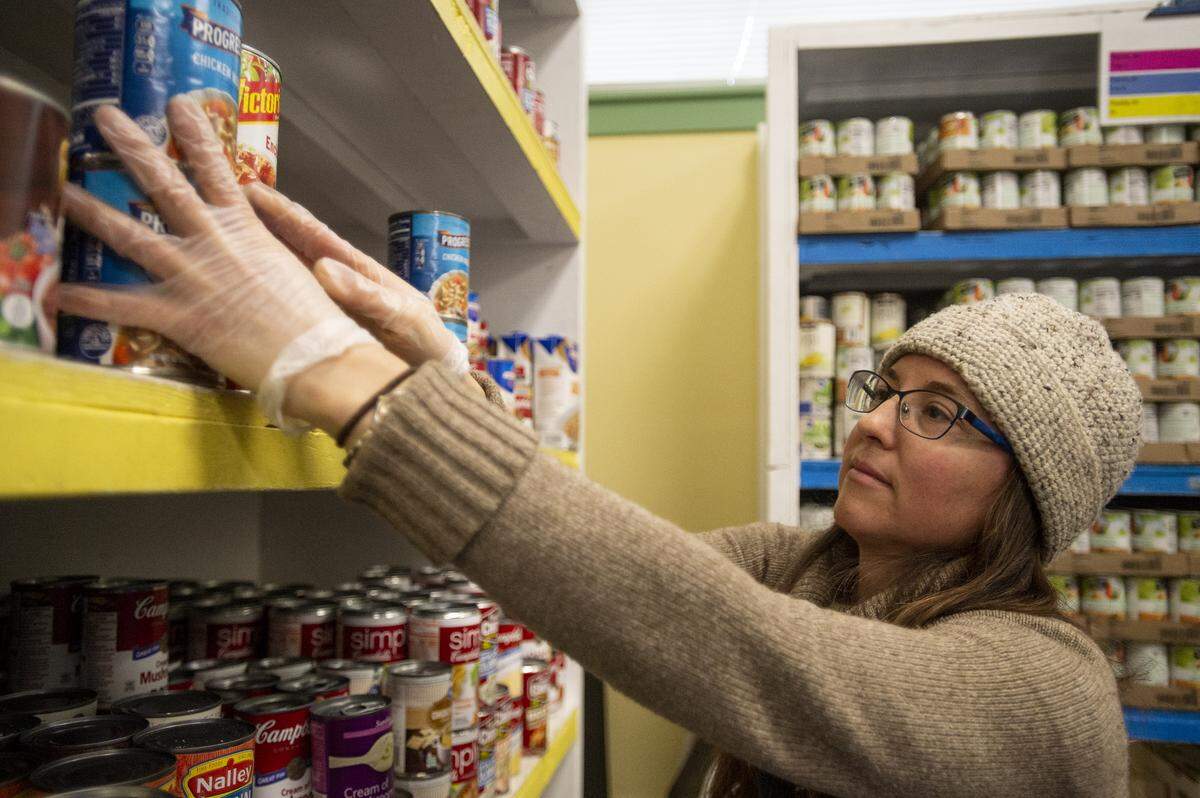
They work full time, or nearly so, yet struggle each month. But, they make too much to qualify for food stamps, Cohen said.
They use the food bank to stretch their limited income to pay bills where costs are firm, such as rent and child care, Cohen said.
“The food budget has a lot of elasticity to it,” he said.
At the food bank
These days, almost 20 percent of Bellingham gets food from the food bank, Cohen as he stood at the food bank’s Ellis Street location in January.
“It’s a lot of humanity and food moving through here,” Cohen said.
The nonprofit doesn’t ask visitors about their income or other questions “as we try to serve folks with as much dignity as possible,” Cohen said.
But, “household visits” to the Bellingham Food Bank have increased by nearly 129 percent in the past decade to 79,534 in 2018.
The city’s population grew a little over 11 percent in that time.
A household is at least one person. A “household visit” means all households that come during a year, and includes repeats.
The food bank also counted the number of unduplicated clients who used its services in 2018. They totaled 16,558, or a little under 20 percent of Bellingham’s population.
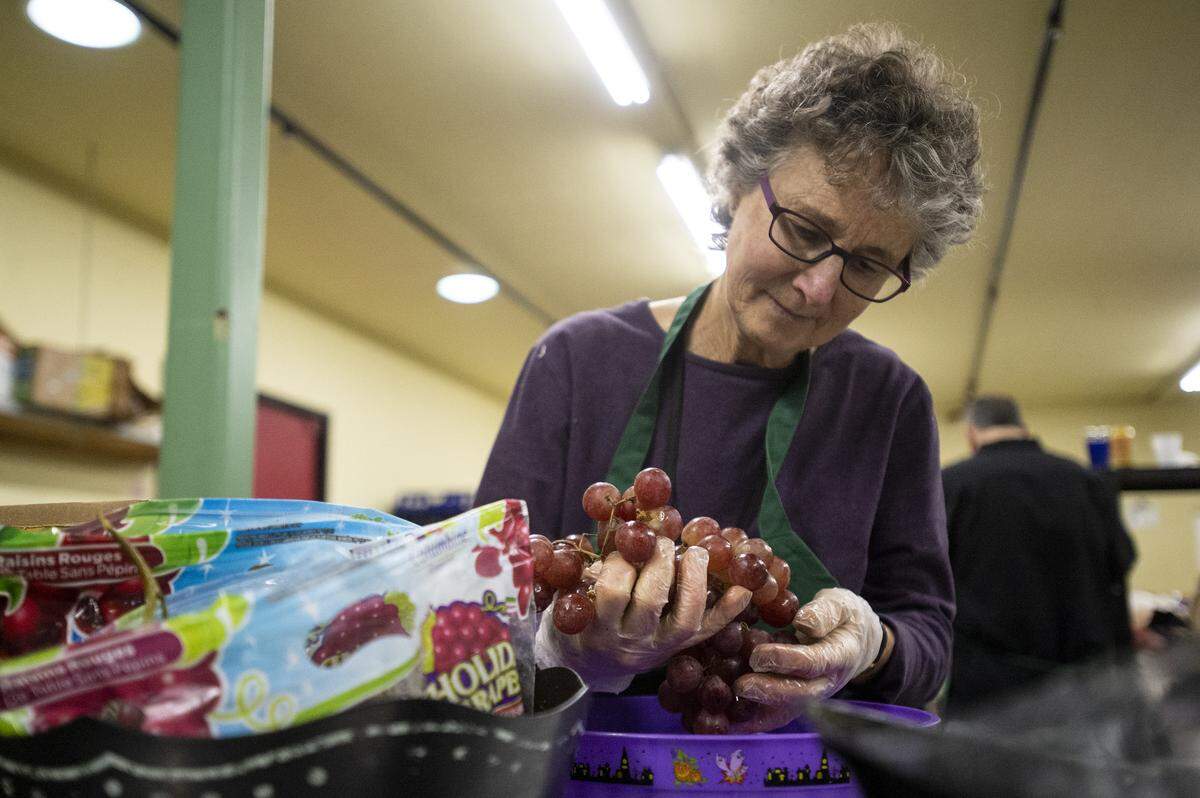
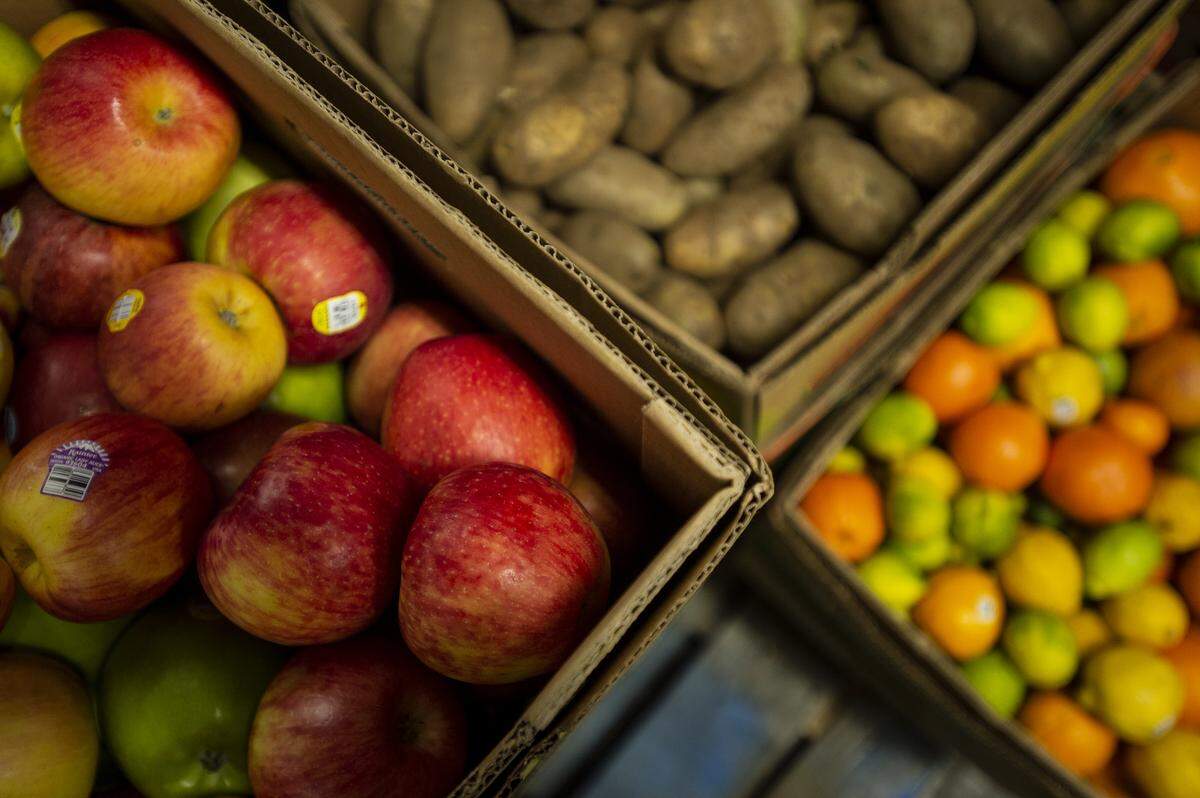
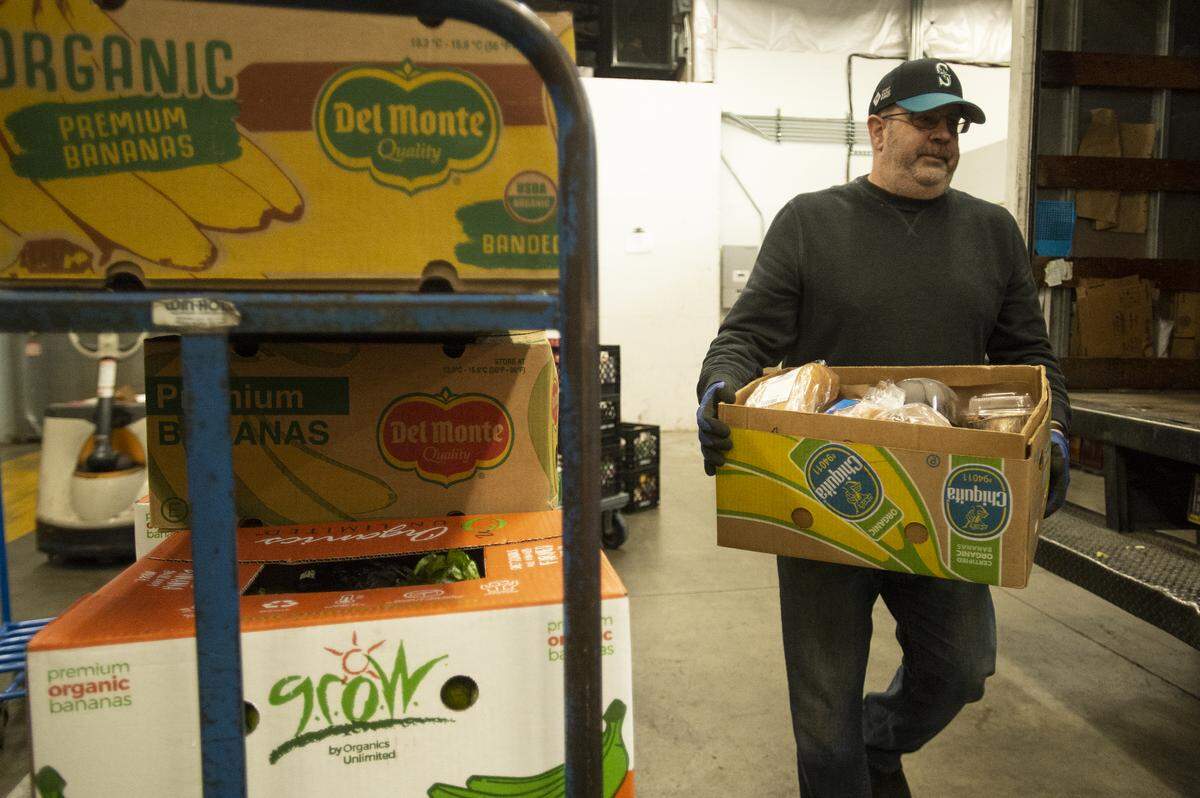
As Cohen watched on Jan. 23, people looked through bins of food that included lettuce and eggplants, dried great northern beans, apples and potatoes. Near one wall sat skinless/boneless chicken breasts that were frozen, with the food bank bought from one of its food suppliers for 49 cents a pound. There were jugs of milk in people’s carts.
Twenty-five people were allowed to come into the building at a time to get food.
There were elderly people, young adults and a few children with adults. Someone came in on crutches. A woman pushed a man in a wheelchair as they began selecting groceries.
More than 14 percent of the food bank’s clients were seniors and 29 percent were children in 2018, according to Cohen.
At Ellis Street, the food bank distributes food three times a week.
A three-person household gets an average of $75 worth of food per visit to the food bank, according to Cohen.
Since summer, people have been able to get food twice a week after the food bank heard from people that going just once a week wasn’t enough, Cohen said.
Help in Alderwood
It also has opened satellite food banks at Christ the King Community Church and Alderwood Elementary School, both in north Bellingham and both operating one day a week in the evenings. The satellites are in a part of town that is more densely populated with low-income and lower-income families, Cohen said.
Nearly 64 percent of Alderwood Elementary School students come from low-income families, according to the Washington State Office of Superintendent of Public Instruction. That’s compared to nearly 34 percent of all students in Bellingham School District.
The satellites are there for people who don’t regularly go into downtown Bellingham or are limited by transportation.
For example, getting from Alderwood to downtown Bellingham took a couple of hours on the bus, according to Mikah Smith, a counselor at Alderwood Elementary School who helped bring the food bank to the school.
When the satellite food bank opened at the school — it operates year-round — in October 2015, it made it getting food easier for others in the neighborhood as well.
“It really has evolved into serving the Alderwood community. You know a lot of people who don’t have kids here come and access it and a lot of those people have been regulars for the last few years,” Smith said. “Access was much more realistic for the people in the community here.”
Expanding service
Back on Ellis Street downtown, Cohen talked about other needs that the Bellingham Food Bank wants to address.
By March, the food bank hopes to be able to start giving out tampons, pads and other feminine hygiene products, to help women who struggle to afford them.
He expected they’ll learn that “it’s a dramatic need for a lot more families than we even realize.”
As Cohen spoke, others waited outside to get in — a line of people that stretched from the entrance of the Bellingham Food Bank on Ellis Street down to the intersection at Ohio Street.
Food help
More on the Bellingham Food Bank, including hours and dates for food distribution, is online at bellinghamfoodbank.org.
The website also has information on where to find other food banks in Whatcom County as well as hot meals. Those details are under Feeding Hungry Families on the home page and then Food Resources.
The Bellingham Food Bank serves as a hub for a network of some 20 food banks and meal programs in Whatcom and San Juan counties.
Bellingham Food Bank is at 1824 Ellis St. 360-676-0392.
Food for pets
Need help feeding your pets?
The Whatcom Humane Society has a pet food bank for Whatcom County residents that can be accessed once a month.
“We serve anyone in need, no income requirements,” said Laura Clark, the humane society’s executive director.
A range of people turn to the pet food bank — from those who are homeless to “middle-income folks who are just down on their luck and need a little help for their pets,” Clark said.
“In many cases, folks will use the services of the program for a few months and we then see them come back when they are in a better financial position and donate food to the program, as they were so appreciative that it was available to them during tough times,” Clark said.
People can go to the Whatcom Humane Society during regular business hours to get pet food.
“It really reinforces the special bond that people share with their companion animals,” she said.
All the food is donated.
On Feb. 8, the Whatcom Humane Society put out a call on its Facebook page, saying it needed more food for cats and dogs for its food bank.
The humane society accepts donations of all brands of dog and cat food, wet or dry, as well as food for small animals and grain for horse and livestock.
Details: whatcomhumane.org and 360-733-2080. The shelter is at 2172 Division St. in Bellingham.
Let us know
We were inspired by Broke in Philly’s reporting on economic mobility and know it’s an issue here as well. We’d love your input on what makes you feel broke in Bellingham and Whatcom County and invite you to share your experiences, frustrations and solutions. We’ll use your feedback to develop future stories. Tell us by sending an email to newsroom@bellinghamherald.com or use the hashtag #BrokeinBellingham.
This story was originally published February 18, 2019 at 5:00 AM.