
Bellingham man charged in mom’s murder declared incompetent. What happens now?
Two months after he was declared competent to stand trial for allegedly murdering his mother, Matthew Downey Gregory has now been found incompetent and is waiting to be sent to Western State Hospital, the state’s largest psychiatric facility, to receive mental health treatment.
Gregory, 30, is accused of murdering his mother, wrapping her in a blanket and leaving her body in Lake Samish in July. He is charged with second-degree murder.
Gregory was found incompetent to stand trial at a Nov. 1 hearing, according to Whatcom County Superior Court records.
In his competency evaluation report, a certified mental health expert noted Gregory appeared to be suffering from auditory and visual hallucinations and delusions due to schizophrenia.
Gregory claimed the people visiting him at Whatcom County Jail, including his attorney and family members, were “body doubles” and were disguises by the government that were coming after him and his family, court records indicate.
He also claimed faith groups or gangs had killed his mother as part of a setup, and that the symptoms of his mental illness were “a result of his involvement with a larger conspiracy and the use of advanced technology,” the records state.
Gregory has been in at least one fight with a cellmate, has refused to follow multiple deputies’ orders and his behavior has worsened, according to court records.
He is currently in isolation in the Whatcom County Jail.
Gregory had been referred to outpatient services at least four times in the last few years, but it does not appear he received services, court records show.
Most recently, Chief Criminal Deputy Prosecuting Attorney Eric Richey requested and received an order on Nov. 13 to have Gregory forcibly medicated while at Western State. Gregory refused to come to the hearing.
According to court records, Gregory has been non-compliant with medication in the past, has refused to take medication when offered it in the jail and told the mental health expert during his competency evaluation that he would not take prescribed medication as part of a treatment plan.
Gregory was supposed to be transferred to Western State by Nov. 8 for 90 days of restoration, but is still in jail without an estimated admission date, according to his public defense attorney Angela Anderson. If he hasn’t been transferred by Nov. 29, he will have a hearing that requires Western State to explain the delay in providing him services, Anderson said.
Some forensic patients who were originally scheduled to go to Western State may be sent to Eastern State, Western’s sister hospital southwest of Spokane, according to Whatcom County officials. Both Anderson and Richey said this may be an option for Gregory, but acknowledged the distance puts a strain on attorney-client relations.
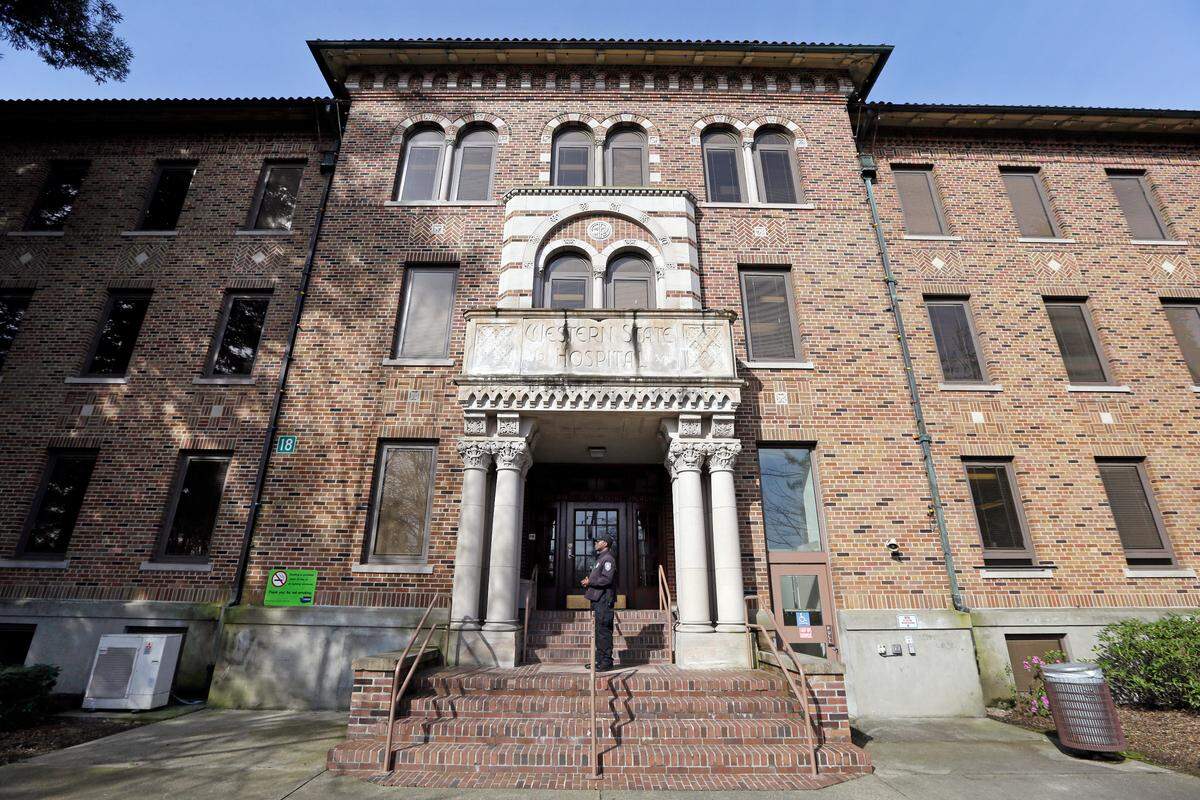
A larger problem
Gregory’s case is not an isolated one, and is part of a much larger problem plaguing the state’s mental health system and the way it provides services for those accused of crimes.
Per state law, a forensic patient, or a patient who is sent by the criminal courts to receive services, must be transferred to a facility within seven days of the treatment order being signed.
That deadline is rarely met. According to data provided by the state Department of Social and Health Services, as of Aug. 30, the average wait time for a forensic patient to receive competency restoration services is 45.2 days, with Eastern having an average of 20.4 days. Eastern currently has the capacity to treat 124 forensic patients, with Western able to take 350.
“It’s so inhumane to see someone so incompetent who doesn’t know what a judge or jury is and can’t interact with their attorney, so we put them in isolation in a 10-by-10 room for four months waiting to get on medication. It’s sickening,” Anderson said in an interview in August.
“What we’re doing with these long delays … just makes these guys worse and worse and we’re exasperating the system. There’s no bright side to competency right now.”
One 42-year-old woman, who is accused of attacking another woman and breaking her nose at Compass Health in Bellingham in April, waited for more than four months in the Whatcom County Jail to be sent to Western State to receive restoration services.
The hospital, which was held in contempt in mid-August, has been fined more than $65,500 for the delay. The woman’s public defense attorney, Stephen Jackson, filed a motion to dismiss her case on Nov. 7, arguing that the delay violated her constitutional rights.
The woman was taken to the state hospital Thursday, 127 days after the court order was signed.
As of Thursday, there were 256 other forensic patients on the waitlist to receive competency services at Western State, according to Kelly Stowe, media relations manager for the hospital in Lakewood, south of Tacoma.
Jackson said the problems surrounding delays are frustrating and bring the system to a grinding halt.
“It’s not going away, the state is not going to save us. So I feel like we’re on our own. These are our most vulnerable citizens. These are people who don’t know what they’re doing,” Jackson said in the August interview.
“If you don’t know someone who has a mental illness, you’re paying for somebody who has a mental illness in a very inefficient way. Our police officers and our corrections deputies, their jobs are dramatically harder as a result of this. And this is a really vulnerable population that we’ve largely abandoned.”
Richey said holding those with mental illnesses in custody helps no one.
“The delays are a problem for everyone in the system. It affects our community, our victims who have been hurt by crime, and it affects the defendants significantly,” Richey said in interviews in August and November.
“It’s just a human point of view that people are languishing in jail unnecessarily. We’re not able to move their cases, but it’s also just that that person is being held in jail while they’re not competent. It’s terrible and there’s not another option right now given the state of affairs at Western.”
The problems at Western State are not new. Last year in Southwest Washington, a man waited almost 70 days for competency restoration services to stand trial for trafficking in stolen property and third-degree theft.
And in Skagit County, prosecutors started seeing an increase in case dismissal requests due to delays in getting patients services, according to the Skagit Valley Herald.
The state hospital also lost $53 million in annual federal funding this year after inspections from the U.S. Centers for Medical & Medicaid Services revealed an array of safety problems, according to the Seattle Times. And in 2015, a lawsuit out of Snohomish County, known as Trueblood, addressed the issue of patients receiving timely services, which also mandated the seven-day transfer rule.
The state has since paid millions in fines over the delays. A tentative settlement was reached in the case in August, the Seattle Times reported.
“There is a mental health crisis in our state. The demand for all forms of mental health services far outweighs what is currently available including competency evaluation and restoration services,” Stowe, the Western State spokesperson, said in an emailed response from September.
“Many of the problems with untimely competency evaluations can be prevented if fewer people with mental illness enter the criminal justice system. When people are able to get the treatment they need when they need it, they are more likely to avoid becoming entwined in the criminal justice system.”
Stowe said there are several solutions being discussed, including diversion services that work with state and local agencies. Those services focus on preventing recidivism, reducing the demand for competency services and long-term incarceration for those with behavioral health issues, and serving defendants in the least restrictive environment.
“We have a vested interest in the protection of defendant rights, the efficient delivery of necessary behavioral health services, and public safety,” Stowe said. “It is also important to remember that people can and do get well from mental illness.”
A top referring county
In 2017, Whatcom County was one of the top 10 referring counties across the state requesting competency restoration services for forensic patients, according to DSHS data. The county submitted 23 orders related to felony cases, down from 36 the previous year, according to the data.
Anderson said the public defender’s office has roughly around 30 to 60 clients at any given time who have had competency issues raised in their cases, many of whom are in custody.
Whatcom currently has six inmates who are receiving competency evaluations or restorations at Western State, with another 10 waiting, according to Wendy Jones, Chief Corrections Deputy at the Whatcom County Jail. There’s also one inmate at the Maple Lane restoration facility in Centralia.. This is a decline from August, when roughly 22 inmates were waiting for services.
“For the local community, I want them to understand that we share their concern about the number of people who are mentally ill who wind up in jail,” Jones said in an interview from August. “But I also want the community to understand that we have become that last safety net.”
The competency delays strain the jail’s resources, Jones said.
Often, those who are declared incompetent are resistant to taking medication or have behavioral issues that cause problems with other inmates, landing them in isolation for the safety of themselves and others, Jones said.
Sometimes, the amount of time inmates spend waiting for a bed at Western will be longer than the sentence they end up receiving, she said.
“The jail was never intended to be a mental health treatment location and it is frustrating to me that ... it has always been treated that way because there’s not sufficient resources in the entire state,” Jones said in an interview in November.
“There is no place for them to go … and it’s a societal issue that jails get stuck dealing with. They get caught in limbo land and nobody knows what to do with them. Here we do what we can, but we’re not a hospital,” she said.
This story was originally published November 16, 2018 at 7:03 PM.