Whatcom receives another ‘medium’ COVID grade from CDC, but one region would be ‘high’
Whatcom County remained in the U.S. Centers for Disease Control and Prevention’s “medium” community COVID-19 risk level for a second straight week, while infection and hospitalizations rates in one region within the county would earn it a “high” ranking, where masking is recommended for everyone.
Based on its weekly COVID infection rate being higher than 200 new cases per 100,000 residents, the CDC gave Whatcom the “medium” community level rating when new data was released Thursday, June 16, meaning masking is recommended for those who are at high risk of serious complications from COVID and those who could expose those at high risk. It marked the second straight week and the third time in four weeks that Whatcom has received the “medium” ranking.
But The Bellingham Herald’s analysis of the latest location data released Thursday by the Whatcom County Health Department showed that the region covered by the Ferndale School District would actually receive a “high” rating if the CDC drilled down to that level. It’s the third time in five weeks that the Ferndale region has seen weekly infection and hospitalization rates high enough to receive a ranking where masking is recommended for everyone.
Additionally, The Herald found that three other regions — Bellingham, Meridian and Mount Baker — had numbers placing them in the “medium” range, while Blaine, Lynden and Nooksack Valley all would be in the “low” community levels. Nooksack Valley is the only region in the county that has been in the “low” range since the CDC introduced its community-level rankings in early spring.
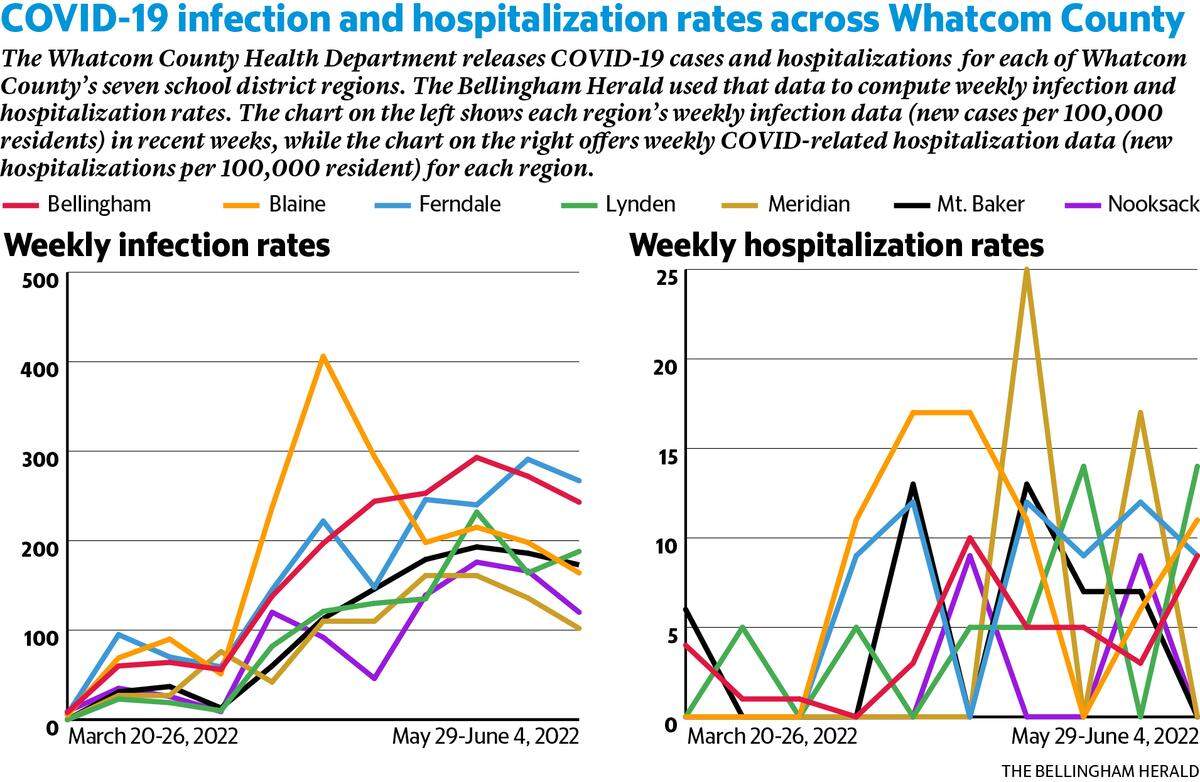
Though it remained “low,” the Nooksack region was one of four regions in the county to see its weekly number of new cases per 100,000 residents climb last week. Only the Ferndale and Lynden regions saw infection rates decrease, while Bellingham’s rate was unchanged from the week before.
To be classified in the “low” level by the CDC, counties must have:
▪ Fewer than 200 new cases per 100,000 residents in the past seven days.
▪ Fewer than 10 new COVID-related hospitalizations per 100,000 residents in the past seven days.
▪ Less than 10% of staffed inpatient beds occupied by COVID-19 patients.
While masking is recommended for everyone for counties with “high” community levels, the CDC only recommends face coverings only for those who are at high risk of serious complications from COVID and those who could expose those at high risk for counties in the “medium” range. Masking in most indoor situations is not included among the CDC’s recommended guidelines for communities in the “low” level.
At every level, the CDC says people “can wear a mask based on personal preference” and should wear a mask if they have COVID symptoms, test positive or have possible exposure.
As of Friday, June 17, St. Joseph hospital in Bellingham reported it was treating 20 COVID-related patients. That would give it an average of 19.7 COVID-related patients per day over the past week (June 11-17) — its highest weekly patient count since Feb. 25 when it was 21.0, but still within the CDC’s “low” guidelines with 7.8% of the hospital’s 252 inpatient beds filled by COVID patients.
The Washington State Department of Health’s COVID-19 Data Dashboard’s latest update on Wednesday, June 15, showed Whatcom County had a weekly infection rate of 267 new cases per 100,000 residents and an infection rate of 8.8 new COVID-related patients per 100,000 residents for the most recently complete epidemiological data from May 31 to June 6. For the entire pandemic, Whatcom County has had 42,032 cases with 1,662 hospitalizations and 307 deaths related to COVID-19.
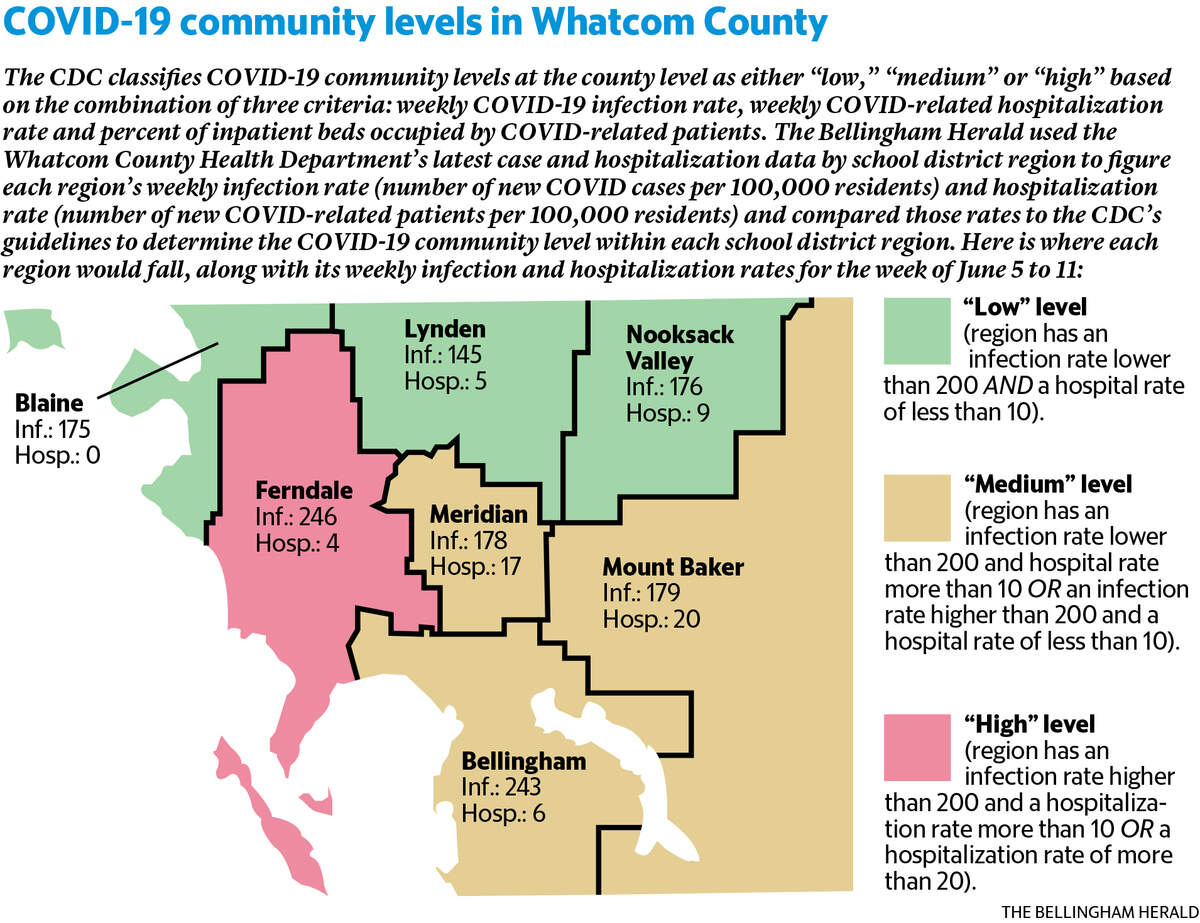
Here is what the health department’s latest data showed for the seven regions in the county for the week of June 5-11:
▪ Bellingham: Had 325 new cases, eight new hospitalizations and one new death reported, increasing its pandemic totals to 18,057 cases, 573 hospitalizations and 146 deaths. Its weekly infection rate of 243 cases per 100,000 residents was unchanged from one week earlier.
▪ Blaine: Had 31 new cases, no new hospitalizations and no new deaths reported, increasing its pandemic totals to 3,491 cases, 128 hospitalizations and 23 deaths. Its weekly infection rate of 175 cases per 100,000 residents was up from 164 one week earlier.
▪ Ferndale: Had 83 new cases, four new hospitalizations and no new deaths reported, increasing its pandemic totals to 7,665 cases, 349 hospitalizations and 55 deaths. Its weekly infection rate of 246 cases per 100,000 residents was down from 267 one week earlier.
▪ Lynden: Had 30 new cases, one new hospitalization and no new deaths reported, increasing its pandemic totals to 5,652 cases, 272 hospitalizations and 38 deaths. Its weekly infection rate of 145 cases per 100,000 residents was down from 188 one week earlier.
▪ Meridian: Had 21 new cases, two new hospitalizations and no new deaths reported, increasing its pandemic totals to 1,943 cases, 86 hospitalizations and 14 deaths. Its weekly infection rate of 178 cases per 100,000 residents was up from 102 one week earlier.
▪ Mount Baker: Had 27 new cases, three new hospitalizations and no new deaths reported, increasing its pandemic totals to 2,274 cases, 128 hospitalizations and 17 deaths. Its weekly infection rate of 179 cases per 100,000 residents was up from 173 one week earlier.
▪ Nooksack Valley: Had 19 new cases, one new hospitalization and no new deaths reported, increasing its pandemic totals to 2,692 cases, 114 hospitalizations and 13 deaths. Its weekly infection rate of 176 cases per 100,000 residents was up from 120 one week earlier.
This story was originally published June 17, 2022 at 11:12 AM.