‘Nobody wants another summer crushed by COVID-19.’ Here’s where Whatcom stands
Whatcom County stayed put in the U.S. Centers for Disease Control and Prevention’s “low” COVID-19 community level for a second straight week, but that ranking continues to “hover on the boarder” between “low” and “medium” risk levels, the Whatcom County Health Department cautioned.
“We can’t predict the future, but our COVID-19 cases may very likely go back up into the medium range, or even yo-yo back and forth for the next several weeks,” the health department said in a news release Friday, May 20. “Nobody wants another summer crushed by COVID-19. The choices you make now can really help us stop the spread of this disease.”
The health department reiterated its advice for residents to get tested when they have symptoms or are exposed, stay home if they are sick, stay up to date with COVID-19 vaccines and boosters and wear a high-quality mask if they are indoors, public areas or are at risk of increased serious illness.
Whatcom County actually has only two school district regions that would receive “low” risk grades, if the CDC boiled its analysis down to that level. The regions covered by the Lynden and Nooksack Valley school districts would each be at the “low” level, The Bellingham Herald’s analysis of location data released Thursday, May 19, by the Whatcom County Health Department found.
Meanwhile another two regions — those covered by the Ferndale and Meridian school districts — would be in the “high” community level, leaving the remaining three regions with “medium” risk-level grades.
To be classified in the “low” level by the CDC, counties must have:
▪ Fewer than 200 new cases per 100,000 residents in the past seven days.
▪ Fewer than 10 new COVID-related hospitalizations per 100,000 residents in the past seven days.
▪ Less than 10% of staffed inpatient beds occupied by COVID-19 patients.
While masking is recommended for everyone for counties with “high” community levels, the CDC only recommends face coverings only for those who are at high risk of serious complications from COVID and those who could expose those at high risk for counties in the “medium” range. Masking in most indoor situations is not included among the CDC’s recommended guidelines for communities in the “low” level.
At every level, the CDC says people “can wear a mask based on personal preference” and should wear a mask if they have COVID symptoms, test positive or have possible exposure.
As of Monday, May 23, St. Joseph hospital in Bellingham reported it was treating 13 COVID-related patients — its highest single-day snapshot since it reported treating 14 on May 6. That would give it an average of 9.4 COVID-related patients per day over the past week (May 17-23), or 3.7% of the hospital’s 252 inpatient beds. The hospital averaged 10.4 patients per day a week earlier (May 10-16).
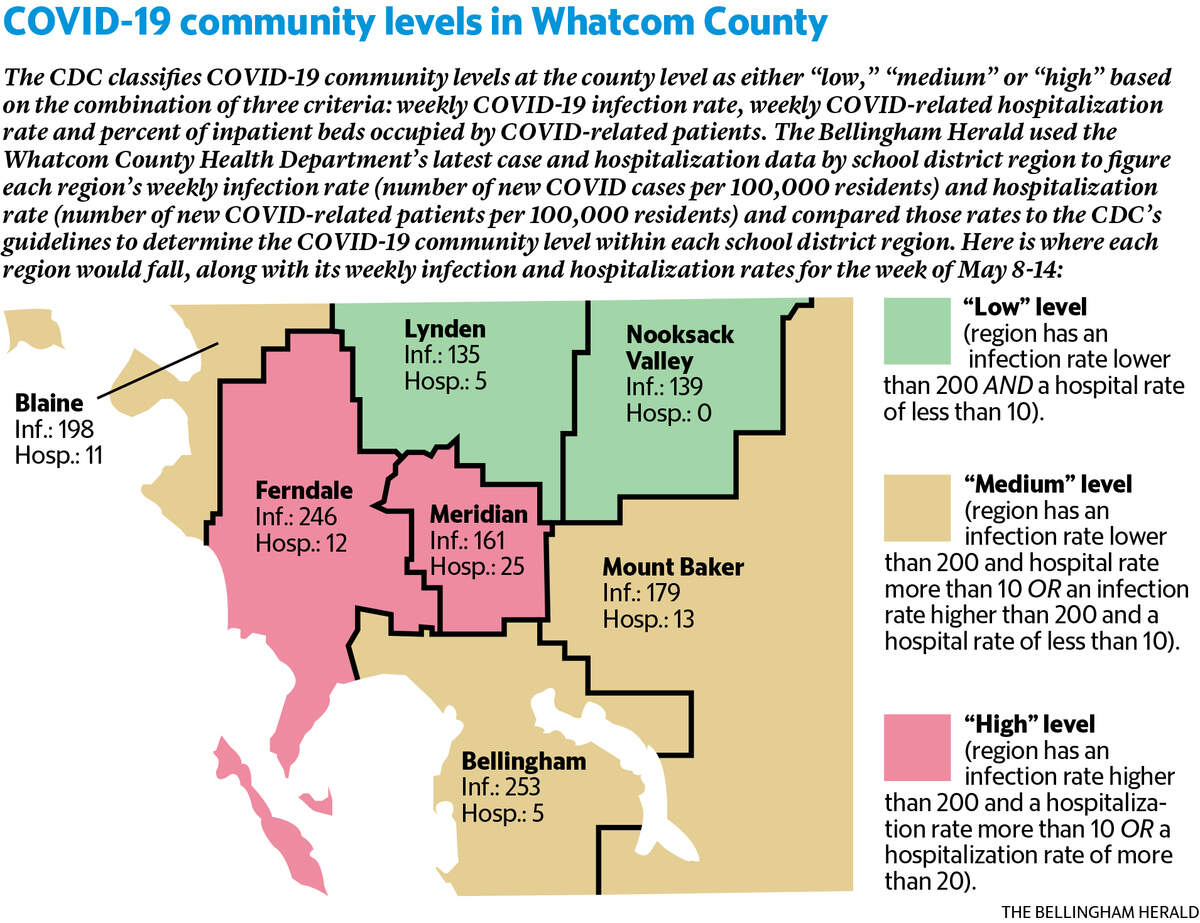
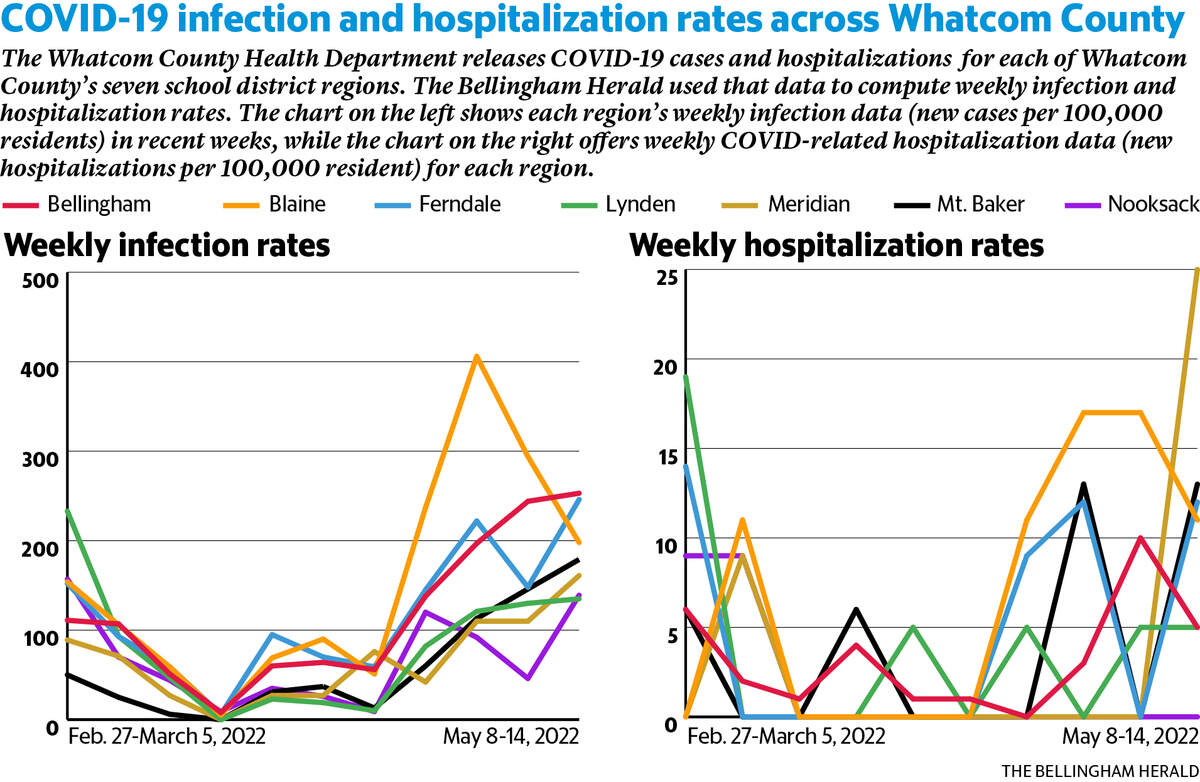
Overall, six of the seven regions saw their weekly infection rates increase, The Herald found, while weekly hospitalization rates increased in three regions.
Here is what the health department’s latest data showed for the seven regions in the county for the week of May 8-14:
▪ Bellingham: Had 338 new cases, seven new hospitalizations and one new death reported, increasing its pandemic totals to 16,653 cases, 542 hospitalizations and 144 deaths. Its weekly infection rate of 253 cases per 100,000 residents was up from 244 one week earlier.
▪ Blaine: Had 35 new cases, two new hospitalizations and no new deaths reported, increasing its pandemic totals to 3,358 cases, 125 hospitalizations and 23 deaths. Its weekly infection rate of 198 cases per 100,000 residents was down from 294 one week earlier.
▪ Ferndale: Had 83 new cases, four new hospitalizations and no new deaths reported, increasing its pandemic totals to 7,313 cases, 335 hospitalizations and 52 deaths. Its weekly infection rate of 246 cases per 100,000 residents was up from 148 one week earlier.
▪ Lynden: Had 28 new cases, one new hospitalization and no new deaths reported, increasing its pandemic totals to 5,501 cases, 265 hospitalizations and 38 deaths. Its weekly infection rate of 135 cases per 100,000 residents was up from 130 one week earlier.
▪ Meridian: Had 19 new cases, three new hospitalizations and no new deaths reported, increasing its pandemic totals to 1,875 cases, 82 hospitalizations and 13 deaths. Its weekly infection rate of 161 cases per 100,000 residents was up from 110 one week earlier.
▪ Mount Baker: Had 27 new cases, two new hospitalizations and no new deaths reported, increasing its pandemic totals to 2,164 cases, 124 hospitalizations and 17 deaths. Its weekly infection rate of 179 cases per 100,000 residents was up from 146 one week earlier.
▪ Nooksack Valley: Had 15 new cases, no new hospitalizations and no new deaths reported, increasing its pandemic totals to 2,623 cases, 113 hospitalizations and 13 deaths. Its weekly infection rate of 139 cases per 100,000 residents was up from 46 one week earlier.
Whatcom’s weekly COVID data
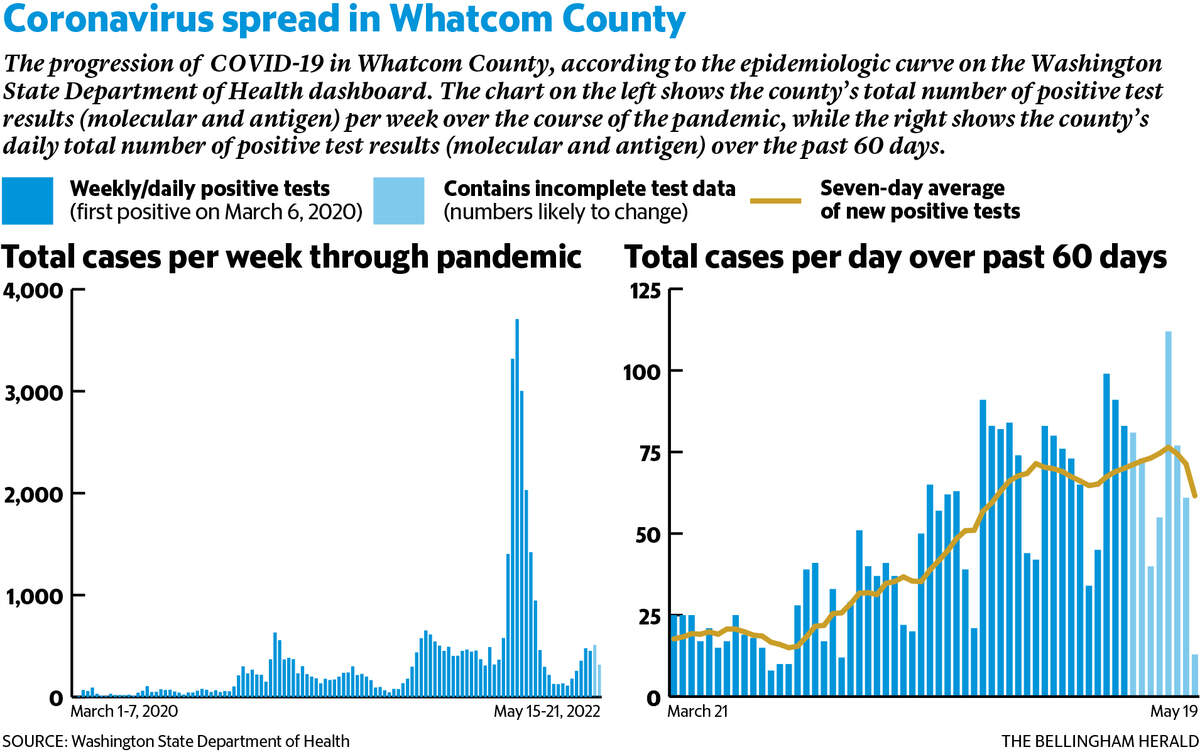
As of Friday, the state reported Whatcom County has seen 39,911 total cases (confirmed and probable combined) during the pandemic, which was an increase of 568 from the week before. Though down from the 623 new cases reported the week before (May 8-14), it still represented the second-largest increase Whatcom has seen since it saws 1,502 cases reported the week of Feb. 6-12.
Through Friday’s update, the state dashboard reported Whatcom County has:
▪ 34,944 confirmed COVID-19 cases during the pandemic — an increase of 450 from the week before.
▪ 4,967 additional probable COVID cases during the pandemic — up 118 cases from the week before — resulting from positive antigen tests not confirmed by a molecular test.
▪ A weekly infection rate of 215 cases per 100,000 residents for the most recently completed epidemiological data May 5-11 — up from 212 one week earlier (April 28 to May 4).
▪ 1,594 COVID-related hospitalizations during the pandemic — up 16 from the week before.
▪ A weekly COVID-related hospitalization rate of 5.7 new patients per 100,000 residents for the most recently completed epidemiological hospitalization data May 5-11 — down from 10.5 from a week earlier (April 28 to May 4).
▪ 301 COVID-related deaths during the pandemic — unchanged from the last week.
▪ 2,441 tests (molecular and antigen combined) completed during the most recently completed epidemiological data May 4-10, with 20.6% of the tests returning a positive result. A week earlier (April 27 to May 3) the state reported 4,217 tests completed and 11.6% returning positive results. The state’s data does not include at-home rapid tests that were not reported.
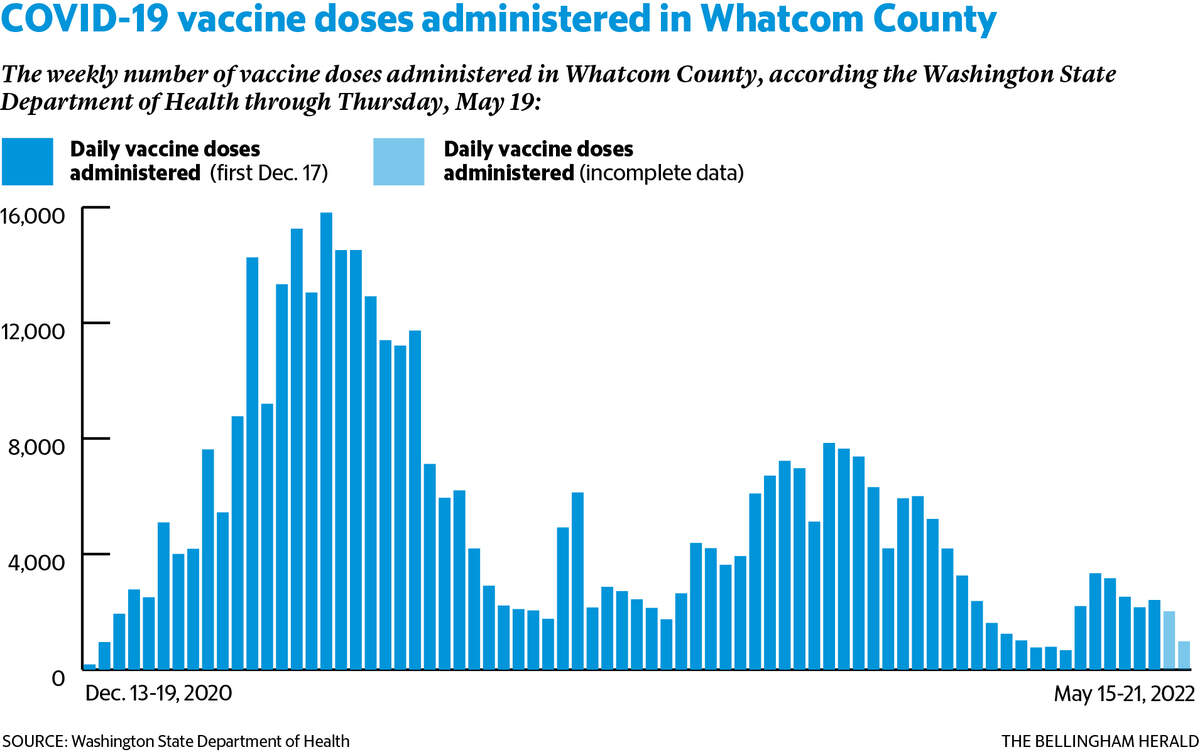
▪ 390,358 vaccine doses have been administered, an increase of 2,133 from the week before. Approximately 75.4% of all Whatcom County residents have initiated vaccination and 69.0% have completed a primary vaccination cycle.
▪ 90,461 booster vaccine doses administered, meaning 61.6% of Whatcom’s residents eligible to receive a booster dose have done so.
Whatcom’s vaccination status
Whatcom County saw case rates climb among both vaccinated and unvaccinated residents the week of May 8-14, The Herald’s analysis of the data reported by the Whatcom County Health Department found. Here is what the data showed for the week:
▪ Unvaccinated residents: The county data showed 142 new cases, seven new hospitalizations and no new deaths among the county’s unvaccinated residents. Based on the state’s vaccination data, Whatcom’s unvaccinated residents had an infection rate of 196 new cases per 100,000 residents during the week (up from 142 a week earlier) and a hospitalization rate of 10 new patients per 100,000 residents (up from seven a week earlier).
▪ Fully vaccinated residents: The county data showed 130 new cases, three new hospitalizations and no new deaths among the county’s fully vaccinated residents. Based on the state’s vaccination data, Whatcom’s fully vaccinated residents had an infection rate of 83 new cases per 100,000 residents during the week (up from 76 a week earlier) and a hospitalization rate of two new patients per 100,000 residents (down from three a week earlier).
▪ Fully vaccinated and single boosted residents: The county data showed 207 new cases, nine new hospitalizations among the county’s fully vaccinated residents who have received a booster dose. Due to privacy laws, a death total was not released, as there are fewer than 10 fully vaccinated and single boosted residents in the county who have died. Based on the state’s vaccination data, Whatcom’s fully vaccinated and single boosted residents had an infection rate of 231 new cases per 100,000 residents during the week (up from 228 a week earlier) and a hospitalization rate of 10 new patients per 100,000 residents (up from seven a week earlier).
▪ Fully vaccinated and double boosted residents: The county data showed 22 new cases among the county’s fully vaccinated residents who have received two booster doses. Due to privacy laws, hospital and death totals were not released, as there are fewer than 10 fully vaccinated and double-boosted residents in the county who have been hospitalized or died. The state is not reporting the number of residents who have received two booster doses, so infection rates could not be determined.
Whatcom schools COVID report
COVID-19 case rates in Whatcom County schools dropped climbed during the second week of May.
Whatcom County’s seven school districts reported a total 243 COVID cases between May 8 and 14. Based on student enrollment, that works out to approximately 11.1 cases per 1,000 students, The Herald’s analysis found.
That was up from the rate of 10.0 cases per 1,000 students a week earlier (May 1-7), The Herald found.
There have been 152 cases reported so far last week (May 15-21), with just the Bellingham, Ferndale and Meridian school districts reporting, which works out to a rate of 16.4 cases per 1,000 students in those three districts.
Since returning from winter break, the seven districts have reported a total of 4,527 cases, or a weekly rate of approximately 13.8 cases per 1,000 students.
The COVID-19 dashboards on Whatcom County school district websites showed:
▪ Bellingham Public Schools has reported 1,682 total COVID-19 cases in its schools since winter break, or a weekly rate of 16.2 cases per 1,000 students, according to The Herald’s analysis. The district reported 177 cases the week of May 8-14, which was up 28 from the week before.
▪ Blaine School District has reported 705 total COVID-19 cases in its schools since winter break, or a weekly rate of 16.9 cases per 1,000 students, according to The Herald’s analysis. The district reported 10 cases the week of May 8-14, which was down 10 from the week before.
▪ Lynden School District has reported 451 total COVID-19 cases in its schools since winter break, or a weekly rate of 7.3 cases per 1,000 students, according to The Herald’s analysis. The district reported four cases the week of May 8-14, which was down three from the week before.
▪ Meridian School District has reported 425 COVID-19 cases in its schools since winter break, or a weekly rate of 12.2 cases per 1,000 students, according to The Herald’s analysis. The district reported 17 cases the week of May 8-14, which was up eight from the week before.
▪ Mount Baker School District has reported 329 COVID-19 cases in its schools since winter break, or a weekly rate of 9.8 cases per 1,000 students, according to The Herald’s analysis. The district reported 11 cases the week of May 8-14, which was down one from the week before.
▪ Nooksack Valley School District has reported 366 cases in its schools since winter break, or a weekly rate of 10.2 cases per 1,000 students, according to The Herald’s analysis. The district reported eight cases the week of May 8-14, which was up six from the week before.
▪ Ferndale School District reported Monday, May 16, that 23 students or staff had positive COVID-19 tests reported to the Whatcom County Health Department, which was up from the 16 it reported on May 16.