With Whatcom at ‘medium’ COVID community level, which areas are seeing even higher risk?
Higher COVID-19 case rates pushed Whatcom County into the U.S. Centers for Disease Control and Prevention’s “medium” community level last week, but only one school district region within the county would actually fall in that level.
Two others would have received “high” ratings last week if the CDC measured community levels by school district, The Bellingham Herald’s analysis of the latest location data released by the Whatcom County Health Department found, while the remaining four would all be at the “low” level.
Based on the data released Thursday, May 5, by the Whatcom County Health Department and U.S. Census data, The Herald found that the regions covered by the Blaine and Ferndale school districts would both be in the “high” range, based on each region having more than 200 new COVID cases and 10 new COVID-related hospitalizations per 100,000 residents between April 24 and 30.
It’s the second straight week the Blaine region would have fallen in the “high” range.
Even though its case rate remained well below 200 new cases per 100,000 residents, the Mount Baker region would fall in the “medium” range, because its hospitalization rate climbed above the threshold last week.
The other four regions — Bellingham, Lynden, Meridian and Nooksack Valley — would all be in the “low” range, though weekly case rates climbed in three of the four regions, with only the Nooksack Valley region having fewer than 100 new cases per 100,000 residents during the week.
To be classified in the “low” level by the CDC, counties must have:
▪ Fewer than 200 new cases per 100,000 residents in the past seven days.
▪ Fewer than 10 new COVID-related hospitalizations per 100,000 residents in the past seven days.
▪ Less than 10% of staffed inpatient beds occupied by COVID-19 patients.
As of Monday, May 9, St. Joseph hospital in Bellingham reported it was treating seven COVID-related patients. That would give it an average of 7.4 COVID-related patients per day over the past week (May 3-9), or 3.1% of the hospital’s inpatient beds.
While masking is recommended for everyone for counties with “high” community levels, the CDC only recommends face coverings for those who are at high risk of serious complications from COVID and those who could expose those at high risk for counties in the “medium” range. Masking in most indoor situations is not included among the CDC’s recommended guidelines for communities in the “low” level.
At every level, the CDC says people “can wear a mask based on personal preference” and should wear a mask if they have COVID symptoms, test positive or have possible exposure.
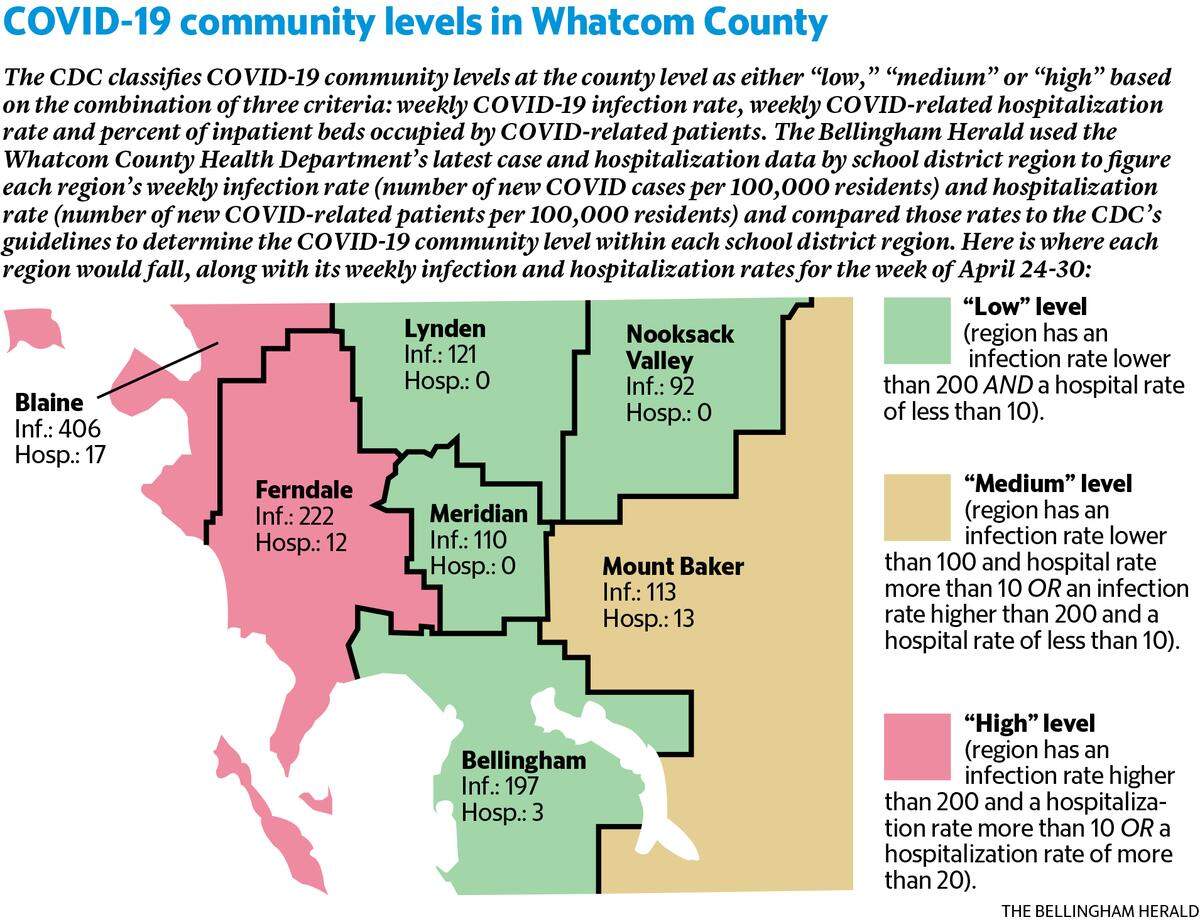
Here is what the health department’s latest data showed for the seven regions in the county for the week of April 24-30:
▪ Bellingham: Had 263 new cases, four new hospitalizations and no new deaths reported, increasing its pandemic totals to 15,989 cases, 521 hospitalizations and 142 deaths. Its weekly infection rate of 197 cases per 100,000 residents was up from 138 one week earlier.
▪ Blaine: Had 72 new cases, three new hospitalizations and no new deaths reported, increasing its pandemic totals to 3,271 cases, 120 hospitalizations and 23 deaths. Its weekly infection rate of 406 cases per 100,000 residents was up from 237 one week earlier.
▪ Ferndale: Had 75 new cases, four new hospitalizations and no new deaths reported, increasing its pandemic totals to 7,180 cases, 331 hospitalizations and 52 deaths. Its weekly infection rate of 222 cases per 100,000 residents was up from 145 one week earlier.
▪ Lynden: Had 25 new cases, no new hospitalizations and no new deaths reported, increasing its pandemic totals to 5,446 cases, 263 hospitalizations and 38 deaths. Its weekly infection rate of 121 cases per 100,000 residents was up from 82 one week earlier.
▪ Meridian: Had 13 new cases, no new hospitalizations and no new deaths reported, increasing its pandemic totals to 1,843 cases, 79 hospitalizations and 13 deaths. Its weekly infection rate of 110 cases per 100,000 residents was up from 42 one week earlier.
▪ Mount Baker: Had 17 new cases, two new hospitalizations and no new deaths reported, increasing its pandemic totals to 2,115 cases, 122 hospitalizations and 17 deaths. Its weekly infection rate of 113 cases per 100,000 residents was up from 60 one week earlier.
▪ Nooksack Valley: Had 10 new cases, no new hospitalizations and no new deaths reported, increasing its pandemic totals to 2,603 cases, 112 hospitalizations and 13 deaths. Its weekly infection rate of 92 cases per 100,000 residents was down from 120 one week earlier.
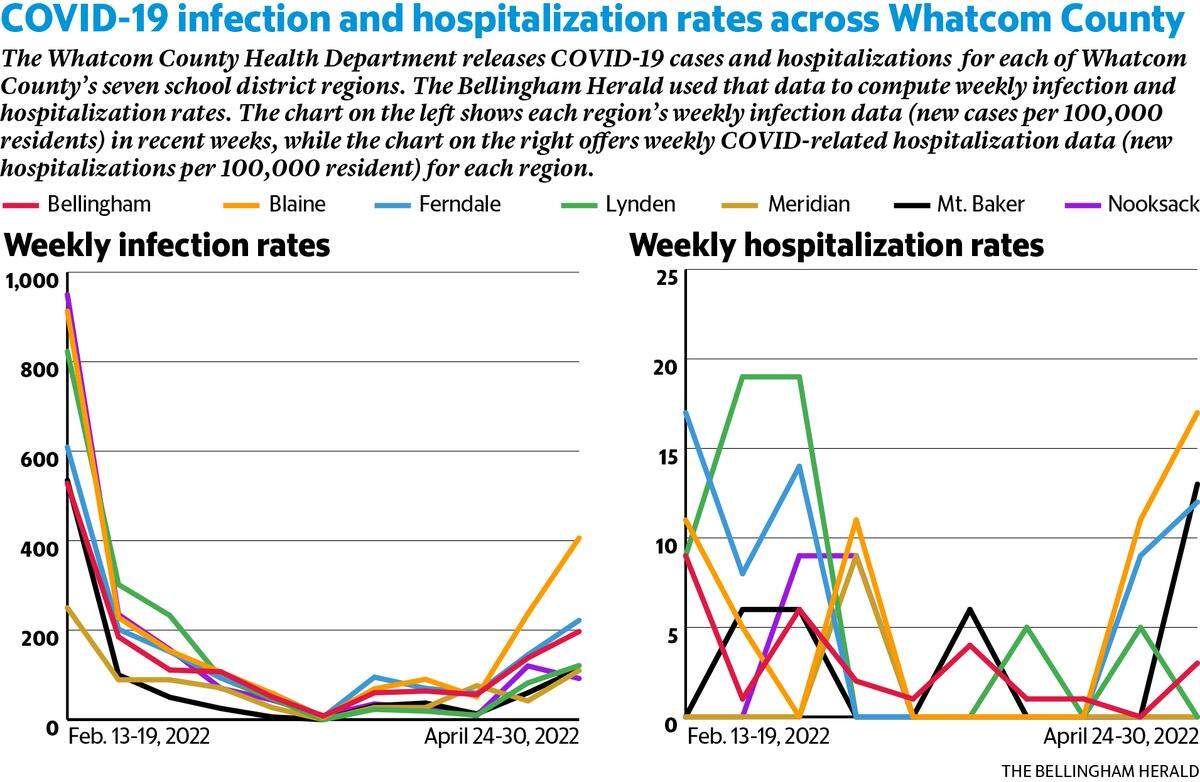
Whatcom’s weekly COVID data
The Washington State Department of Health’s COVID-19 Data Dashboard reported that a technical issue prevented it from reporting updated case, hospitalization, death and testing data on Friday, May 6.
Through the report Wednesday, May 4, the state reported Whatcom County has:
▪ 33,950 confirmed COVID-19 cases during the pandemic — an increase of 271, which was down from the 405 reported the week before.
▪ 4,770 additional probable COVID cases during the pandemic — up 71 cases — resulting from positive antigen tests not confirmed by a molecular test. Whatcom had 96 probable cases reported the week before.
▪ A weekly infection rate of 175 cases per 100,000 residents for the most recently completed epidemiological data April 19-25 — up from 108 one week earlier (April 12-18).
▪ 1,556 COVID-related hospitalizations during the pandemic — up 10. Whatcom had seven COVID-related hospitalizations reported the week before.
▪ A weekly COVID-related hospitalization rate of 2.6 patients per 100,000 residents for the most recently completed epidemiological hospitalization data April 19-25 — up from 2.2 from a week earlier (April 12-18).
▪ 298 COVID-related deaths during the pandemic — unchanged from the last week.
▪ 3,761 tests (molecular and antigen combined) completed during the most recently completed epidemiological data April 16-22, with 8.9% of the tests returning a positive result. A week earlier (April 9-15) the state reported 3,533 tests completed and 7.1% returning positive results. The state’s data does not include at-home rapid tests that were not reported.
▪ 1,276 confirmed omicron variant cases and 2,095 confirmed delta variant cases, according to the weekly SARS-CoV-2 Sequencing and Variants in Washington State released Wednesday, May 4. That was an increase of 197 omicron cases and no delta cases since last week’s report, though, with just 24.6% of all confirmed COVID cases in the state sequenced during the month of March, those numbers are likely much higher.
▪ 385,733 vaccinations administered during the pandemic — an increase of 2,355 from last week. Whatcom had 2,141 administered vaccine doses reported the week before. The state reports 75.2% of Whatcom County’s total population has initiated vaccination and 68.9% has completed it.
▪ 89,796 booster vaccine doses administered, meaning 61.5% of Whatcom’s residents eligible to receive a booster dose have done so.
Whatcom schools COVID report
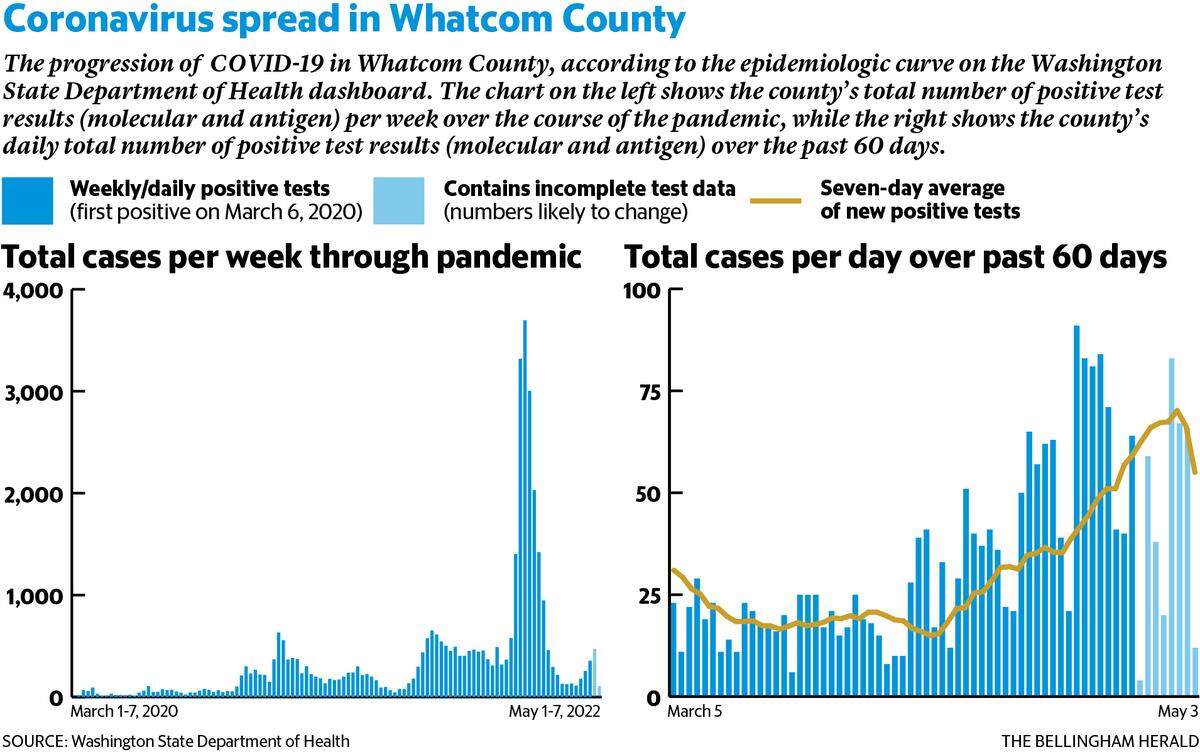
COVID-19 case rates in Whatcom County schools continued to increase the final week of April, but the rate of increase slowed.
Whatcom County’s seven school districts reported a total 252 COVID cases between April 24 and 30. Based on student enrollment, that works out to approximately 11.5 cases per 1,000 students for those six districts, The Herald’s analysis found.
That’s the highest rate county schools have seen since they averaged 12.5 cases per 1,000 students the week of Feb. 6-12, but was only up slightly from the 224 cases (11.2 cases per 1,000 students) reported the week before (April 17-23).
There have been 104 cases reported so far last week (May 1-7), with just the Bellingham and Ferndale school districts reporting, which works out to a rate of 13.9 cases per 1,000 students in those two districts.
Since returning from winter break, the seven districts have reported a total of 4,017 cases, or a weekly rate of approximately 12.2 cases per 1,000 students.
The COVID-19 dashboards on Whatcom County school district websites showed:
▪ Bellingham Public Schools has reported 1,342 total COVID-19 cases in its schools since winter break, or a weekly rate of 14.4 cases per 1,000 students, according to The Herald’s analysis. The district reported 141 cases the week of April 24-30, which was up seven from the week before.
▪ Blaine School District has reported 675 total COVID-19 cases in its schools since winter break, or a weekly rate of 18.2 cases per 1,000 students, according to The Herald’s analysis. The district reported 49 cases the week of April 24-30, which was up four from the week before.
▪ Lynden School District has reported 440 total COVID-19 cases in its schools since winter break, or a weekly rate of 8.1 cases per 1,000 students, according to The Herald’s analysis. The district reported 17 cases the week of April 24-30, which was up one from the week before.
▪ Meridian School District has reported 368 COVID-19 cases in its schools since winter break, or a weekly rate of 12.6 cases per 1,000 students, according to The Herald’s analysis. The district reported four cases the week of April 24-30, which was up three from the week before.
▪ Mount Baker School District has reported 306 COVID-19 cases in its schools since winter break, or a weekly rate of 10.3 cases per 1,000 students, according to The Herald’s analysis. The district reported eight cases the week of April 24-30, which was up eight from the week before.
▪ Nooksack Valley School District has reported 356 cases in its schools since winter break, or a weekly rate of 11.2 cases per 1,000 students, according to The Herald’s analysis. The district reported three cases the week of April 24-30, which was down one from the week before.
▪ Ferndale School District reported Monday May 9, that 20 students or staff had positive COVID-19 tests reported to the Whatcom County Health Department, which was down from the 38 it reported on May 2.