Whatcom sees 290th COVID-related death, but infection, hospitalization rates remain steady
Another Whatcom County resident’s death has been linked to COVID-19, but infection and hospital rates continued to remain steady.
Whatcom has now had 290 COVID-related deaths during the pandemic, the Washington State Department of Health COVID-19 Data Dashboard reported on Wednesday, March 30.
The death reported Wednesday was for a resident who first tested positive for COVID-19 on Feb. 1, The Bellingham Herald’s analysis of the state’s epidemiological data showed, bringing Whatcom’s epidemiological death total for February to 14. There have been 64 COVID-related deaths epidemiologically linked to 2022, so far, including one in March.
With 15,807 total cases (confirmed and probable combined) in the county so far this year, Whatcom has seen 0.5% of cases during that time frame result in death, The Herald’s analysis showed. That is better than the county’s total pandemic average of deaths resulting in 0.8% of cases.
No other information about the person whose death was reported Wednesday, such as their age, gender, vaccination status or hometown, was reported.
Through data reported by the Whatcom County Health Department Thursday, March 24, 87% of the first 281 COVID-related deaths in the county were in residents 60 and older, including 133 deaths in residents 80 and older. The data also shows Whatcom has had one death of a person between 10 and 19, six deaths of people in their 30s and 15 in their 40s.
The county health department has not updated vaccine breakthrough death data since mid-February, but between Aug. 22, 2021, and Feb. 12, approximately 61% of deaths were among the county’s unvaccinated residents.
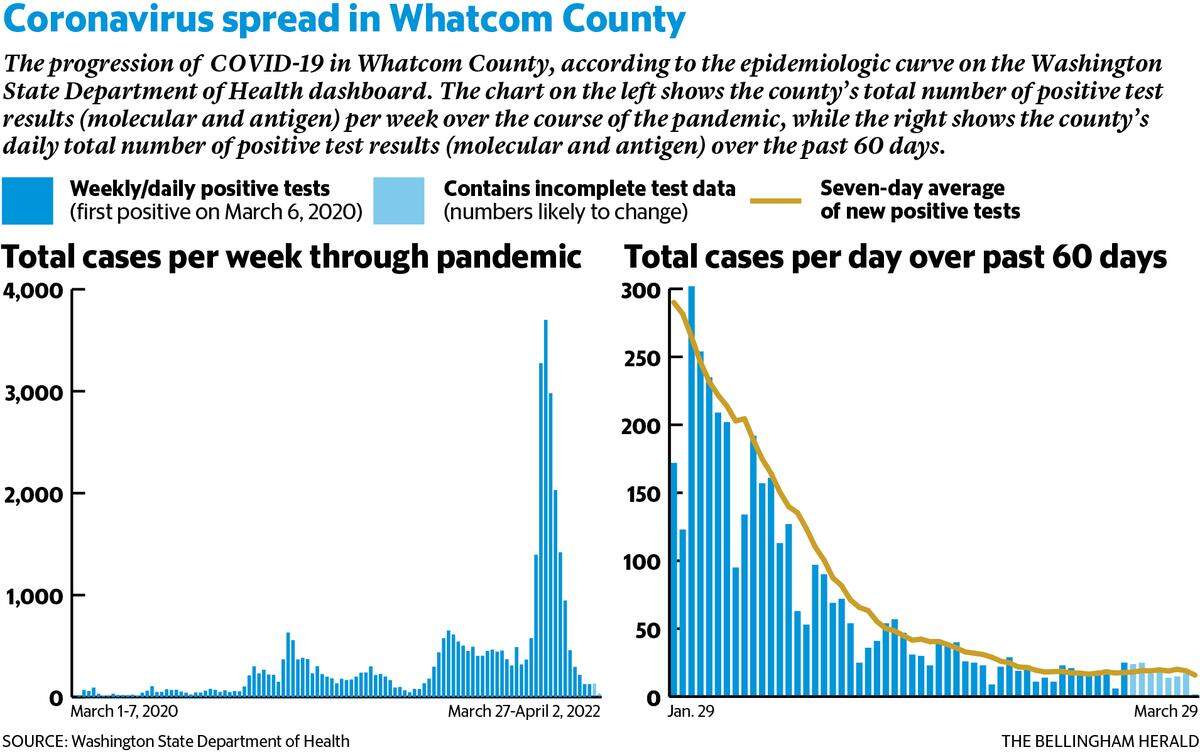
Additional Whatcom COVID data
Whatcom had 41 new COVID-19 cases reported by the state on Wednesday, bringing its pandemic total to 37,191 cases.
St. Joseph hospital in Bellingham reported it was treating seven COVID-related patients Thursday, March 31, which was unchanged from Wednesday’s report. Over the past week, the hospital’s daily snapshot of COVID-related patients is 6.0 per day, which represents 2.4% of the 252 inpatient beds at the hospital and is up from an average of 5.3 patients one week earlier.
The latest report on the state dashboard, which is updated on Monday, Wednesday and Friday evenings, also shows Whatcom has:
▪ 32,664 confirmed cases during the pandemic — up 33 from the last report.
▪ 4,527 additional probable COVID cases during the pandemic — up eight from the last report — resulting from positive antigen tests not confirmed by a molecular test.
▪ A weekly infection rate of 54 cases per 100,000 residents for the most recently completed epidemiological data March 15-21 — down from 57 one week earlier (March 8-14).
▪ 1,519 COVID-related hospitalizations during the pandemic — up one from the last report.
▪ A weekly COVID-related hospitalization rate of 2.2 new patients per 100,000 residents for the most recently completed epidemiological data March 15-21 — down from 4.4 from a week earlier (March 8-14).
▪ A weekly total of 5,830 tests (molecular and antigen combined) during the most recently completed epidemiological data March 14-20, with 2.1% of the tests returning a positive result. A week earlier (March 7-13) the state reported 5,784 tests completed and 2.2% returning positive results. The state’s data does not include at-home rapid tests that were not reported.
▪ 371,237 vaccinations administered during the pandemic — up 186 from the last report. The state reports 74.8% of Whatcom County’s total population has initiated vaccination and 68.4% has completed it.
▪ 87,501 booster vaccine doses administered, meaning 61.0% of Whatcom’s residents eligible to receive a booster have done so.
▪ 844 confirmed omicron variant cases and 2,095 confirmed delta variant cases, according to the weekly SARS-CoV-2 Sequencing and Variants in Washington State released Wednesday. That was a decrease of one omicron case and an unchanged delta count since last week’s report, though with just 8.9% of all confirmed COVID cases in the state sequenced during the month of February, those numbers are likely much higher. The report provided no data concerning the omicron subvariant (BA.2).