Whatcom maintains ‘low’ COVID ranking from CDC, as one region’s infection rate drops to 6
Whatcom County received its third consecutive “low” COVID-19 community level ranking from the CDC, and the county’s latest regional data showed only one of Whatcom’s seven school district regions would fail to have a “low” ranking — and it just barely missed.
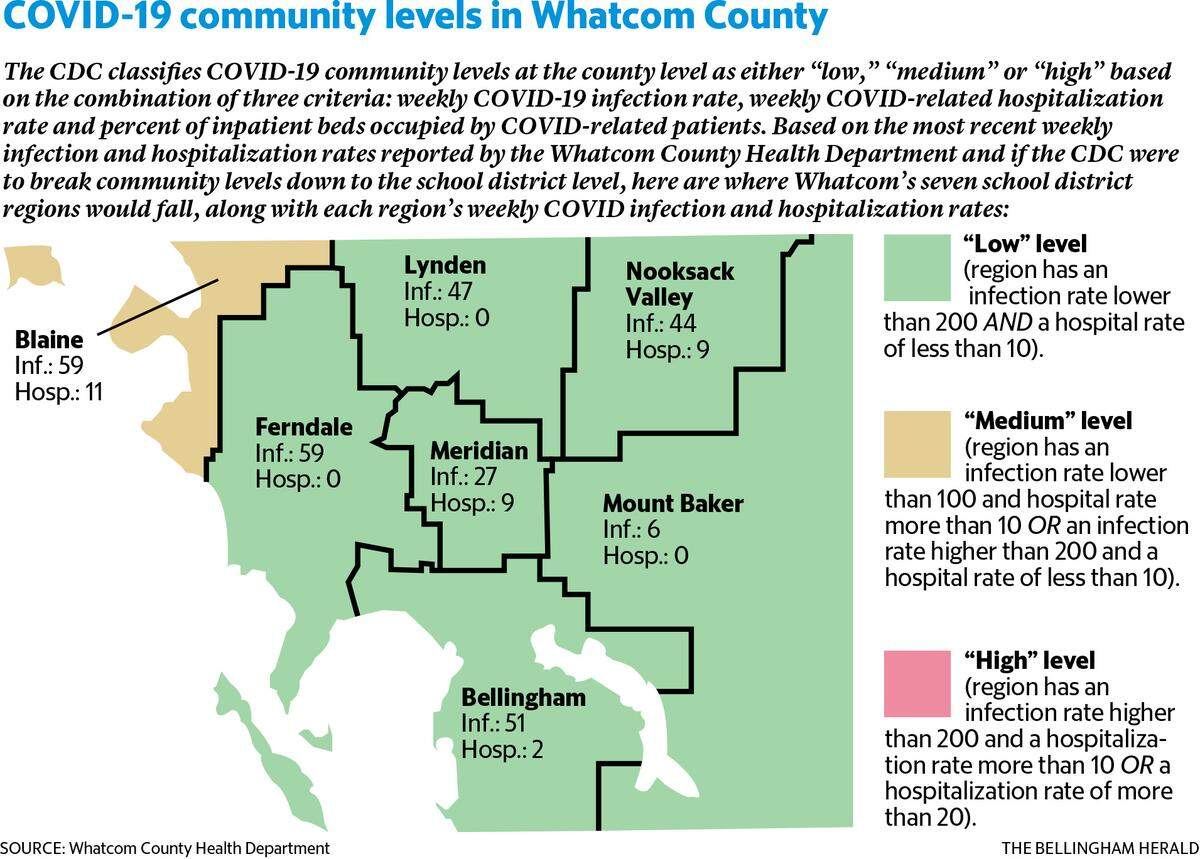
The region covered by the Blaine School District would not have received the CDC’s best grade if community data were broken down to that level, The Bellingham Herald’s analysis of the latest location data released by the Whatcom County Health Department showed, as it missed the COVID-related hospitalization threshold by just one patient last week.
To be classified in the “low” level by the CDC, counties must have:
▪ Fewer than 200 new cases per 100,000 residents in the past seven days.
▪ Fewer than 10 new COVID-related hospitalizations per 100,000 residents in the past seven days.
▪ Less than 10% of staffed inpatient beds occupied by COVID-19 patients.
At the “medium” level, the CDC recommends those who are at high risk of serious complications from COVID and those who could expose those at high risk to wear masks. Masking for all people in most indoor situations is not included among the CDC’s recommended guidelines for communities in the “low” level.
At every level, the CDC says people “can wear a mask based on personal preference” and should wear a mask if they have COVID symptoms, test positive or have possible exposure.
Washington state ended its mandate to wear masks in most public indoor areas, including schools, on Saturday, March 12.
The CDC analyzed data March 10-16 for its latest community levels. The Washington State Department of Health COVID-19 Data Dashboard showed Whatcom had a weekly infection rate of 80 new cases per 100,000 residents and a weekly infection rate of 7.0 new patients per 100,000 residents for the most recently completed epidemiological data March 1-7.
St. Joseph’s hospital in Bellingham reported it was treating three COVID-related patients on Friday, which was down one from its last report and gave it an average daily snapshot of 4.4 patients over the past week, which represents 1.7% of the hospital’s 252 inpatient beds, meaning the county, as a whole, is well below all three thresholds used by the CDC to determine COVID community levels.
All 39 counties in Washington state were classified in the “low” community level by the CDC in its latest updated Thursday, March 17.
Weekly regional data
The weekly COVID-19 infection rate in the Mount Baker region dropped into single digits, according to data released Thursday by the Whatcom County Health Department. It’s now the lowest rate any region within Whatcom County has seen since the Meridian region had a rate of zero Oct. 25-31, 2020.
In all of 2021, a single-digit infection rate was seen only twice, when the Meridian (June 20-26) and Nooksack Valley (July 11-17) areas had weekly rates of nine new cases per 100,000 residents.
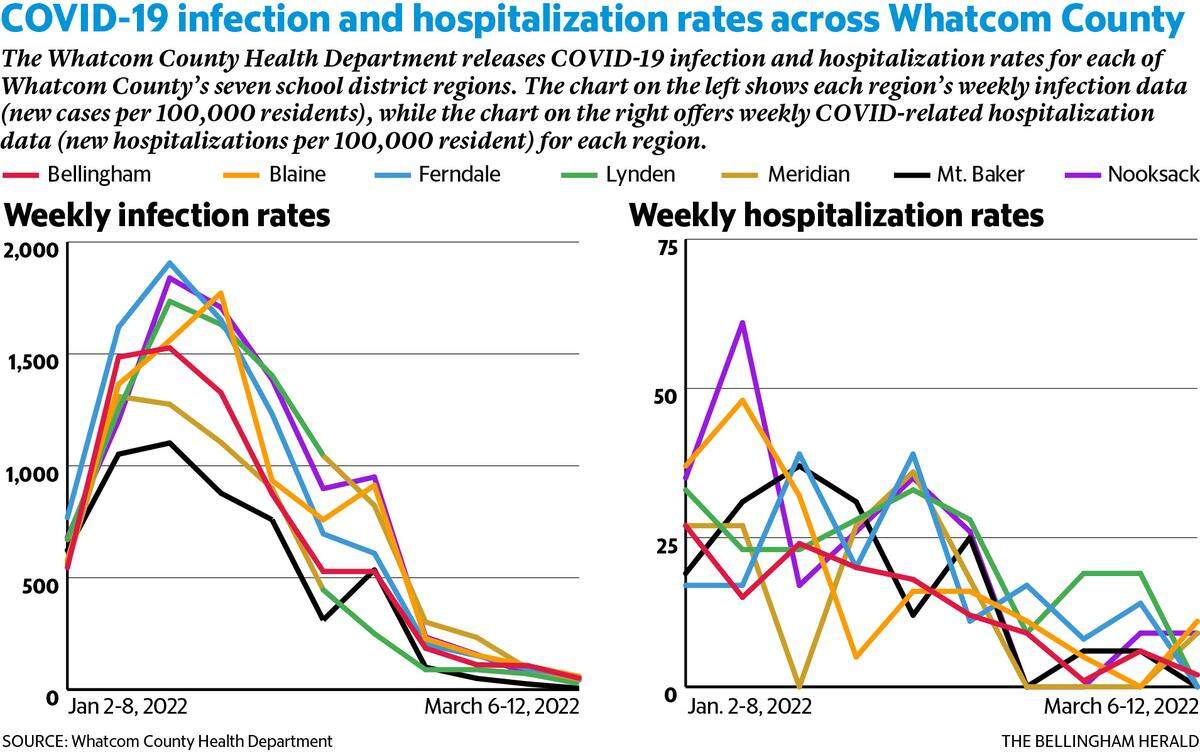
All seven regions saw their weekly COVID infection rates continue to drop significantly last week, as all now have rates lower than 100, the county’s data showed.
Case rates weren’t the only numbers dropping, though, as hospitalization rates decreased in four of the seven regions and remained unchanged in a fifth.
The county health department releases weekly data on the location of COVID-19 cases using school districts as geographical boundaries, including each region’s number of total cases during the pandemic, infection rate, hospitalization rate, percentage of residents who have initiated vaccination and a breakdown of case rates by age. Data in this week’s report was through Saturday, March 12.
Overall, Whatcom County saw its pandemic total of cases increase by 140 between March 6 and March 12, which was less than the 260 cases reported one week earlier.
Here is what the health department’s latest data showed for the seven regions in the county:
▪ Bellingham: Had a weekly infection rate of 51 cases per 100,000 residents (down from 107 a week earlier) with 71 new cases reported. The region’s hospitalization rate dropped to two COVID-related hospitalization per 100,000 residents, and 83% of the region’s residents have initiated vaccination.
▪ Blaine: Had a weekly infection rate of 59 cases per 100,000 residents (down from 106 a week earlier) with 12 new cases reported. The region’s hospitalization rate climbed to 11 COVID-related hospitalizations per 100,000 residents, and 76% of the region’s residents have initiated vaccination.
▪ Ferndale: Had a weekly infection rate of 59 cases per 100,000 residents (down from 93 a week earlier) with 26 new cases reported. The region’s hospitalization rate dropped to no COVID-related hospitalizations per 100,000 residents, and 72% of the region’s residents have initiated vaccination.
▪ Lynden: Had a weekly infection rate of 47 cases per 100,000 residents (down from 93 a week earlier) with 12 new cases reported. The region’s hospitalization rate stayed dropped to no COVID-related hospitalizations per 100,000 residents, and 59% of the region’s residents have initiated vaccination.
▪ Meridian: Had a weekly infection rate of 27 cases per 100,000 residents (down from 71 a week earlier) with eight new cases reported. The region’s hospitalization rate climbed to nine COVID-related hospitalizations per 100,000 residents, and 68% of the region’s residents have initiated vaccination.
▪ Mount Baker: Had a weekly infection rate of six cases per 100,000 residents (down from 25 a week earlier) with two new cases reported. The region’s hospitalization rate dropped to no COVID-related hospitalizations per 100,000 residents, and 50% of the region’s residents have initiated vaccination.
▪ Nooksack Valley: Had a weekly infection rate of 44 cases per 100,000 residents (down from 70 a week earlier) with nine new cases reported. The region’s hospitalization rate stayed at nine COVID-related hospitalizations per 100,000 residents, and 56% of the region’s residents have initiated vaccination.
This story was originally published March 19, 2022 at 5:00 AM.