Four new COVID-related deaths reported in Whatcom, as county sees 532 more cases Wednesday
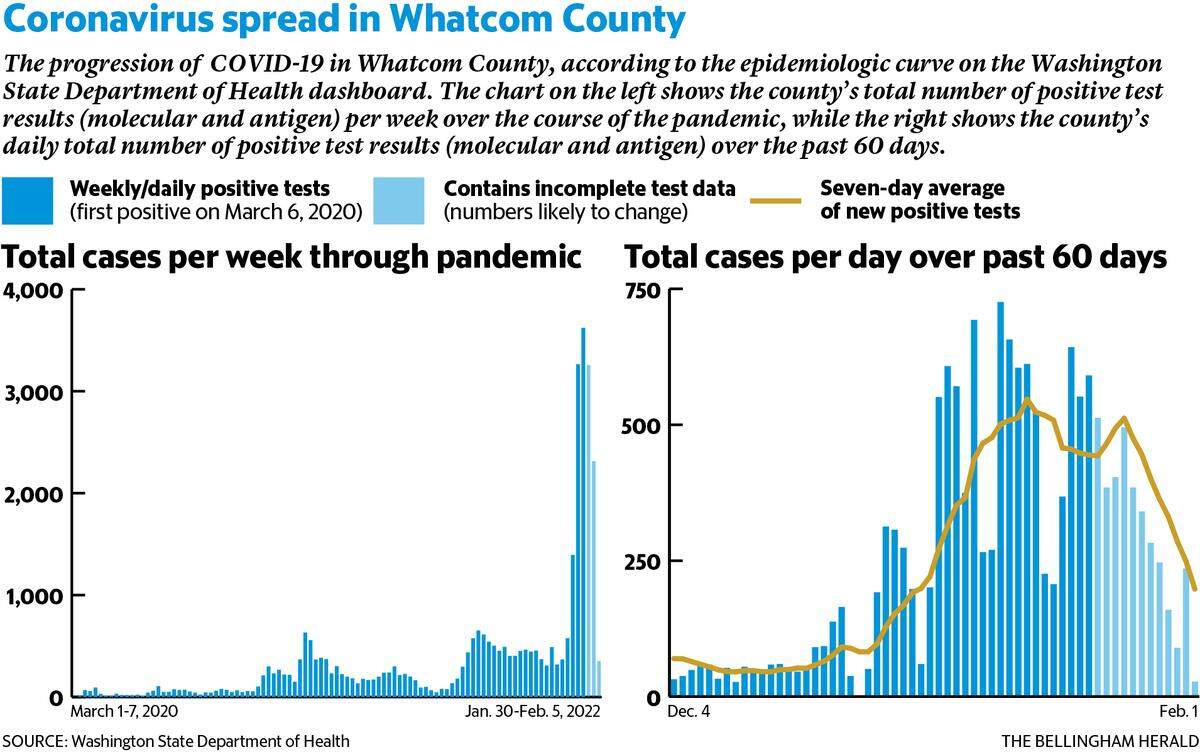
Four more Whatcom County residents’ deaths have been linked to COVID-19, the state reported Wednesday, as the county’s pandemic total of coronavirus cases grew by 532.
The deaths reported Wednesday, Feb. 2, brought the county’s pandemic total to 238, including 37 deaths that have been reported so far in 2022, according to the Washington State Department COVID-19 Data Dashboard. The county also has a pandemic total of 34,259 total cases (confirmed and probable combined).
The most recently reported deaths were for people who first tested positive for COVID Dec. 14, Dec. 20, Jan. 13 and Jan. 23, The Herald’s analysis of the state’s epidemiological data showed. Whatcom has now had 17 deaths epidemiologically linked to January and 27 deaths linked to December, making that month Whatcom’s deadliest of the pandemic (the previous high was 26 epidemiologically linked to March 2020).
Since Dec. 19, which is approximately when Whatcom County began to see large increases due to the omicron surge, there have been 26 epidemiological deaths, The Herald found.
With 12,231 total cases (confirmed and probable combined) in the county since Dec. 19 Whatcom has seen 0.2% of cases during that time frame result in death, The Herald’s analysis showed. That is better than the county’s total pandemic death average of 0.7%.
No other information about the people whose deaths were reported Wednesday, such as their age, gender, vaccination status or hometown, was reported.
Through data reported by the Whatcom County Health Department Jan. 27, 87% of the first 230 COVID-related deaths in the county were in residents 60 and older, including 111 deaths in residents 80 and older. Though the county has not seen any deaths of people younger than 30, the data shows, the deaths of five residents in their 30s and 13 residents in their 40s have been linked to COVID-19.
As of the Whatcom County Health Department’s latest COVID-19 Data Report released Friday, Jan. 28, 64% of Whatcom County’s 86 COVID-related deaths reported since Aug. 22, were in unvaccinated or partially vaccinated residents, The Herald’s analysis shows, including 68% of deaths reported since Dec. 19.
Other Whatcom numbers
The latest report on the state dashboard, which is now only updated on Monday, Wednesday and Friday evenings, also shows Whatcom County has:
▪ 30,128 confirmed cases during the pandemic — up 403 from the last report.
▪ 4,131 additional probable COVID cases during the pandemic — up 129 from the last report — resulting from positive antigen tests not confirmed by a molecular test.
▪ A weekly infection rate of 1,365 cases per 100,000 residents for the most recently completed epidemiological data Jan. 14-20 — down from 1,679 one week earlier (Jan. 7-13).
▪ 1,299 COVID-related hospitalizations during the pandemic — up 16 from the last report.
▪ St. Joseph hospital in Bellingham reported it was treating 48 patients with COVID-related symptoms on Wednesday, Feb. 3, which was up three from its last report.
▪ A weekly COVID-related hospitalization rate of 25.0 patients per 100,000 residents for the most recently completed epidemiological hospitalization data from Jan. 14-20 — down from 29.4 from a week earlier (Jan. 7-13).
▪ 348,103 total tests (molecular and antigen combined). The state reported that an “unexpected delay” has once again pushed back the resumption of its reporting of testing data until approximately Feb. 28.
▪ 359,300 vaccinations administered during the pandemic — up 740 from the last report. The state reports 73.6% of Whatcom County’s total population has initiated vaccination and 67.0% has completed it. The state also reports Whatcom has administered 79,407 “additional doses,” which includes third doses for immunocompromised residents and booster doses, have been administered.
Additionally, the U.S. Centers for Disease Control and Prevention Data Tracker Thursday listed Whatcom’s level of transmission as “High” — the highest of four categories. All of the 39 counties in Washington state and all but five counties nationwide also were listed in the “High” transmission category.
Whatcom variant report
Omicron accounted for nine of Whatcom County’s 11 new confirmed variant cases reported in the Department of Health’s latest SARA-CoV-2 Sequencing and Variants in Washington State report released Wednesday.
Whatcom County has now seen 296 confirmed omicron cases, according to the report, but the Whatcom County Health Department has previously said it expects almost all cases currently being seen in the county are omicron.
Two new confirmed delta variant cases also were reported in Whatcom in the past week, according to the report, leaving Whatcom’s total at 2,076.
Whatcom County has at least one case of seven of the eight “variants being monitored” by the state. But beyond the delta, omicron, alpha (476 total cases) and gamma (255 total cases), Whatcom has seen fewer than 50 cases of every other variant.
Whatcom’s 3,175 total variant cases represent 14% of the 23,291 confirmed cases in the county since the first variant was reported Feb. 23, 2021.
Statewide, the report said that 1% of all confirmed molecular COVID-19 cases were sequenced during the month of January and 67,292 specimens (7% of all confirmed cases) have been sequenced since January 2021, meaning variant counts are likely much higher.
The Department of Health found there have been 11,123 vaccine “breakthrough” cases involving the delta variant, which represents 30% of the 36,634 confirmed delta variant cases in the state. There have been 3,780 omicron “breakthrough” cases, which represents 47% of the 8,111 confirmed cases in the state.
Also, the state reported that 4.1% of confirmed delta and 0.8% of confirmed omicron cases have resulted in hospitalization, while 1.2% of delta cases and 0.2% of omicron cases have resulted in death.
Whatcom schools COVID update
The COVID-19 dashboards on Whatcom County school district websites showed:
▪ Bellingham Public Schools has reported 651 COVID-19 cases in its schools since winter break and did not list any new cases Wednesday.
▪ Blaine School District reported 363 total COVID-19 cases in its schools since winter break, including 36 new cases with a possible exposure window of Jan. 24-30: nine cases at Blaine Primary, seven cases at Blaine Elementary, seven cases at Blaine Middle School, 11 cases at Blaine High and two cases among district staff.
▪ Lynden School District reported 280 total COVID-19 cases in its schools since winter break, including 74 new cases with a possible exposure window of Jan. 24-28: 12 cases at Bernice Vossbeck Elementary, 13 cases at Fisher Elementary, 14 cases at Isom Elementary, one case at Lynden Academy, 15 cases at Lynden Middle School, 15 cases at Lynden High and four cases at the preschool.
▪ Meridian School District reported 256 COVID-19 cases in its schools since winter break and listed no new cases since Jan. 28.
▪ Mount Baker School District reported 223 COVID-19 cases in its schools since winter break, including 68 new cases listed Wednesday. Two cases had a possible exposure window of Jan. 15-21: one new case at Kendall Elementary (18 total cases with the same exposure window) and one new case at the preschool (two total cases). The other 66 cases had a possible exposure window of Jan. 22-28: four cases at Acme Elementary, 19 cases Harmony Elementary, 17 cases at Kendall Elementary, nine cases at Mount Baker Junior High, 10 cases at Mount Baker High, four cases at the preschool and three cases among district staff.
▪ Nooksack Valley School District reported 247 COVID-19 cases since returning from winter break, including 79 new cases with a possible exposure window of Jan. 23-29: 19 cases at Nooksack High, 15 cases at Nooksack Middle School, eight cases at Nooksack Elementary, 16 cases at Everson Elementary and 21 cases at Sumas Elementary.
▪ Ferndale School District reported that as of Wednesday, 71 students or staff had a positive test reported to the Whatcom County Health Department in the past seven days — up two from the last report. Twenty-seven of those people were on a school campus during their infectious period.