Bellingham school district received a third of COVID tests it needed from state last week
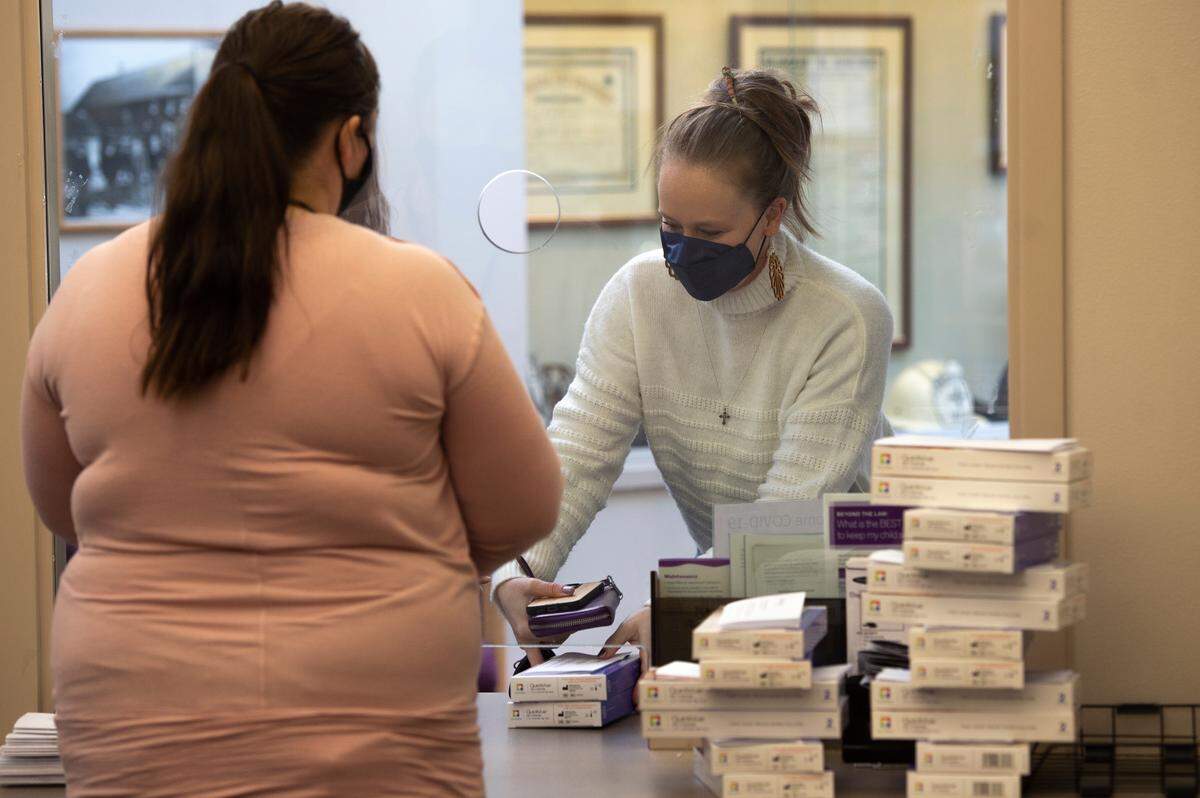
Bellingham Public Schools reported it received less than a third of the total number of COVID-19 tests from the Washington State Department of Health that it needed to continue providing testing to students and staff at the level it had been.
Last week, the school district reported it would be forced to make changes to the way it prioritizes utilizing tests due to an expected shortage of tests being provided to school districts across the state.
“Unfortunately, the state Department of Health has notified us that there are insufficient COVID-19 tests for schools across the state, and this shortage is expected to impact all schools over the next 2-3 weeks,” an email sent by Bellingham Public Schools Tuesday, Jan. 25, to families stated. “We are disappointed with this news, which comes at a challenging time with the Omicron surge and new government programs for free at-home tests.”
Last week, Bellingham Public Schools received approximately 3,200 tests from the state, district spokesperson Dana Smith told The Bellingham Herald in an email.
That was less than a third of the 10,000 tests the district had been using per week in January to test students, staff and for athletic events, Smith told The Herald. Smith added that the district had some testing supplies in reserve, but “but they will likely be used this week as well.”
Smith said the shortage is at least in part because the state is adjusting the way it is distributing tests to help streamline the supply chain and ensure equitable distribution to all school districts, rather than having each district make orders for tests.
“It has been our privilege to support community testing efforts and are discouraged to have to prioritize our testing,” Smith wrote. “We are committed to the required testing to keep our kids in school, connected and learning, and we look forward to widening that testing again once DOH gets more supply.”
Whatcom’s vaccine breakthrough data
COVID-19 case rates dropped among Whatcom County’s vaccinated and unvaccinated populations, according to data released by the Whatcom County Health Department.
A little more than two-thirds of Whatcom County’s 2,974 total COVID-19 cases reported between Jan. 16 and Jan. 22 (2,005 cases) were among people who were unvaccinated or partially vaccinated, according to the Whatcom County Health Department’s latest COVID-19 Data Report released Friday, Jan. 28.
Based on the 146,552 residents in the county who would have been fully vaccinated by Jan. 16, according to previous reports on the state dashboard, that leaves approximately 82,148 residents who were not fully vaccinated by that date, The Bellingham Herald’s analysis found. That means that the infection rate for Whatcom’s unvaccinated or partially vaccinated is 2,441 cases per 100,000 residents, which is down from the rate of 2,924 per 100,000 residents one week earlier (Jan. 9-15).
For comparison, the health department reported 969 COVID cases among fully vaccinated residents in the county between Jan. 16 and Jan. 22. That works out to an infection rate of 661 cases per 100,000 residents, The Herald’s analysis found, which is down from 719 cases per 100,000 residents one week earlier (Jan. 9-16).
The health department also reported that four of the six COVID-related deaths reported between Jan. 16 and Jan. 22, were in unvaccinated or partially vaccinated residents. Among the deaths that week were:
▪ Two unvaccinated women in their 70s.
▪ One unvaccinated woman in her 80s.
▪ One unvaccinated woman in her 90s.
▪ One vaccinated woman in her 70s.
▪ One vaccinated man in his 70s.
Throughout the pandemic, 20% of Whatcom County’s first 231 COVID-related deaths (47 deaths) were in fully vaccinated residents.
Two-thirds of Whatcom’s COVID-related hospitalizations during the week of Jan. 16-22 also were among the county’s unvaccinated or partially vaccinated residents, with 34 of 51 among those not fully vaccinated, the health department reported.
In the five weeks since Dec. 19, which is when Whatcom began to experience its omicron surge in cases, 67% of COVID-19 cases (7,722 of 11,560 total cases), 74% of COVID-related hospitalizations (146 of 197 hospitalizations) and 68% of COVID-related deaths (23 of 34 deaths) have been in unvaccinated or partially vaccinated residents, The Herald’s analysis of the county’s data showed.
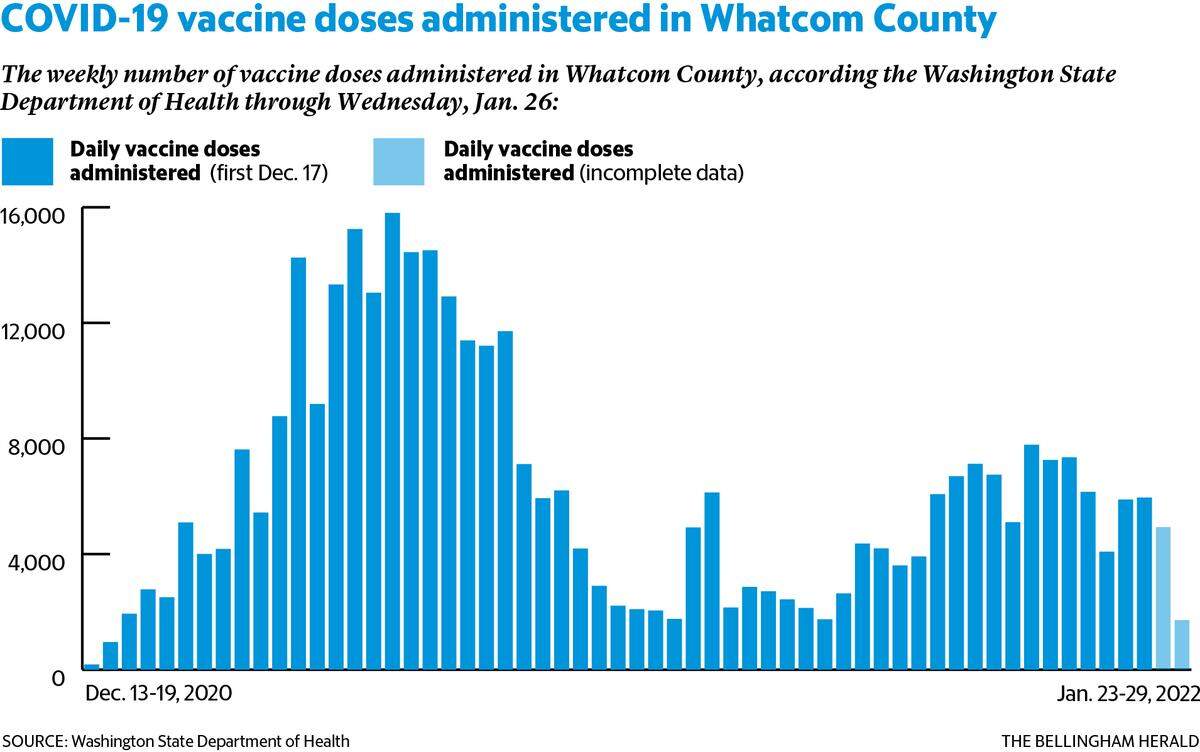
As of Friday, the state reported that 355,924 vaccinations have been administered in Whatcom County — an increase of 5,054 reported doses last week — and that 73.3% of Whatcom’s total population had initiated vaccination and 66.7% has completed it. The state also reported 76,715 additional doses, which include extra doses administered to immunocompromised residents and booster shots, have been administered in the county.
According to the CDC, people are considered fully vaccinated two weeks after receiving their second dose of the Pfizer or Moderna vaccines or their single-dose Johnson & Johnson vaccine.
More Whatcom numbers
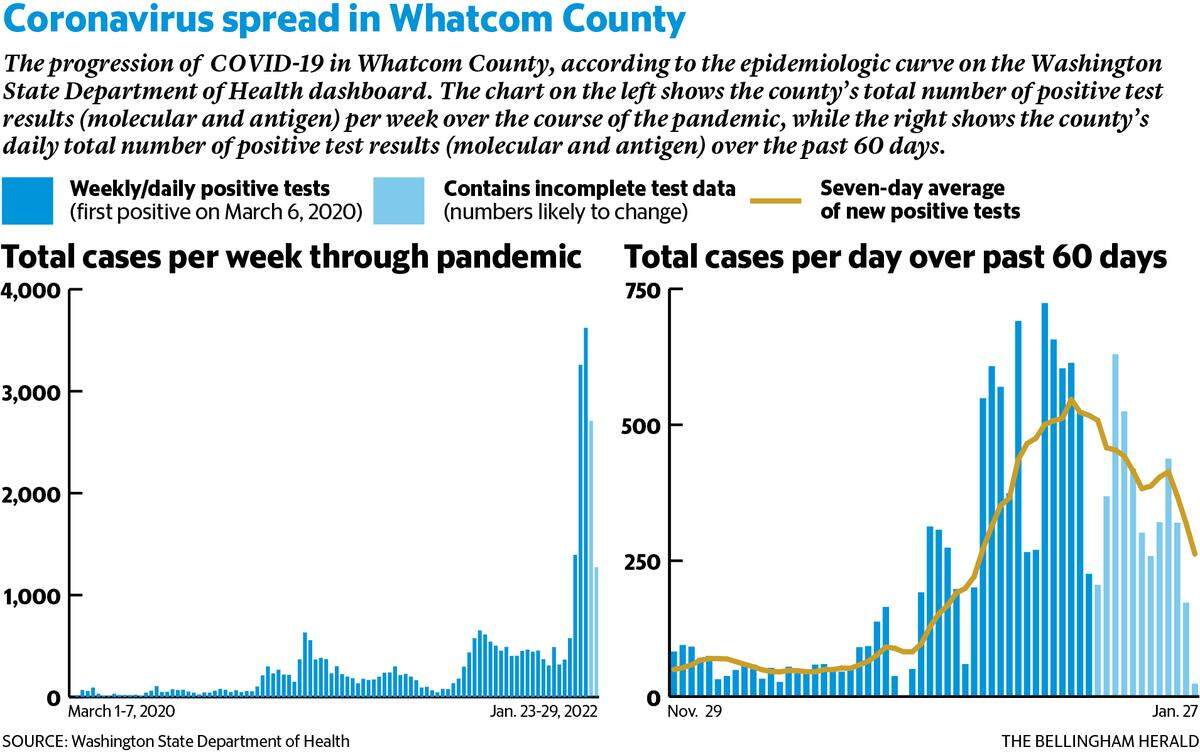
Whatcom County saw an increase in reported cases last week, as it had 2,727 confirmed cases reported by the Washington State Department of Health’s COVID-19 Data Dashboard between Jan. 23 and Jan. 29. That was up from 2,460 confirmed cases reported in the county one week earlier (Jan. 16-22).
With 717 new confirmed cases reported by the state on Friday, Whatcom County now has a pandemic total of 28,554 confirmed cases.
Other weekly Whatcom County COVID based on data released Friday on the state dashboard shows that:
▪ With an additional 188 probable cases reported Friday, Whatcom had 671 reported last week resulting from a positive antigen test not confirmed by a molecular test. That was up from 603 the week before and brought the county’s pandemic total to 3,759.
▪ Whatcom’s weekly infection rate stands at 1,589 cases per 100,000 residents based on the state’s most recently completed data from Jan. 9-15, which is up from 1,429 the week before (Jan. 2-8). Whatcom currently has the 12th-highest weekly infection rate of the 39 counties in the state, according to the state dashboard.
▪ With 40 COVID-related hospitalizations reported Friday, Whatcom has seen 1,263 hospitalizations reported during the pandemic. The county had 71 hospitalizations reported last week, which was up from 52 the week before.
▪ Whatcom’s weekly hospitalization rate stands at 24.1 COVID-related hospitalizations per 100,000 residents for the most recently completed data Jan. 9-15, which is up from 23.3 the week before (Jan. 2-8). Whatcom currently has the 17th-highest weekly hospitalization rate of the 39 counties in the state, according to the state dashboard.
▪ St. Joseph hospital in Bellingham reported that it was treating 58 patients for COVID-related symptoms on Monday, Jan. 31, which was up four from the 54 it was treating Sunday, Jan. 30, but down from the 60 it reported Saturday, Jan. 29.
▪ The state is still working “to increase its capacity to process the increased testing data volume received in the last few months” by Feb. 28.
▪ The statewide Effective Reproductive Number (R-effective) shows that each person who tests positive for COVID-19 is estimated to infect 1.46 others as of Jan. 6, which is up from 1.34 on Jan. 1. Anything above 1.0 means that transmission of the disease is increasing.
The CDC’s COVID Data Tracker on Monday continued to list the level of transmission in Whatcom County as “High” (the highest of four classifications). All of Washington state’s 39 counties and all but six counties nationwide are listed in the “High” category.
Whatcom schools COVID update
The Herald’s analysis of data published by the Bellingham, Blaine, Lynden, Meridian, Mount Baker and Nooksack Valley school districts, shows there have been 1,507 total cases reported in those districts since they returned from winter break. For comparison, those districts reported 902 total cases during the fall.
During the week of Jan. 16 to Jan. 22, those six districts combined to report 700 cases, which was up from the 589 reported a week earlier.
The Herald’s data analysis shows there have been a total of 642 cases reported in elementary schools (57.1 cases per 1,000 students), 361 cases reported in middle/junior high schools (68.6 cases per 1,000 students) and 504 cases reported in high schools (70.3 cases per 1,000 students) so far this school year. Another 149 cases have been reported in other district programs or facilities.
The Ferndale School District does not report data in a way where total case counts can be calculated.
The COVID-19 dashboards on Whatcom County school district websites showed:
▪ Bellingham Public Schools has reported 608 total COVID-19 cases in its schools since winter break, or approximately 50.4 cases per 1,000 students, according to The Herald’s analysis. The district reported 194 cases the week of Jan. 16 to 22, or approximately 16.1 cases per 1,000 students.
▪ Blaine School District has reported 327 total COVID-19 cases in its schools since winter break, or approximately 140.8 cases per 1,000 students, according to The Herald’s analysis. The district reported 145 cases the week of Jan. 16 to 22, or approximately 62.4 cases per 1,000 students.
▪ Lynden School District has reported 206 total COVID-19 cases in its schools since winter break, or approximately 56.8 cases per 1,000 students, according to The Herald’s analysis. The district reported 110 cases the week of Jan. 16 to 22, or approximately 40.0 cases per 1,000 students.
▪ Meridian School District has reported 196 COVID-19 cases in its schools since winter break, or approximately 107.3 cases per 1,000 students, according to The Herald’s analysis. The district reported 90 cases the week of Jan. 16 to 22, or approximately 49.2 cases per 1,000 students.
▪ Mount Baker School District has reported 151 COVID-19 cases in its schools since winter break, or approximately 81.3 cases per 1,000 students, according to The Herald’s analysis. The district reported 72 cases the week of Jan. 16 to 22, or approximately 38.8 cases per 1,000 students.
▪ Nooksack Valley School District has reported 168 cases in its schools since winter break, or approximately 84.7 cases per 1,000 students, according to The Herald’s analysis. The district reported 89 cases the week of Jan. 16 to 22, or approximately 49.9 cases per 1,000 students.
▪ Ferndale School District reports that as of Monday, 57 students or staff have had a positive test reported to the Whatcom County Health Department in the past seven days, down from 109 in the previous report. Of those, 36 people were on a school campus during their infectious period.