Magnitude of Whatcom’s COVID testing demand ‘far beyond anything we have ever seen before’
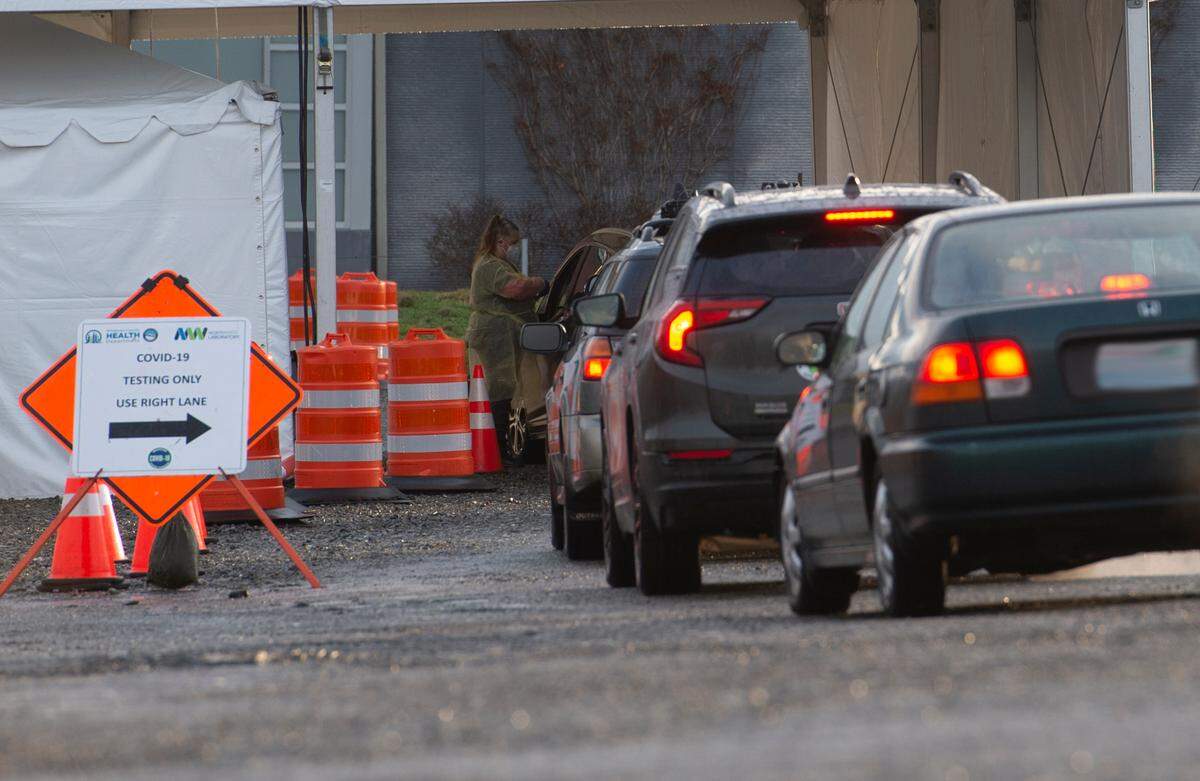
Whatcom County COVID-19 testing sites have been unable to keep up with growing community demand as the omicron variant continues to drive record case numbers.
“Our systems are stretched throughout. … Testing is very challenging right now,” Whatcom County Health Director Erika Lautenbach said during an online briefing Tuesday, Jan. 11.
Just how great Whatcom County’s testing demand is isn’t exactly known.
The Washington State Department of Health’s COVID-19 Data Dashboard hasn’t updated testing data since Sept. 15, when it paused those metrics in an effort to increase its ability to process data. A series of “unexpected delays” have delayed when the state plans to resume reporting testing data multiple times, and it now is expected to return approximately Feb. 28.
But if Whatcom County’s 2,978 molecular and antigen tests that came back positive during the first 10 days of 2022 are any indication — already more than any other month of the pandemic — it’s safe to say demand is higher than it’s ever been.
“If you think about 400 people testing positive, there are that and many more who have tested negative each day, and there is just an incredible demand for testing given how prevalent this has become in our community,” Lautenbach said. “We are working with our partners to try to increase capacity, but truly when you see that line (of daily new cases in Whatcom County), that shows just incredible growth. We don’t have exponential resources.”
The Bellingham Herald checked testing availability at the community testing center at Bellingham International Airport, which is operated jointly by the Whatcom County Health Department and Northwest Laboratory, through scheduling website testdirectly.com at noon on Wednesday, Jan. 12, and found no available testing slots until the afternoon of Jan. 20, even with preferences adjusted to include both COVID-related symptoms and close exposure to someone with COVID-19.
The health department has asked residents who are symptomatic and/or believe they’ve been exposed to COVID-19 to call them if they are unable to make appointments to get tested and they may be able to get them in quicker.
“We only know what is coming to us,” Lautenbach said. “Our call volume to the health department is extremely high for people who are symptomatic or have an exposure and want to get tested. At this point, we are about four days out for general-purpose testing, where people can register themselves, and we’re able to get folks who are symptomatic or have a close exposure in earlier than that, but it still can be days.
‘It’s not the swabs’
The reason, Lautenbach said, is simply there are not enough trained healthcare workers available or hours in a day required to swab the number of residents seeking to be tested.
“It’s not the swabs. It’s not the lab capacity,” Lautenbach said. “It’s been staffing and truly just the magnitude of the need is so far beyond anything we have ever seen before that to be able to ramp up effectively would take a bit of time.”
Whatcom County’s health care providers are “doing all they can to enhance testing,” Whatcom County Co-Health Officer Dr. Amy Harley said during Tuesday’s briefing, adding that community clinics, family clinics and the county’s Tribal health partners have helped out by testing their patients and others in the community.
But the recent demand has simply been too great.
Lautenbach acknowledged that Whatcom’s lack of testing availability is putting “incredible strain” on businesses and schools in the area that can’t get employees or students tested if they become symptomatic or are possibly exposed. While they await testing, employers and schools need to treat those people like they have COVID to prevent further possible transmission.
“The sooner we can ramp up testing additionally, the better for our community, but we’re just not able to keep up with the demand at this point,” Lautenbach said.
Alleviating testing burden
The good news is help is hopefully on the way in the form more over-the-counter testing products expected to come from the state and federal sources, as well as other partners, Lautenbach said.
“There is some movement on expansion of home testing,” Harley said. “The Department of Health has increasing amounts of tests to distribute, which they will be distributing through the local health jurisdictions and also through the schools. So we expect an infusion of the rapid antigen tests through the health department and through the schools in the next week to two.
“Additionally, as you are probably aware, there is a direct-to-consumer portal that is being developed — a website where people can go and request an at-home test to be sent directly to their homes from the state. Those are some options that we hope will alleviate some of the testing burden.”
But even when those arrive in Whatcom County, Lautenbach said there “will not be enough to distribute to everyone in Whatcom County.”
Instead, the health department will once again need to decide who is most in need, Lautenbach said, including those living in congregant communities, homeless shelters and other areas that place them at high risk to contract COVID. Lautenbach said the next priorities will be childcare providers and schools and service industries, where employees are forced to report to work and are in direct contact with others, making them more susceptible to infection.
“We’re really trying to think about how to best utilize the scarce resources in a way that we can prevent infection as best as we can,” Lautenbach said.
This story was originally published January 13, 2022 at 5:00 AM.