Whatcom’s record COVID rate continues, WWU extends online, Bellingham schools update rules
Whatcom County continued to post COVID-19 numbers at unprecedented rates, as the county saw its first quadruple-digit increase in confirmed cases and three more COVID-related deaths reported by the state Monday.
Whatcom County had 1,134 new confirmed COVID-19 cases reported over the weekend by the Washington State Department of Health COVID-19 Data Dashboard on Monday, Jan. 10, upping its pandemic total to 21,889 cases.
The three-day increase is the largest reported for Whatcom during the pandemic, eclipsing the 947 confirmed cases that were reported one week earlier for the four-day New Year’s holiday weekend.
An additional 76 new probable cases were reported for Whatcom on Monday, resulting from a positive antigen test not confirmed by a molecular test, upping the county’s pandemic total to 2,017 cases.
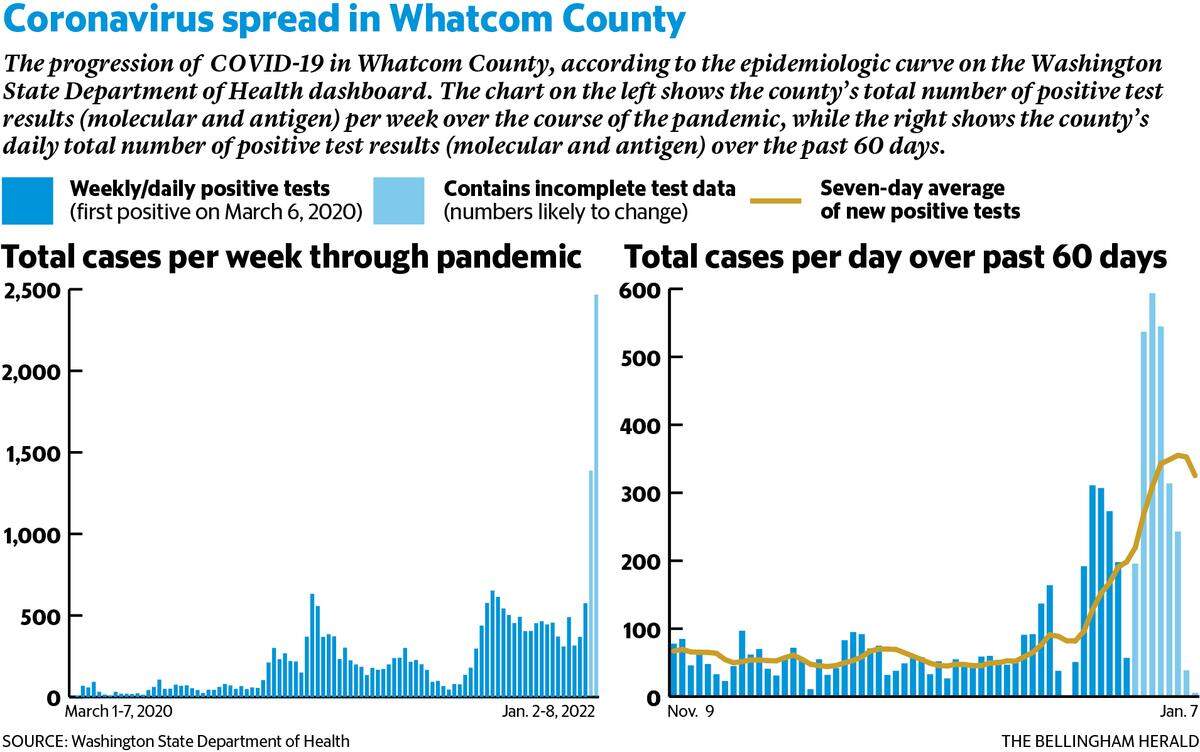
Epidemiologically speaking, the county saw its three highest number of positive test results on Jan. 3-5, when the total number of cases (confirmed and probable combined) topped 500 per day. Before that stretch, Whatcom had not seen any days with more than 311 positive tests, which came on Dec. 28.
Though data remains incomplete between Jan. 2 and Jan. 9 and case numbers are likely to rise, 2,170 people have tested positive for COVID-19 (molecular and antigen tests combined) since the first of the year so far, meaning that one in every 106 Whatcom County residents has tested positive during the first nine days in 2022, The Bellingham Herald’s analysis found.
Whatcom County’s weekly infection rate is at a record-high 609 cases per 100,000 residents based on the most recently completed data from Dec. 26 through Jan. 1, according to the state dashboard, up from 252 from one week earlier (Dec. 19-25).
Whatcom’s most recent deaths
The three deaths reported by the state Monday brought the county’s pandemic total to 211, including 26 reported in the past 22 days.
The deaths reported Monday were for people who first tested positive for COVID-19 on Dec. 13, Dec. 19 and Jan. 1, The Bellingham Herald’s analysis of the state’s epidemiological data found, bringing the county’s epidemiological death total for December to 19 and marking the first epidemiological death of 2022.
Since Aug. 1, the beginning of the delta surge, there have been 98 epidemiological deaths, The Herald found, which is 47% of the county’s pandemic total.
With 13,493 total cases (confirmed and probable combined) in the county since Aug. 1, Whatcom has seen 0.7% of cases during that time frame result in death, The Herald’s analysis showed. That is better than the county’s total pandemic death average of 0.9%, according to the state’s data, and the statewide 1.0% rate for the pandemic.
No other information about the people whose deaths were reported Monday, such as their age, gender, vaccination status or hometown, was reported.
Through data reported by the Whatcom County Health Department on Jan. 4, 87% of the first 201 COVID-related deaths in the county were in residents 60 and older, including 101 deaths in residents 80 and older. Though the county has not seen any deaths of people younger than 30, the data shows, the deaths of four residents in their 30s and 13 residents in their 40s have been linked to COVID-19.
As of the Whatcom County Health Department’s latest COVID-19 Data Report released Friday, Jan. 7, 44 of Whatcom County’s 67 COVID-related deaths (66%) since Aug. 22 were in unvaccinated or partially vaccinated residents, The Herald’s analysis shows.
Other Whatcom numbers
The latest report on the state dashboard also shows Whatcom County has:
▪ 1,087 COVID-related hospitalizations during the pandemic — up 12 from the last report.
▪ A weekly COVID-related hospitalization rate of 15.8 patients per 100,000 residents for the most recently completed epidemiological hospitalization data from Dec. 26 to Jan. 1 — up from 7.9 from a week earlier (Dec. 19-25).
▪ 348,103 total tests (molecular and antigen combined). The state reported that an “unexpected delay” has once again pushed back the resumption of its reporting of testing data until approximately Feb. 28.
▪ 338,707 vaccinations administered during the pandemic — up 2,266 from the last report. The state reports 69.7% of Whatcom County’s total population has initiated vaccination and 64.0% has completed it. The state also reports Whatcom has administered 63,541 “additional doses,” which includes third doses for immunocompromised residents and booster doses.
Additionally, the U.S. Centers for Disease Control and Prevention Data Tracker Tuesday listed Whatcom’s level of transmission as “High” — the highest of four categories. All of the 39 counties in Washington state and 99% of counties nationwide also were listed in the “High” transmission category.
Hospital asks for help
St. Joseph’s hospital in Bellingham reported that it was treating 54 COVID-related patients on Tuesday, Jan. 11. That was down four from Monday’s report, after the hospital’s snapshot on Sunday showed a pandemic record 61 COVID-related patients.
On Monday, the hospital asked for community help in reducing the strain on its emergency room by going to area urgent care clinics and primary care physicians for non-life-threatening and minor medical issues.
“With local and regional emergency department capacity stretched by extremely high patient volumes, PeaceHealth is asking people with non-emergency healthcare needs to seek care at primary care, same-day and urgent care clinics,” a news release stated Monday. “Reducing the volume of patients visiting the ER allows our doctors and nurses to take care of patients with acute medical issues as quickly as possible, 24/7.”
People with serious medical and life-threatening injuries, such as fractures, serious lacerations, severe bleeding, head or eye injuries, sudden blurry vision, dizziness, weakness or loss of coordination or balance, chest pain, difficulty breathing, moderate to severe burns or loss of consciousness, should still go to the ER, according to the release. Others with milder injuries or illness, such as mild burns or cuts, allergies, sprains, urinary tract infections or flu and cold symptoms, can be treated by primary care physicians, urgent care clinics and same-day clinics.
“PeaceHealth St. Joseph Medical Center’s Emergency Department has seen record-breaking patient volumes in recent months, due in part to COVID-19 cases but also because so many people delayed needed care early in the pandemic,” the release read. “Injuries related to the recent snow and ice, as well as a sharp rise in COVID-19 cases across the region due to the new omicron variant, have contributed to an uptick in the new year.”
Whatcom schools COVID update
Western Washington University on Monday announced that it will extend remote learning another two weeks, with in-person classes now expected to resume Jan. 24. Remote learning was originally only scheduled to last the first week of the winter quarter.
“Western is committed to a return to face-to-face learning as soon as possible, but we know that Omicron has a significantly higher transmission rate, and so we are taking this precaution to help reduce transmission and the stresses on our hospitals and other health resources,” a letter from WWU President Sabah Randhawa stated.
Western Washington University reported that it had 221 students and 33 employees test positive for COVID-19 Jan. 3-9. The school had 337 students and 46 employees test positive during the fall quarter.
Bellingham Public Schools, meanwhile, announced that it has updated its protocols to align with the state Department of Health’s new COVID-19 guidance for K-12 schools, shortening the isolation period for students and staff who test positive to five days and allowing them to return to school five days after the onset of symptoms, no symptoms are present and no fever is seen in the last 24 hours. The district is also recommending an antigen test on the fifth day. If the result is positive, isolation must continue until the 10th day, but if it is negative, students or staff can return wearing a mask.
The quarantine period for those exposed to COVID outside school may now participate in the district’s Test to Stay program and continue to attend school rather than quarantine, as long as they don’t have symptoms.
“We will continue to plan in case remote learning is temporarily needed for a class or a school, but at this time we are not going fully remote,” Superintendent Greg Baker wrote in the letter. “We will continue to take weather, COVID and other challenges day-by-day, so thank you as always for your patience and understanding.”
Bellingham’s dashboard has reported 106 COVID cases in its schools and facilities since the first of the year, including 102 cases with a possible exposure window of Jan. 3-7: six at Alderwood Elementary, 10 at Bellingham High, two at Birchwood Elementary, five at Carl Cozier Elementary, two at Carl Cozier Elementary, two at Geneva Elementary, three at Fairhaven Middle School, one through the Family Parent Partnership, three at Happy Valley Elementary, one at Lowell Elementary, six at Northern Heights Elementary, three at Options High, three at Parkview Elementary, one at Roosevelt Elementary, four at Sehome High, five at Shuksan Middle School, 10 at Silver Beach Elementary, 19 at Squalicum High, one at Sunnyland Elementary, two at Wade King Elementary, eight at Whatcom Middle School and five at non-school district sites. The other four cases had a possible exposure window of Jan. 10-14: one case at Alderwood Elementary and three at Lowell Elementary.
The Meridian School District dashboard, one of the three Whatcom districts to have reported cases in 2022, shows 36 cases so far this year with a possible exposure window of Jan. 3-7: one case in the Meridian Parent Partnership Program, 15 cases at Irene Reither Elementary, two cases at Meridian Middle School and 18 cases at Meridian High.
Ferndale School District reported Monday that 37 students or staff had a positive test reported to the Whatcom County Health Department in the past seven days in its first report of the year. Sixteen of those people were on a school campus during their infectious period.
This story was originally published January 11, 2022 at 10:25 AM.