No new omicron cases reported, but 3 more COVID-related deaths push Whatcom to 200 total
Though the omicron variant has been slow to gain a foothold in Whatcom County, according to the latest report from the state, three more COVID-related deaths in the county Wednesday brought the pandemic total to 200.
The three deaths reported by the Washington State Department of Health’s COVID-19 Data Dashboard Wednesday, Dec. 29, mean there have now been 15 deaths reported in the past 10 days.
Whatcom County reached 200 reported COVID-related deaths 650 days after the first death was reported on March 19, 2020, and 198 days since its 100th death was reported June 14, 2021.
The deaths reported Wednesday were for a people who first tested positive on Nov. 25, Dec. 16 and Dec. 19, The Herald’s analysis of the state’s epidemiological data found. That brings the county’s epidemiological death total for December to nine, while there were 15 deaths epidemiologically linked to November.
Since Aug. 1 there have been 88 epidemiological deaths, The Herald found, which is 44% of the county’s pandemic total.
With 9,703 total cases (confirmed and probable combined) in the county since Aug. 1, Whatcom has seen 0.9% of cases during that time frame result in death, The Herald’s analysis showed. That is better than the county’s pandemic death average of 1.0%, according to the state’s data, and the statewide 1.2% rate for the pandemic.
No other information about the people whose deaths were reported Wednesday, such as their age, gender, vaccination status or hometown, was reported.
Before the deaths reported Wednesday and three others reported Tuesday, 73% of Whatcom’s 82 deaths since Aug. 1 were in people 65 and older, according to The Herald’s analysis of the latest age-range data released by the state on Monday, Dec. 27. An additional nine deaths (11%) were in people between 50 and 64, while 11 (13%) were in people between 35 and 49.
Though Monday’s data, no COVID-related deaths have been seen in any Whatcom residents younger than 30 during the pandemic, according to data released by the Whatcom County Health Department, though there have been four deaths among people in their 30s and 12 in their 40s.
Through data reported by the Whatcom County Health Department on Dec. 17, there were 59 COVID-related deaths in unvaccinated or partially vaccinated Whatcom County residents between Feb. 1 and Dec. 11, including 32 since Aug. 22, according to The Herald’s analysis of the latest data released Friday, Dec. 17, by the Whatcom County Health Department. For comparison, there were 25 deaths of fully vaccinated residents between Feb. 1 and Dec. 11, including 20 since Aug. 22.
According to the Centers for Disease Control and Prevention, a person is still considered “fully vaccinated” two weeks after receiving their second dose of the Pfizer or Moderna vaccine or the single-dose Johnson & Johnson vaccine. Booster and third doses are not yet factored in.
Whatcom variant update
Whatcom County had no new omicron variant cases reported in the Department of Health’s latest SARS-CoV-2 Sequencing and Variants in Washington State report released Wednesday, as the county continued to have two confirmed Omicron cases.
Statewide, 396 confirmed omicron cases have been reported, according to the report, which is up 225 cases from last week’s report.
The state’s latest variant report showed all of Whatcom’s 15 new confirmed variant cases reported last week were delta variant — the only other “variant of concern” being monitored by the state. Whatcom has now had 1,961 confirmed delta cases since the first case was reported July 6. Those 1,961 cases represent 22% of the 8,912 total cases reported in the county since July 6.
Whatcom County has at least one case of seven of the eight “variants being monitored” by the state. But beyond the delta, alpha (476 total cases) and gamma (255 total cases), Whatcom has seen fewer than 50 cases of every other variant.
Whatcom’s 2,766 total variant cases represent 23% of the 12,000 confirmed cases in the county since the first variant was reported Feb. 23.
Statewide, the report said that 11.5% of all confirmed molecular COVID-19 cases were sequenced during the month of November and 57,803 specimens (11.9% of all confirmed cases) have been sequenced since January, meaning variant counts are likely much higher.
Statewide, the Department of Health found there have been 10,136 vaccine “breakthrough” cases involving the delta variant, which represents 29% of the 34,858 confirmed delta variant cases in the state. There have been 225 Omicron “breakthrough” cases, which represents 57% of the 396 confirmed cases in the state.
Other Whatcom COVID data
The latest report on the state dashboard also shows Whatcom County has:
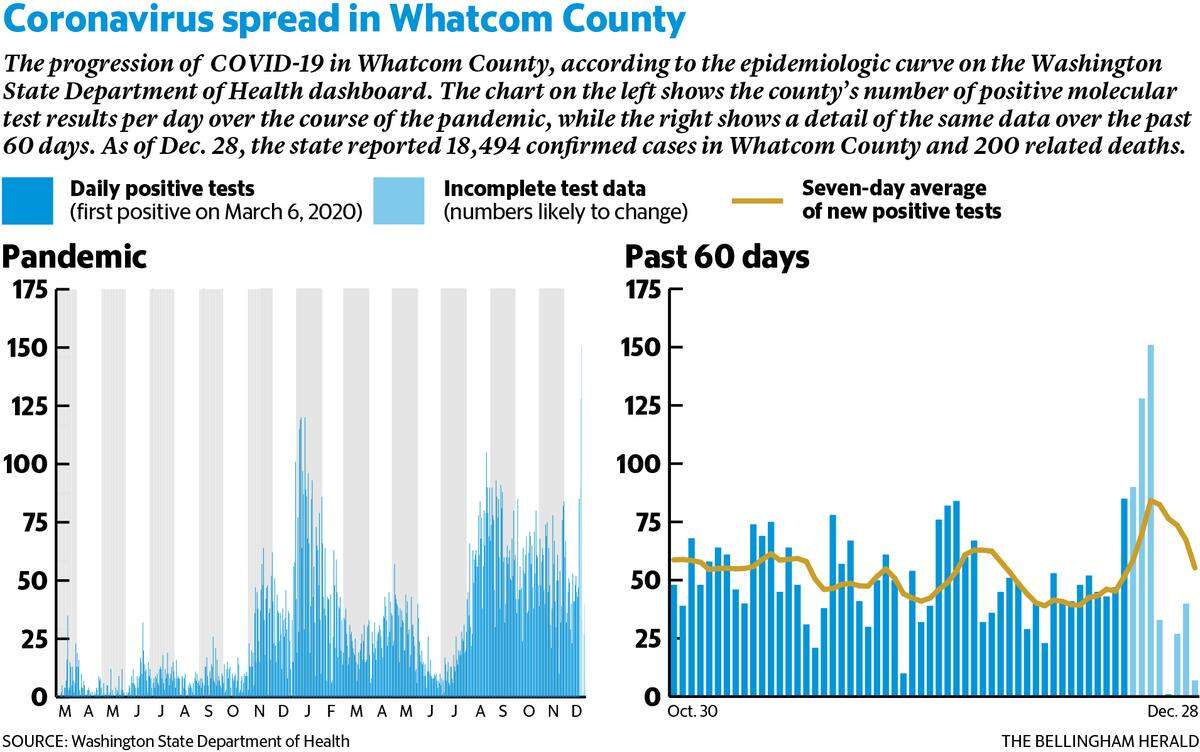
▪ 18,494 confirmed cases during the pandemic — up 60 from the last report.
▪ 1,622 probable COVID cases during the pandemic — down one from the last report — resulting from positive antigen tests not confirmed by a molecular test.
▪ A weekly infection rate of 176 cases per 100,000 residents for the most recently completed epidemiological data Dec. 14-20 — up from 145 one week earlier (Dec. 7-13).
▪ 1,027 COVID-related hospitalizations during the pandemic — up five from the last report. St. Joseph hospital in Bellingham reported it was treating 29 patients with COVID-related symptoms on Thursday, Dec. 30 — up one from its last report.
▪ A weekly COVID-related hospitalization rate of 7.5 patients per 100,000 residents for the most recently completed epidemiological hospitalization data from Dec. 14-20 — down from 7.9 a week earlier (Dec. 7-13).
▪ 348,103 total tests (molecular and antigen combined). The state reported that an “unexpected delay” has once again pushed back the resumption of its reporting of testing data until approximately Feb. 28.
▪ 330,490 vaccinations administered during the pandemic — up 690 from the last report. The state reports 69.3% of Whatcom County’s total population has initiated vaccination and 63.7% has completed it. The state also reports Whatcom has administered 57,208 “additional doses,” which includes third doses for immunocompromised residents and booster doses.
Additionally, the U.S. Centers for Disease Control and Prevention Data Tracker Thursday listed Whatcom’s level of transmission as “High” — the highest of four categories. Thirty-three of the 39 counties in Washington state and 88% of counties nationwide also were listed in the “High” transmission category.
Lummi not updating guidance
Though the CDC updated its isolation and quarantine recommendations on Monday, shortening the duration from 10 days to five days, the Lummi Public Health team has decided not to change its recommendations, it announced in a Facebook post on Wednesday.
“At this time our community has 105 active COVID-19 cases that we are managing,” the post read. “Our community also has a significant number of (multi-generational) households that place us at a higher risk of COVID-19 transmission.
“Given such a high burden of disease, we are not (going) to change our quarantine guidelines until we have better control of this virus.”
The Washington State Department on Tuesday announced that it would be adjusting its quarantine and isolation guidelines to match the CDC.
The recommended isolation time for people with COVID-19 was shortened to five days followed by five days of wearing a mask around others, according to the state release. If symptoms occur, individuals are asked to quarantine immediately until they receive a negative test result.
Spike in cases
The state’s recent increase of COVID-19 cases is expected to continue to rise in coming weeks and is likely tied to the rise of the omicron variant, the Washington State Department of Health said in a news release Wednesday.
Statewide there were 6,140 new COVID cases seen on Friday, Dec. 24, the release stated, which was a high for the pandemic.
“Despite a recent increase in testing around the holidays, public health officials say the increase in new cases significantly outpaces the increase in testing,” the release stated. “The number of cases is expected to continue to increase through the new year.”
State Epidemiologist for Communicable Diseases Dr. Scott Lindquist reported that omicron has overtaken delta, or it soon will, based on sequencing data from the University of Washington, the state and the CDC, according to the release.
“What we are seeing now is the leading edge. Our focus is on getting a better picture of how and where omicron is spreading,” Lindquist said in the release. “It is not just about counting omicron cases. It is about sampling the entire state so we can understand the prevalence of the variant beyond high-population areas. Washington state has one of the most extensive genotyping systems in the U.S., which allows us to track a variant’s spread faster than many other states.”
It is still too early to predict what impact the increased omicron cases will have on the state’s hospitalization and death rates, according to the release, but the state recommends all residents that have not yet received their COVID-19 vaccination booster shots to do so and to get their flu vaccination.
“The recent emergence of omicron is another reminder of the importance of vaccinations and boosters for everyone eligible, especially for children and adults with chronic conditions that place them at higher risk for severe illness due to COVID-19,” Chief Science Officer Dr. Tao Sheng Kwan-Gett said in the release. “We know vaccines are safe and effective at protecting us from hospitalization and death due to COVID-19. Getting a booster is the best way to increase immunity that tends to wane over time.”