Though COVID cases drop in Whatcom, these 2 regions continue to see high infection rates
Though COVID-19 infection rates decreased in all seven Whatcom County school district regions last week, the two-week rates remained relatively high in two regions.
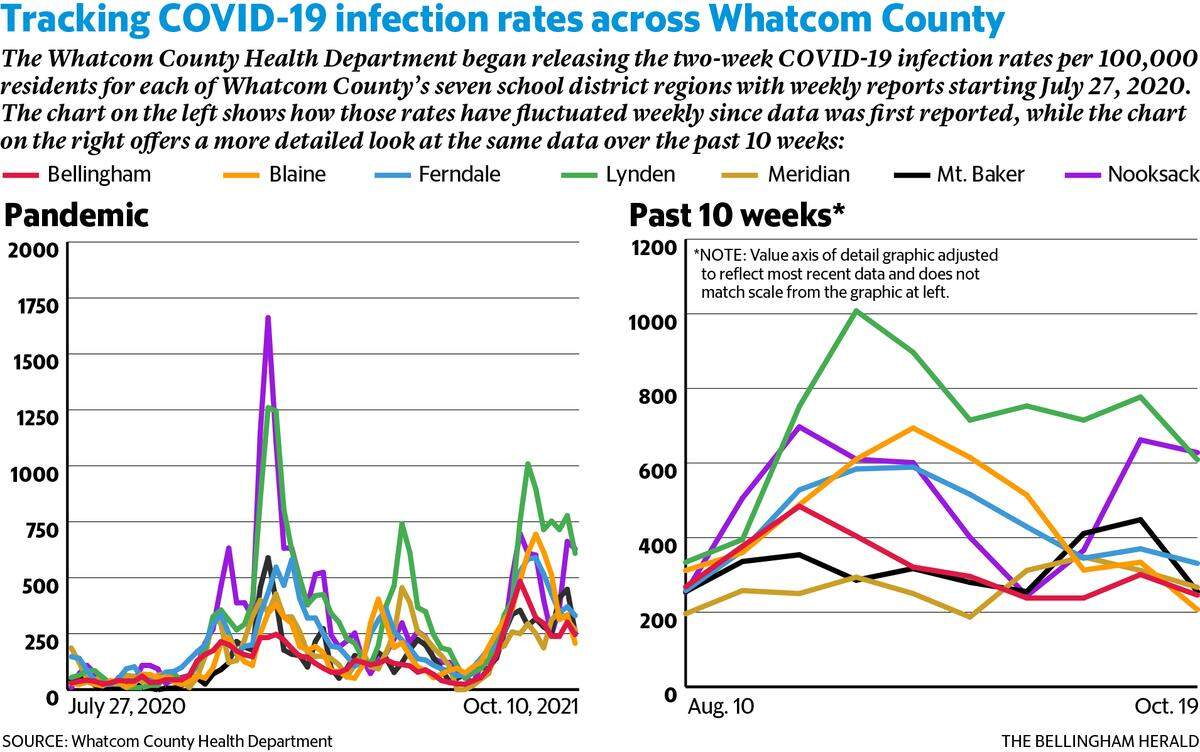
The areas covered by the Lynden and Nooksack Valley school districts continued to see their numbers of new COVID-19 cases per 100,000 residents over the past two weeks remain above 600, according to the latest location data released by the Whatcom County Health Department on Tuesday, Oct. 19.
For comparison, none of the other five regions had a rate higher than 350, and four were lower than 300.
Lynden residents between the ages of 18 and 24 had a weekly infection rate at nearly 634 cases per 100,000 residents, which was nearly double any other age group within the region, according to the health department’s data. That’s a change from a week earlier, when residents between 5 and 17 had the highest rate.
Nooksack Valley, meanwhile, saw its highest impacted age group being residents 4 and younger, as that age group had a weekly infection rate of 585 cases per 100,000 residents. That age range had been among the region’s least impacted since early September, the data shows.
“The health department is still investigating this uptick, but please keep in mind that this is a small population size,” Whatcom’s Health Information Assessment Supervisor Amy Hockenberry said in an email to The Bellingham Herald. “Small numbers of cases may appear as significant case rates.”
Countywide, weekly infection rates were highest among residents 5 to 17 (234 cases per 100,000 residents) and 25 to 44 (213 cases per 100,000 residents). Those 65 and older had the lowest weekly infection rate in the county at 110 cases per 100,000 residents.
The county health department releases weekly data on the location of COVID-19 cases using school districts as geographical boundaries, including each region’s number of total cases during the pandemic, infection rate, hospitalization rate, percentage of residents who have initiated vaccination and a breakdown of case rates by age. Data in this week’s report was through Saturday, Oct. 16.
Overall, Whatcom County saw a 2.3% growth in cases with 349 cases between Oct. 10 and 16 — down from the 481 new cases the county reported the previous week, according to the data.
With 830 cases in the past two weeks, Whatcom County has an overall two-week infection rate of 369, based on 225,300 residents in the county. Five of the county’s regions had infection rates lower than that mark, according to the county’s data this week.
As of Oct. 13, the Washington State Department of Health reported that 66.1% of all Whatcom County residents had initiated vaccination and 61.0% had completed it.
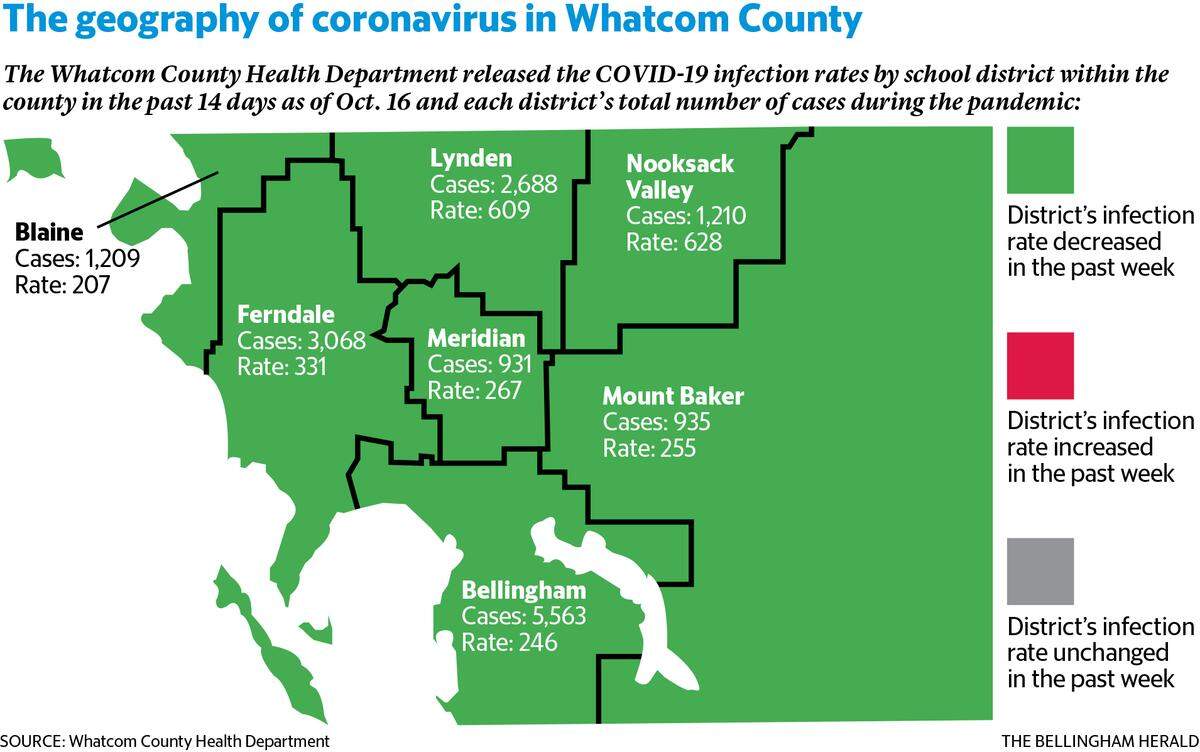
Here is what the health department’s latest data showed for the seven regions in the county:
Bellingham: Up 2.5% (135 cases) since the Oct. 12 report to 5,563 total cases, but the rate of new infections per 100,000 residents in the past 14 days decreased from 301 last week to 246 this week. Approximately 74% of residents in the region have initiated vaccination, and the region has seen 11 COVID-related hospitalizations per 100,000 in the past two weeks.
Blaine: Up 1.3% (15 cases) since the Oct. 12 report to 1,209 total cases, but the rate of new infections per 100,000 residents in the past 14 days decreased from 334 last week to 207 this week. Approximately 67% of residents in the region have initiated vaccination, and the region has seen 11 COVID-related hospitalizations per 100,000 residents in the past two weeks.
Ferndale: Up 2.2% (66 cases) since the Oct. 12 report to 3,068 total cases, but the rate of new infections per 100,000 residents in the past 14 days decreased from 370 last week to 331 this week. Approximately 63% of residents in the region have initiated vaccination, and the region has seen 34 COVID-related hospitalizations per 100,000 residents in the past two weeks.
Lynden: Up 2.6% (69 cases) since the Oct. 12 report to 2,688 total cases, but the rate of new infections per 100,000 residents in the past 14 days decreased from 777 last week to 609 this week. Approximately 53% of residents in the region have initiated vaccination, and the region has seen 28 COVID-related hospitalizations per 100,000 residents in the past two weeks.
Meridian: Up 1.6% (15 cases) since the Oct. 12 report to 931 total cases, but the rate of new infections per 100,000 residents in the past 14 days decreased from 312 last week to 267 this week. Approximately 62% of residents in the region have initiated vaccination, and the region has seen nine COVID-related hospitalizations per 100,000 residents in the past two weeks.
Mount Baker: Up 1.2% (11 cases) since the Oct. 12 report to 935 total cases, but the rate of new infections per 100,000 residents in the past 14 days decreased from 448 last week to 255 this week. Approximately 45% of residents in the region have initiated vaccination, and the region has seen 12 COVID-related hospitalizations in the past two weeks.
Nooksack Valley: Up 3.2% (38 cases) since the Oct. 12 report to 1,210 total cases, but the rate of new infections per 100,000 residents in the past 14 days decreased from 662 last week to 628 this week. Approximately 49% of residents in the region have initiated vaccination, and the region has seen 17 COVID-related hospitalizations per 100,000 residents in the past two weeks.
This story was originally published October 20, 2021 at 5:00 AM.