How many Whatcom residents are not receiving their second COVID-19 vaccination doses?
Approximately 8% to 9% of Whatcom County residents who initiate the two-dose Pfizer or Moderna COVID-19 vaccinations are not getting their second shot, according to the Whatcom County Health Department.
That is pretty close to the national average of people not receiving their second dose within four to six weeks after their first dose, health department spokesperson Jennifer Moon told The Bellingham Herald in an email.
Nationwide, the Centers for Disease Control and Prevention estimates that means approximately 5 million people have chosen not to get fully vaccinated, according to a story by the New York Times.
In Whatcom County, it likely means fewer than 9,000 people have not completed vaccination who are were eligible to do so.
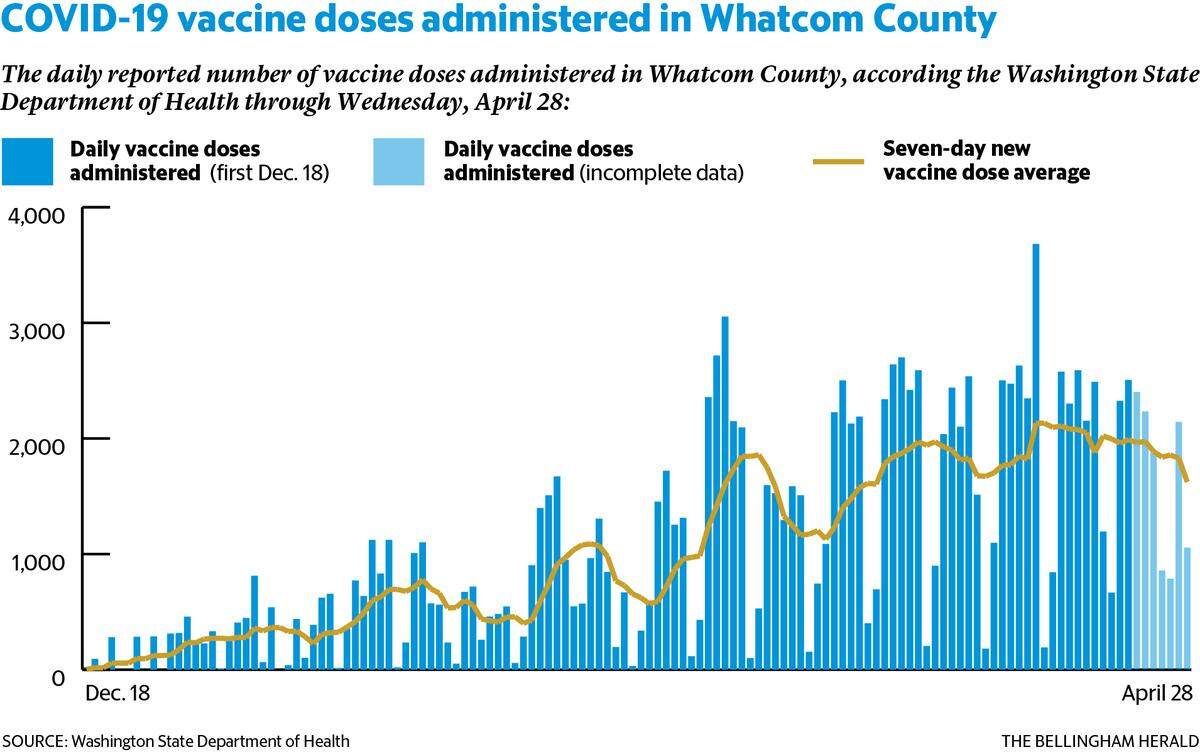
The Washington State Department of Health reported Friday, April 30, that 99,926 people have initiated vaccination in Whatcom County and 70,479 have completed vaccination.
“The efficacy of the mRNA vaccines (Moderna and Pfizer) in preventing infection, symptomatic disease, and hospitalization/death is based on a two-dose series, with a primary dose boosted by a second dose,” Whatcom County Health Officer Dr. Greg Stern said in the email.
“There is data showing that two doses are more effective than one dose. Two doses of these vaccines produce a stronger and longer lasting immune response than a single primary dose. Delaying the booster dose by 6 weeks does not reduce the final efficacy of the series, but there’s limited data on how longer delays affect vaccine efficacy.”
While research shows the first dose of the Pfizer vaccine offers approximately 64% efficacy against COVID-19, Dr. Sudhakar Karlapudi, chief medical officer at St. Joseph hospital in Bellingham told The Herald, the second dose ups that 94% to 95%.
“Completing the vaccine, gives you much, much higher protection for you — for the individual getting the vaccine — and also for the community over getting just a single dose,” Dr. Karlapudi said. “We need to encourage everyone to get vaccinated, because essentially the vaccine is very safe.”
According to the New York Times story, reasons for people not receiving a second dose range from fear over the potential side effects, which can include flu-like symptoms to people saying they feel sufficiently protected by a single shot.
Karlapudi said the side effects are relatively mild, ranging from fatigue, muscle pain and headache, to soreness at the injection site and a mild fever, “and they usually pass within 12 to 18 hours.”
Whatcom County’s Community Vaccination Center has not had any reports of anyone being reluctant to get their second dose, Moon reported, and the clinic has had good luck in getting residents scheduled for their second doses.
All of which is good news for the community, according to Dr. Stern.
“Because the COVID-19 vaccine prevents infection as well as disease, it protects both the person being vaccinated and the broader community, because that person is much less likely to get infected and transmit the virus,” Stern wrote. “ Having more people fully vaccinated reduces transmission in the community, and also slows the development of variants that could be more transmissible or cause more severe disease.”
The CDC’s COVID-19 vaccination webpage states those receiving the Pfizer vaccine should receive a second dose 21 days (three weeks) after receiving their first, while the Moderna vaccine is most effective with a second dose 28 days (four weeks) after the first. Though the CDC recommends getting the second shot as close to that timeline as possible, the second dose may be given up to 42 days (six weeks) after the first when needed.
The CDC advises against receiving a second dose earlier than recommended.
“If you receive a Pfizer-BioNTech or Moderna COVID-19 vaccine, you will need two shots to get the most protection,” the CDC webpage states. “COVID-19 vaccines are not interchangeable. If you received a Pfizer-BioNTech or Moderna COVID-19 vaccine, you should get the same product for your second shot. You should get your second shot even if you have side effects after the first shot, unless a vaccination provider or your doctor tells you not to get it.”