In Whatcom County, work continues to get COVID vaccine to these underserved communities
When farmworkers show up at the PeaceHealth clinic in Bellingham to get their COVID-19 vaccine, someone is there to greet them and walk them through the process in a way that they understand.
With the help of volunteers who speak their languages, they learn what to expect in Spanish, Awaketeco, Chalchiteco, Mixteco Alto/Bajo, Mam, Qʼanjobʼal, Quiché or Triqui.
The community health workers, known as promotoras, who provided the farmworkers with information about the vaccine and signed them up for appointments reserved for them on Thursday evenings and Saturdays — the times that accommodated their work schedule — also are there.
“Our purpose is not to force people to get the vaccine. Our purpose is to inform and to educate and to have farmworkers make the voluntary decision to take the vaccine,” said Australia Tobon, the C2C Whatcom Promotora coordinator.
C2C stands for Community to Community Development, a Bellingham immigrant and farmworker rights group.
At least 505 farmworkers have received vaccine doses in Whatcom County since the first clinic on March 6, according to Tobon.
“Our essential workers have a right to the vaccine but there are some structural barriers to that access,” Tobon said. “Our goal of our program is to save lives. That’s our focus and will be until this pandemic ends.”
Such efforts continue to be needed as new county-by-county vaccination data released by the state Department of Health showed that Whatcom County residents who identify as Hispanic are being vaccinated for COVID-19 at a rate about half the rest of the county.
The report showed that 4.6% of all Whatcom County residents who have initiated vaccination and 3.7% of those to complete it identify as Hispanic. Those averages are well below the 9.8% of the county’s total population that identifies as Hispanic, according to 2019 U.S. Census Bureau estimates.
For comparison, the report showed that 71.5% of those initiating and 73.7% of those completing vaccination in the county identify as white, compared to 78.1% of Whatcom County’s total population, according to U.S. Census estimates.
Based on the Department of Health’s data and population estimates from the U.S. Census Bureau, The Bellingham Herald estimates approximately 19.3% of Whatcom County residents identifying as Hispanic have initiated vaccination and 10.5% have completed it. Countywide, the state estimates 41.5% of Whatcom’s population has initiated vaccination and 28.86% has completed it.
Reaching underserved communities
The clinics are part of an ongoing collaboration among PeaceHealth, various organizations, and state and Whatcom County public health to reach out to underserved communities — providing them with information, videos in their language and messaging about COVID-19 vaccine from people to whom, it is hoped, they can relate.
For example, Bellingham-based North Sound Accountable Community of Health, which serves five counties, has a series of videos on its website in which people, some of them health care workers from PeaceHealth, explain why they got vaccinated against COVID-19.
The videos feature Indian tribal members, including from the Nooksack Tribe, as well as people who speak Punjabi, Korean, Vietnamese, Spanish, Mixteco and Tagalog.
“They spoke about their experience getting the vaccine,” even their initial concerns, said Rachel Lucy, the director of Community Health for PeaceHealth.
The videos, which PeaceHealth was part of, ended with the same message: “We hope when it’s your turn you also choose to get vaccinated,” Lucy said. “We found that that started to reduce some of the concern.”
People could watch a video, say to themselves that they recognized a face or a language, know that some of the same concerns they may have had were being addressed, and perhaps consider getting vaccinated as a result, according to Lucy.
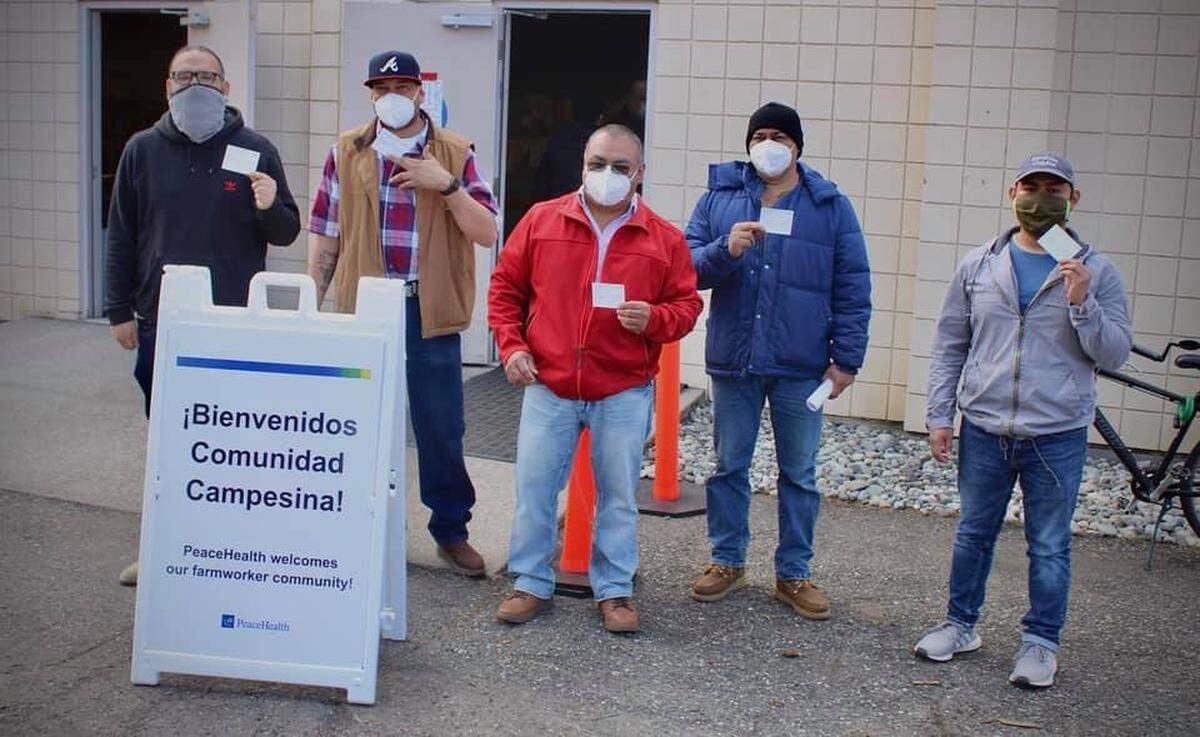
For farmworkers, hearing from others who have gotten vaccinated also has been key.
“A lot of the referrals are word of mouth,” said Tobon, noting that all of the promotoras received the Pfizer vaccine that’s being offered through the PeaceHealth clinics, first so they could share the process with their community.
The collaboration began about mid-February, as PeaceHealth realized it needed to figure out how to improve vaccine access for all people, not just those who had an easier time getting it. That process included understanding barriers and challenges for people, whether transportation, language, a history of discrimination or cultural sensitivities around receiving the vaccine, Lucy said.
“That’s a trust thing. That’s a tricky thing with communities that have been underserved where trust has been broken,” Lucy said. “We’re always in a building trust mode.”
So PeaceHealth sat in, and “just listened,” as North Sound Accountable Community of Health hosted what was essentially a town hall for communities, where people talked about challenges such as navigating the earlier versions of the state Department of Health site to find a vaccine, back when vaccine doses were sharply limited, and language problems. They talked about just wanting more information about the three different vaccines, or how they didn’t have time to check while working to find vaccine appointments.
“We realized the way we did outreach was going to have to change as a community,” Lucy said.
Vaccine appointment blocks
PeaceHealth worked with others, including the C2C Whatcom Promotora program, to set aside blocks of vaccine appointments for farmworkers, who have been designated as essential workers during the pandemic.
“So many of those people in those communities are serving such a central role that often are unrecognized,” said Liz Baxter, CEO of North Sound Accountable Community of Health.
Nicole Willis, chief operations officer for North Sound Accountable Community of Health, said the group also wanted to unpack some of the narrative around vaccine hesitancy. Some of it could be, as in the wider community, a need for more information about the vaccines.
“This is a pandemic. It’s all new,” Willis said.
And, deeper issues need to be considered, such as the way people have been treated or their trust in the health care system. Or it could be that vaccine appointments are occurring during peak work time for farmworkers, or they don’t have the flexibility of paid time off.
“With the vaccine, the hesitancy side of things, it is also a time to reflect on treatment bias and structural racism. That’s what we’re kind of needing to get at more than just folks who are afraid. It’s not so much that,” Willis said.
By way of comparison, Willis referred to another vulnerable population in the state — those in skilled nursing homes that the state has done a good job of getting vaccinated, she said.
“The age part is getting addressed,” she said, but there’s a ways to go for race/ethnicity.
—David Rasbach (drasbach@bhamherald.com) contributed to this story.