Whatcom sees 32 new COVID cases Monday, as area school districts report new incidents
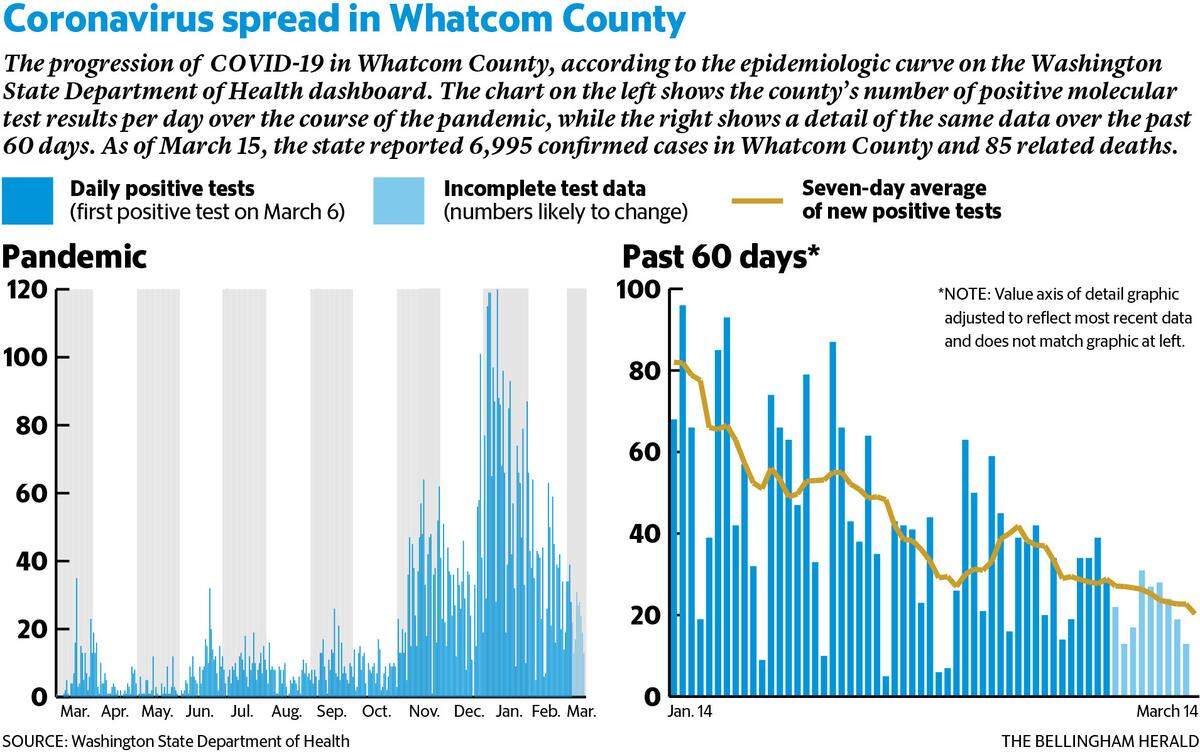
Whatcom County had 32 new confirmed COVID-19 cases on the Washington State Department of Health’s coronavirus dashboard on Monday, March 15, but no new related deaths over the weekend.
Overall, Whatcom County has seen 6,995 confirmed cases and 85 related deaths during the pandemic, according to state data as of 11:59 p.m. Sunday, March 14. An additional 176 probable cases — an increase of two from Saturday’s report — have been reported in Whatcom County during the pandemic, resulting from positive antigen tests not confirmed by a molecular test.
That means that 1.2% of Whatcom’s 7,171 total cases (confirmed and probable cases combined) have resulted in death — better than the statewide 1.5% average of total cases.
The 32 new confirmed cases reported Monday mean Whatcom County has had 3,526 cases — 50.4% of its pandemic total — reported during the first 72 days of 2021 (an average of 49.0 cases per day). The county’s daily average of newly reported cases the past seven days decreased to 23.0 per day.
The state Department of Health data Monday showed Whatcom County has had 320 hospitalizations during the pandemic, which is a decrease of four from Saturday’s report.
The state also reported that a total of 192,240 molecular tests have been administered in Whatcom County during the pandemic — an increase of 2,090 tests from Saturday’s report — meaning 3.64% of all reported tests in the county during the pandemic have come back positive. The state cautioned that negative test results from Nov. 21-30 remain incomplete and results statewide may include up to 130 duplicates.
St. Joseph hospital in Bellingham, which is licensed and staffed for 241 beds, reported to The Herald on Tuesday morning it was treating four patients for COVID-19, a decrease of one from Monday’s report.
Western Washington University’s most recent on-campus student COVID testing data show Monday that since Sept. 15 WWU has completed 25,599 tests and 78 students have tested positive — unchanged from Friday’s report. The college has seen 40 new cases since the school resumed testing following the winter break after seeing 38 cases during the fall quarter.
The Lummi Tribal Health Center reported in a Facebook post Monday that it had one new confirmed case, bringing the total number of cases in the Lummi community during the pandemic to 491. The Lummi health department reported it has 26 active cases and no current hospitalizations. During the pandemic, 12 community members have been hospitalized, three have died and the health center has conducted 4,853 tests. Positive tests for the last two weeks are at 11.29%. The Lummi Indian Business Council announced Wednesday that its Phase 1 Shelter in Place Order has been extended through March 24.
Whatcom vaccination update
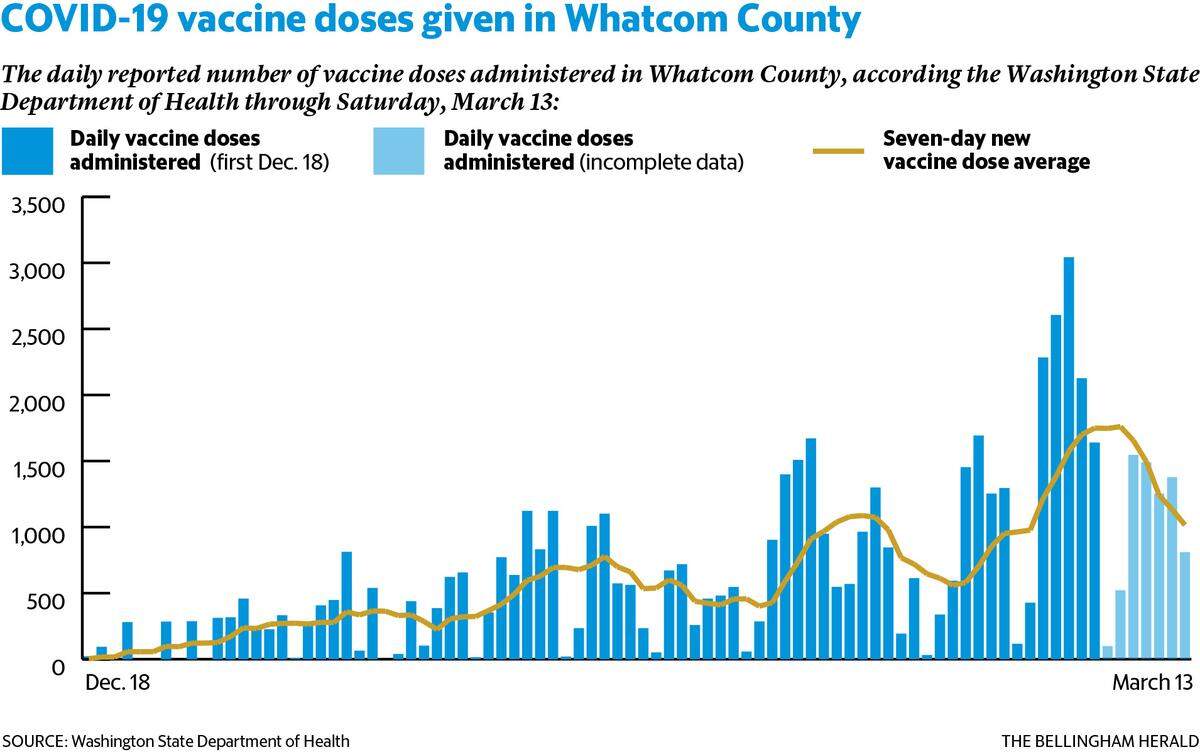
Monday’s vaccination report said that as of 11:59 p.m. Saturday, March 13, Whatcom County had administered 57,288 vaccinations — an increase of 4,681 vaccinations (up 8.90%) from Friday’s report, which was for data through Wednesday, March 10. Statewide, the number of vaccine doses administered increased 7.69% from Friday’s report (174,311 doses administered).
Vaccination data is updated on Monday, Wednesday and Friday afternoons. Here is what data analysis of the latest numbers by The Bellingham Herald showed:
▪ Whatcom County — the ninth most populated county in Washington state, according to 2019 U.S. Census estimates — has administered the 11th most doses of the 39 counties in the state.
▪ The state estimates 21.44% of Whatcom County residents have initiated a COVID-19 vaccine — the 17th-highest rate in the state, and ahead of the statewide average of 20.71%. Based on the county’s population of 225,300 people used by the state, The Herald estimates 48,304 people have initiated a vaccine — an increase of 3,875 from Friday’s report.
▪ The state estimates that 10.49% of Whatcom County residents are fully vaccinated — the 28th-highest rate in the state, and behind the statewide average of 11.94%. Based on the county’s population of 225,300 people used by the state, The Herald estimates 23,634 people have initiated a vaccine — an increase of 2,028 from Friday’s report.
▪ An average of 1,015 Whatcom County residents per day received a vaccination dose from March 7-13— down from the 1,354 seven-day average from Friday’s report.
▪ Whatcom County has administered approximately 2.35% of the 2,442,269 total vaccine doses given in the state — up from 2.32% in Friday’s report. Based on 2019 five-year population estimates from the U.S. Census Bureau, Whatcom County has administered 0.26 doses of vaccine per resident — the 32nd highest rate in the state and behind the overall state average of 0.33 doses per person.
▪ With residents traveling elsewhere for vaccines, Whatcom residents have received approximately 2.95% of the vaccine doses given in the state — up from 2.91% in Friday’s report. Whatcom County residents have traveled outside the county to receive 18.7% of the vaccine doses they’ve received (approximately 13,220 doses) — the fourth-highest rate in the state. Including those who have traveled elsewhere, Whatcom County residents have received 0.32 doses of vaccine per resident, which ranks 21st in the state.
Bellingham schools report case
One new COVID-19 incident was reported by Bellingham Public Schools on its dashboard on Monday. The incident involved a single confirmed case this week at Alderwood Elementary and required one class return to remote learning with an expected return date of March 29.
The district now has had 27 incidents and 29 reported cases since it began returning to in-person learning. Bellingham’s list of schools that have seen COVID cases includes: Birchwood (three cases), Sunnyland (five cases in three incidents), Alderwood (four cases), Carl Cozier (three cases), Northern Heights (two cases), Geneva (two cases), Roosevelt, Wade King, Silver Beach, Lowell and Cordata elementaries, Fairhaven and Kulshan middle school, Sehome High School and a case at a non-school location.
The district estimates 7,820 students have returned for in-person learning and 1,200 staff members are working on site.
Lynden schools see cases
The Lynden School District’s COVID-19 dashboard, showed two new COVID-19 cases in two incidents in its schools when it was updated Monday.
The new incidents, according to the dashboard, included:
▪ One new case reported the week of Feb. 22-26 at Lynden Academy. The incident required one class return to remote learning, and it was expected to return March 10.
▪ One new case reported the week of March 1-5 at Lynden Middle School. The incident required certain individuals to return to remote learning or quarantine.
Overall, the district’s dashboard reports there have been 53 cases spread across 36 incidents since Lynden students began returning to classes. Seventeen incidents have required some students and/or staff or whole classes to temporarily return to remote learning or quarantine.
Weekly case watch
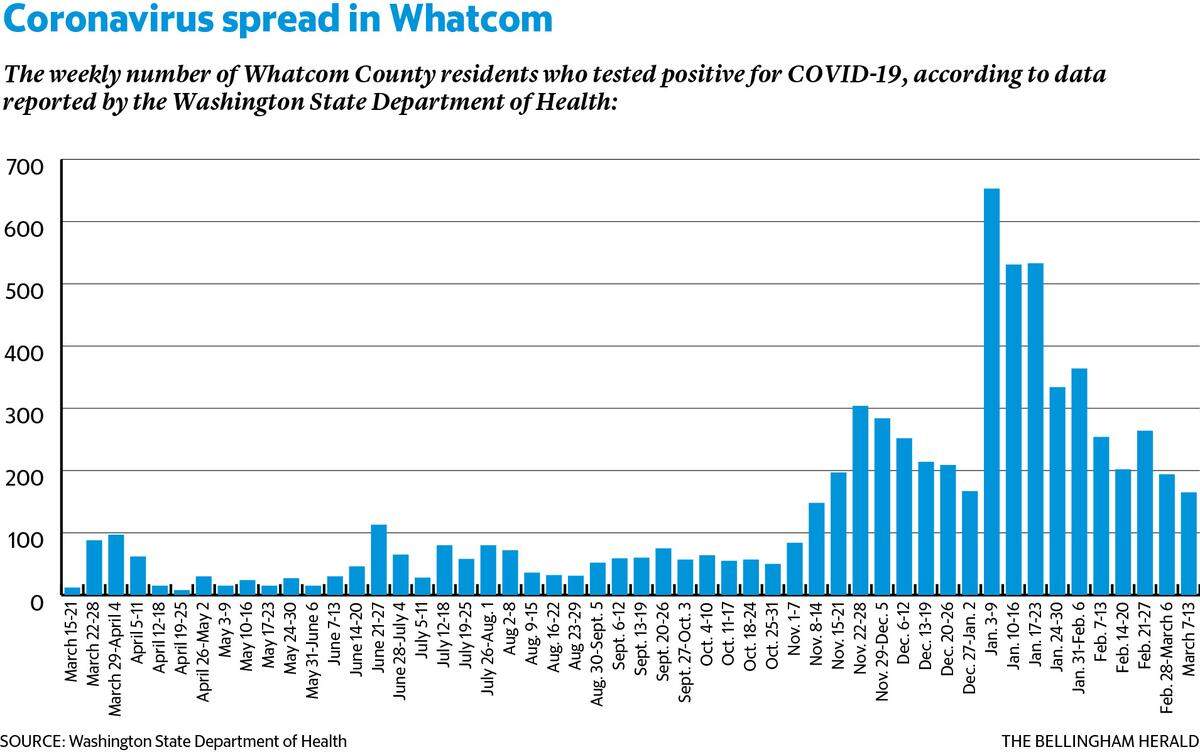
The Washington State Department of Health reported 165 new cases last week in Whatcom County between March 7 and March 13, as the county’s pandemic total climbed from 6,834 to 6,995 (a 2.43% growth). It is the smallest weekly increase Whatcom County has seen since 148 cases were reported between Nov. 8 and 14.
The 165 cases were 14.9% less than the 194 cases reported a week earlier, but it marked the 18th straight week Whatcom has surpassed 100 cases in a week and the 19th week during the pandemic that the county’s case total has reached triple figures in a week.
The state reported a total of 5,256 molecular tests between March 7 and 13, meaning Whatcom’s estimated test positivity was 3.14% last week — up from the 2.00% of the week before.
Whatcom’s risk assessment
The state’s Risk Assessment Dashboard was last updated Monday evening for data as of 11:59 p.m. Friday. With a shift to “Healthy Washington” goals to resume business activities, the state is more specific on reporting dates for some metrics. The dashboard does not update on the weekends.
Whatcom County was missing the marks on two key metrics:
▪ Whatcom is missing the target rate of fewer than 25 new cases per 100,000 residents Feb. 20-March 5 with a rate of 219.7 — a decrease from 239.7 reported Friday. Whatcom County has the seventh-highest infection rate in the state according to Monday’s data.
▪ Whatcom had an average COVID-19 molecular testing rate per 100,000 people Feb. 19-25 of 320.3. No goal was stated for this metric, however, the overall statewide number was 236.2, and Whatcom’s average was a decrease from the 335.7 reported Friday.
▪ Whatcom is missing the target of less than 2.0% of individuals testing positive for COVID-19 Feb. 19-25 with a rate of 5.1% — a decrease from the 5.6% Friday and the 17th-highest rate in the state.
The latest Healthcare System Readiness risk assessment dashboard, updated Friday evening for data through Sunday, shows for the North region, which combines Whatcom, Skagit, Snohomish, San Juan and Island counties:
▪ Occupied beds: 964 of the region’s 1,248 adult hospital beds (77.2%) were occupied, making the state’s goal of 80% or less and down 73 occupied beds from data Friday.
▪ COVID occupied beds: 26 of the region’s 1,248 adult hospital beds (2.1%) were occupied by COVID patients, making the state’s goal of 10% or less and down five occupied beds from data Friday.
▪ Occupied ICU beds: 86 of the region’s 133 adult ICU beds (64.7%) were occupied. The state does not have a goal for this metric, but it’s down six beds in use from data Friday.
▪ COVID occupied ICU beds: 13 of the region’s 133 adult ICU beds (9.8%) were occupied by COVID patients. The state does not have a goal for this metric, but it’s up one occupied bed from data Friday.
Numbers elsewhere
New coronavirus cases and deaths according to Johns Hopkins University Tuesday morning:
▪ The U.S. has more than 29.5 million reported cases, the most of any nation, and more than 535,000 deaths.
▪ Worldwide, there are more than 120.3 million reported cases and 2.6 million deaths.
Washington state reported these numbers from the Department of Health Monday afternoon:
▪ 329,893 confirmed cases, an increase of 918 from reported cases on Saturday.
▪ 20,613 probable cases, an increase of 163 from Saturday’s data.
▪ 19,891 coronavirus-related hospitalizations, an increase of 61 from data Saturday.
▪ 5,576,007 total molecular tests, an increase of 42,128 from Saturday’s data.
▪ 5,135 deaths related to COVID-19, an increase of 12 from Friday’s data. That means 1.5% of all Washington residents who have tested positive for coronavirus have died. New deaths are not reported on the weekends.
Statewide, according to the state’s latest vaccination report, which is updated Mondays, Wednesdays and Fridays:
▪ 2,442,269 vaccinations had been given as of Saturday, March 13, according to the report, an increase of 174,311 from the previous report (7.69%).
▪ The state has averaged administering 42,551 doses of vaccines the past seven days — a little under the Department of Health’s stated daily goal of 45,000, and a decrease from the average 44,610 reported Friday.
▪ The state estimated Monday that 20.71% of the state’s residents have received their first dose of a COVID-19 vaccine and 11.94% percent of residents are fully vaccinated.
▪ 2,721,040 doses have been delivered to Washington state providers (an increase of 94,320 from Friday’s report) and 186,030 doses have been delivered for the CDC’s long-term care program (unchanged from Friday’s report).
▪ Of the 2,907,070 doses delivered, 84.01% have been given, according to Monday’s report.
State situation report
Case rates are beginning to increase slightly in Western Washington, according to the latest statewide situation report released by the Washington State Department of Health on Friday, March 12.
Case rates remain relatively high across the state, according to a release about the report, remaining at about the same level seen in October when the third wave of the disease was just beginning. Overall, the reproductive number is estimated to be 0.96 — the goal is to be well below 1.0 for a long period of time to show the disease transmission is declining.
“Plateauing or increasing at these high levels is concerning. We want to see these numbers continue to decline,” the release states.
Cases are increasing among adults between 20 and 39, according to the release — “an early warning sign of larger surges in the general population.” Case counts that were declining in other age groups have now flattened.
Hospital admissions among people 70 and older are declining, perhaps because that age group was the first to be vaccinated, according to the release.
“When you look at our data, there is a pattern of several waves of COVID-19 activity followed by a return to baseline level,” Acting State Health Officer Dr. Scott Lindquist said in the release. “The baseline we reached after our second wave in summer 2020 was higher than the level after our first wave. Now, following the third wave that began last fall, cases have flattened out at a higher baseline level than ever before.
“I’m concerned about what this means for the future and a possibility of a fourth wave of activity, along with the increases we are seeing in variants of the virus. As we continue working to accelerate vaccination so we can protect more people, it’s critical that we all maintain the precautions we’ve been taking to stop the spread of the virus.”
Washington state actions
On Thursday Inslee announced that the Roadmap to Recovery plan would transition from the regional approach back to a county-by-county evaluation process and that all counties will begin in Phase 3 effective March 22.
In Phase 3, outdoor professional sports can welcome back fans at 25% capacity, according to Inslee’s office, while capacity for indoor activities such as dining at restaurants, attending worship services and shopping at retail stores will double to 50% occupancy.
The state will run analyses every other Friday to determine whether regions will move backward or forward in phases the following Monday, officials said.
All restrictions in Phase 2 will be in some way expanded in Phase 3, according to Inslee’s office. That includes restaurants, gyms, retail, movie theaters, and professional and personal services.
Up to 50% occupancy or 400 people, whichever is lower, will be allowed for indoor activities that were allowed in Phase 2.
Up to 400 people will be allowed for outdoor activities and indoor events with physical distancing and masking in place, according to the governor’s office, as long as that count doesn’t exceed 50 percent capacity. Events at bigger venues will have different guidelines: 25% occupancy or up to 9,000 people.
This story was originally published March 16, 2021 at 9:51 AM.