
State will enter Phase 3 March 22, professional sports to welcome fans
The entire state will advance March 22 to Phase 3 of the state’s “Healthy Washington – Roadmap to Recovery” plan, Gov. Jay Inslee announced Thursday, as he provided the initial, long-awaited details for the new phase.
At a virtual press conference rife with hopeful news, Inslee also announced the state will move to the next tier of vaccine eligibility earlier than scheduled.
On March 17, people in Phase 1B-2 will become eligible. That includes workers in settings such as grocery stores, law enforcement and agriculture, as well as people over age 16 who are pregnant or who have a disability that puts them at high risk.
In Phase 3, outdoor professional sports can welcome back fans at 25% capacity, according to Inslee’s office, while capacity for indoor activities such as dining at restaurants, attending worship services, and shopping at retail stores will double to 50% occupancy.
“We’re excited to take this step forward, we’re going to keep evaluating our progress, we think there’s reason to be optimistic, and we think this gives us a way to keep moving forward,” Inslee said.
The plan will also revert to a county-by-county approach as of March 22, rather than the regional approach the state’s been using for the last two months.
The governor introduced his Healthy Washington plan in early January and it has shifted since. Before January, counties progressed through the state’s former four-phase, county-by-county “Safe Start” reopening plan, which was paused in summer, before statewide restrictions were introduced in November during a surge in cases.
Thursday’s good news comes with the caveat that taking measures to prevent the spread of the virus remains important — especially with concerns around variants of the virus.
“The way I look at it is we’re hitting COVID with the left, with the vaccine,” Inslee said. “We gotta hit it with the right, continuing to pound it with masks and everything else we know works. And we’ve got to keep pounding it until it’s down on the canvas and can’t get back up.”
What’s in Phase 3
All restrictions in Phase 2 will be in some way expanded in Phase 3, according to Inslee’s office. That includes restaurants, gyms, retail, movie theaters, and professional and personal services.
Up to 50 percent occupancy or 400 people, whichever is lower, will be allowed for indoor activities that were allowed in Phase 2.
Up to 400 people will be allowed for outdoor activities and indoor events with physical distancing and masking in place, according to the governor’s office, as long as that count doesn’t exceed 50 percent capacity. Events at bigger venues will have different guidelines: 25 percent occupancy or up to 9,000 people.
“More details are still being hammered out, but we are committed to entering Phase 3 on March 22 and giving people this information in advance,” spokesperson Mike Faulk wrote in an email to McClatchy.
Fans will be able to attend outdoor professional sporting events at 25 percent capacity, with physical distancing and mask-wearing in place, in time for the Seattle Mariners home opener against the San Francisco Giants April 1.
The same capacity will be allowed for high school sports, motor sports, rodeos, and other outdoor spectator events, according to Inslee’s office.
The expanded capacity for fans at high school and youth sporting events will take effect early, on March 18.
The state’s working on guidelines for summer camps and expansion of youth sports, Inslee said — high-contact sports such as basketball, wrestling, and cheerleading will be allowed to start up competitions.
More details are expected for specific industries and social gatherings.
Metrics and logistics
Every county will enter Phase 3 come March 22, according to the governor’s office.
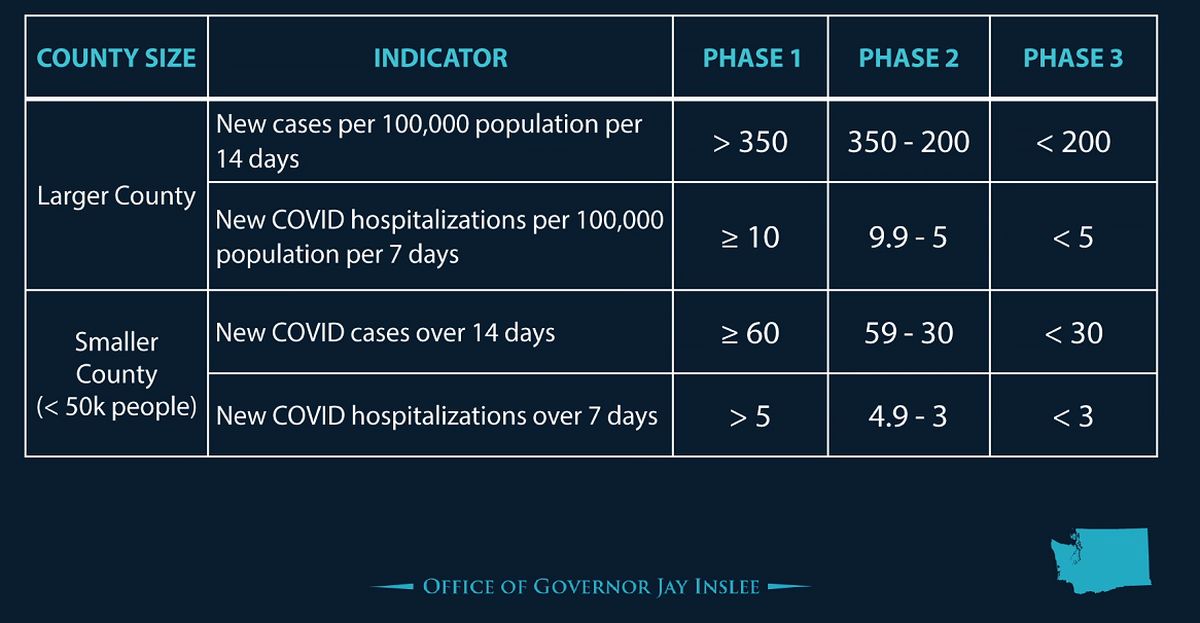
The state will use two metrics to evaluate counties: new cases and new COVID-19 hospitalizations. If a county misses one or both of the metrics, it will backslide one phase.
The threshold for staying in Phase 3 differs based on a county’s population. A county with more than 50,000 residents will be able to stay in Phase 3 if it’s had:
- fewer than 200 new cases per 100,000 over two weeks; and
- fewer than five new hospitalizations per 100,000 over one week.
Different metrics apply to counties with fewer than 50,000 people, which are: Pacific, Klickitat, Asotin, Adams, San Juan, Pend Oreille, Skamania, Lincoln, Ferry, Wahkiakum, Columbia, Kittitas, Stevens, Douglas, Okanogan, Jefferson, and Garfield counties.
For those counties to stay in Phase 3:
- new cases over two weeks need to stay below 30; and
- new hospitalizations over one week need to stay under three.
People who are incarcerated in state or federal facilities won’t be counted in county case rates during evaluation, according to the governor’s office.
There’s a statewide backstop, too: If the state’s ICU capacity rises above 90 percent, the whole state reverts to Phase 1. And, the governor’s office notes, the state Department of Health has the authority to move counties at its discretion if it’s appropriate.
The state will evaluate counties every three weeks, on Mondays. The first evaluation will be scheduled for April 12. Changes to county phases will take effect on Fridays, according to the governor’s office.
The previous, regional approach was based on medical resources. But Inslee said it caused some “envy” among counties, and that people have a more pronounced “sense of identity” with their county than their region.
It was in part influenced by feedback from dozens of local officials who said the approach would be helpful for community morale, according to spokesperson Nick Streuli. Officials believe the county-by-county approach will have more public acceptance.
This story was originally published March 11, 2021 at 2:36 PM with the headline "State will enter Phase 3 March 22, professional sports to welcome fans."
.jpg)