On anniversary of Whatcom’s first reported COVID case, county sees 2 deaths and 23 cases
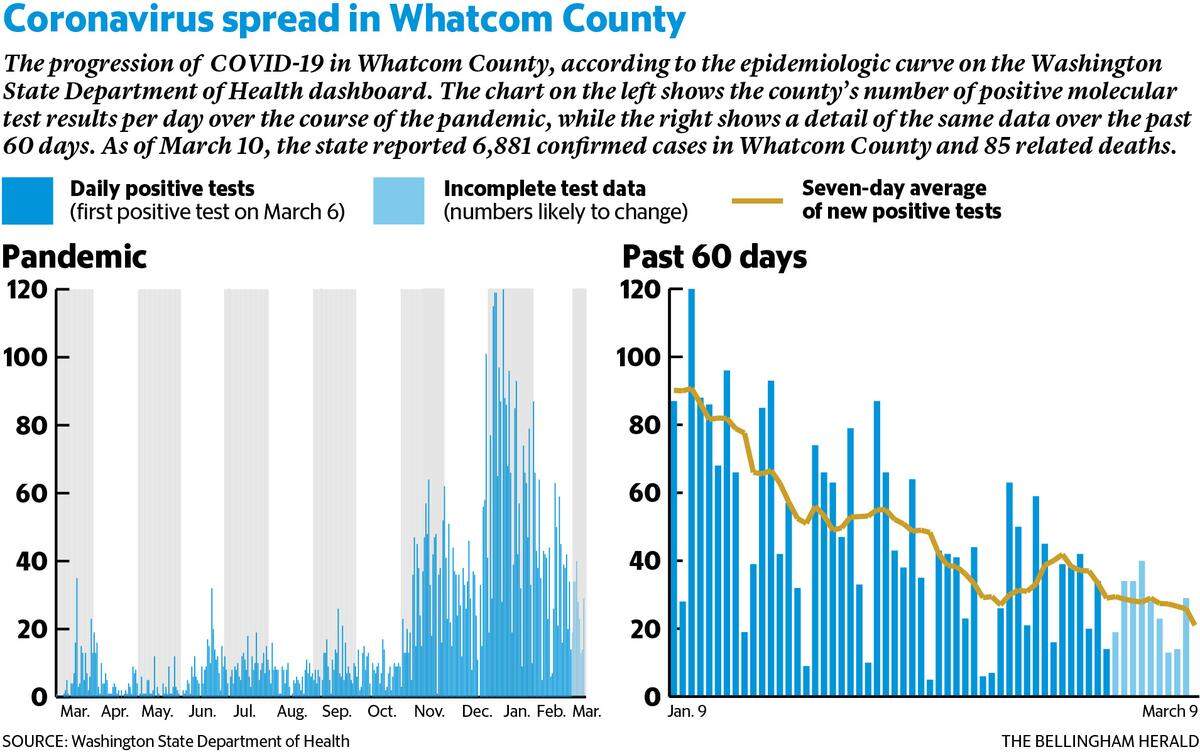
On the one-year anniversary of Whatcom County’s first reported COVID-19 case, the Washington State Department of Health’s coronavirus dashboard on Wednesday, March 10, showed the county had 23 new confirmed cases and two related deaths.
Overall, Whatcom County has seen 6,881 confirmed cases and 85 related deaths during the pandemic, according to state data as of 11:59 p.m. Tuesday, March 9. An additional 163 probable cases — an increase of four from Tuesday’s report — have been reported in Whatcom County during the pandemic, resulting from positive antigen tests not confirmed by a molecular test.
That means that 1.2% of Whatcom’s 7,044 total cases (confirmed and probable cases combined) have resulted in death — better than the statewide 1.5% average of total cases.
The COVID-related deaths reported Wednesday were the 29th and 30th Whatcom has had reported in 2021 and come on the heels of two straight days in which the county’s death total has decreased by one each day.
The people whose deaths were reported Wednesday first tested positive for COVID-19 on Dec. 11 and Feb. 8, according to the state’s epidemiological curves, but no other information about the person, such as gender, age or hometown was reported.
The 23 new confirmed cases reported Wednesday mean Whatcom County has had 3,412 cases — or 49.6% of its pandemic total — reported during the first 69 days of 2021 (an average of 49.4 cases per day). The county’s daily average of newly reported cases the past seven days decreased to 25.7 per day.
The state said that up to 400 duplicates statewide may be included in Wednesday’s case counts along with several “backlog” cases from February.
The state Department of Health data Tuesday showed Whatcom County has had 318 hospitalizations during the pandemic, which is unchanged from Tuesday’s report.
The state also reported that a total of 188,883 molecular tests have been administered in Whatcom County during the pandemic — a decrease of 1,237 tests from Tuesday’s report — meaning 3.64% of all reported tests in the county during the pandemic have come back positive. The state cautioned that negative test results from Nov. 21-30 remain incomplete.
St. Joseph hospital in Bellingham, which is licensed and staffed for 241 beds, reported to The Herald on Thursday morning it was treating two patients for COVID-19, unchanged from Wednesday’s report and matching the lowest mark the hospital has seen since it had two on Oct. 26.
The Lummi Tribal Health Center reported in a Facebook post Wednesday that it had three new confirmed cases, bringing the total number of cases in the Lummi community during the pandemic to 481. The Lummi health department reported it has 25 active cases and no current hospitalizations. During the pandemic, 12 community members have been hospitalized, three have died and the health center has conducted 4,788 tests. Positive tests for the last two weeks are at 10.68%. The Lummi Indian Business Council announced Wednesday that its Phase 1 Shelter in Place Order has been extended through March 24.
Whatcom vaccination update
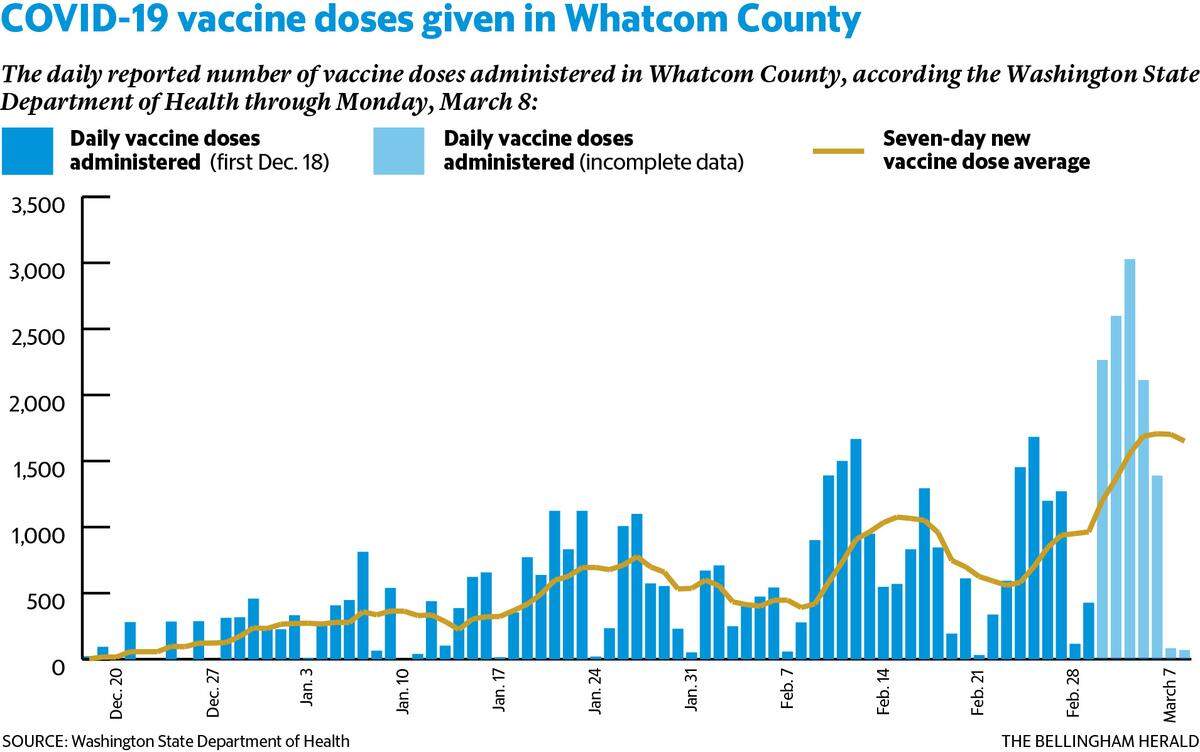
Wednesday’s vaccination report said that as of 11:59 p.m. Monday, March 8, Whatcom County had administered 49,794 vaccinations — an increase of 521 vaccinations (up 1.06%) from Monday’s report, which was for data through Saturday, March 6. Statewide, the number of vaccine doses administered increased 3.61% from Monday’s report (74,656 doses administered).
An average of 1,651 Whatcom County residents per day received a vaccination dose from March 2-8, a slight drop from the 1,656 seven-day average on Monday. Vaccination data is released Mondays, Wednesdays and Fridays.
The state estimates that 18.69% of the county has received its first dose of a COVID-19 vaccine and 9.04% of the county is fully vaccinated. Whatcom remained ahead of the statewide average of 18.04% of residents receiving a first dose and behind the statewide average of 10.26% of residents being fully vaccinated.
The state did not update its county-by-county vaccinations table on Wednesday, nor did it release the number of people who have received the single-dose Johnson & Johnson vaccine, as it previously stated it would begin doing on Wednesday.
Based on the percentages and using a population of 225,300 for Whatcom County, which is the total the state uses in COVID-related estimates, The Bellingham Herald estimates that 42,109 Whatcom residents have received their first dose — an increase of 540 people from the 41,569 reported by the state Monday. The Herald estimates 20,367 Whatcom residents are fully vaccinated — an increase of 239 from the 20,128 the state reported Monday.
The number of vaccines given and people vaccinated may not match, according to the dashboard, because people may be vaccinated in counties other than where they live.
In fact, The Herald’s previous analysis of data has shown Whatcom County residents have had to travel to get vaccine doses at a higher rate than most of the rest of the state. Using Wednesday’s data, The Herald estimates that Whatcom residents have had to travel outside the county for 21.1% of the doses they have received — an increase from the 20.1% estimated from Monday’s data.
According to an analysis of Wednesday’s data by The Herald, Whatcom residents have received approximately 2.92% of the 2,140,418 total vaccine doses given in the state — down from 2.99% in Monday’s report. And the county has administered 2.33% of the state’s total — down from 2.39% in Monday’s report.
For comparison, Whatcom County represents 3.0% of the state’s total population and is the state’s ninth-largest county, according to 2019 U.S. Census estimates.
Based on 2019 five-year population estimates from the U.S. Census Bureau, The Herald’s analysis of Wednesday’s data found Whatcom County has administered 0.22 doses of vaccine per resident. With residents traveling to get the vaccine, Whatcom County has received 0.28 doses of vaccine per resident. Both numbers are below the statewide average of 0.29 vaccine doses administered per resident.
Phase 1B-2 update
Approximately 10% more of Whatcom County residents will become eligible to receive COVID-19 vaccines when the state moves to an expanded Phase 1B-2 announced last week by Gov. Jay Inslee. Inslee said he expects the state to move to the expanded next tier March 22, assuming supply keeps ramping up.
The Whatcom County Health Department estimates between 25,000 and 30,000 Whatcom County residents will be added to the list of those who are eligible to receive vaccine doses once the state moves to next tier of Phase 1B, according to an email to The Bellingham Herald on Wednesday, March 5.
The expanded second tier of Phase 1B, under Inslee’s plan, will now include workers over age 16 in settings such as agriculture, grocery stores and law enforcement. People over age 16 who are pregnant or who have a disability that puts them at high risk will also be eligible, according to Inslee’s office.
The governor’s office expects an expanded Phase 1B-2 will make eligible “critical workers who work in certain congregate settings,” according to Inslee’s office, as well as pregnant people and those with disabilities that put them at high risk.
Workers in the tier include those in agriculture, food processing, grocery stores, public transit, firefighters, law enforcement and workers in prisons and jails. It does not include restaurant workers. The state has yet to determine where they’ll fall in the queue.
Previously, Phase 1B-2 included “high-risk” critical workers 50 and older who work in certain congregate settings. The “high-risk” and age group restrictions are no longer part of the tier.
Vaccine supply should stabilize
Supplies of COVID-19 vaccines should become more reliable soon, Whatcom County’s top health official said.
“The shift and the wild swings have been really challenging,” Whatcom County Health Director Erika Lautenbach told the County Council during a meeting Tuesday afternoon, March 9.
Two weeks ago, some 11,000 doses were received, and last week only 1,800 doses were available through the state, Lautenbach said.
But other vaccine “pipelines” are beginning to open and the supply should be more steady, she said.
“Starting next week they will be providing a more stable number of doses so we’ll have more predictability to our providers,” Lautenbach said.
Lautenbach said the federal government is beginning to supplement the state-provided supplies through distribution to tribal governments and through the National Pharmacy Program that supplies providers such as Haggen, Safeway and Fred Meyer, she said.
Further, a new program will be supplying federally qualified health centers such as SeaMar Unity Care, Lautenbach said.
“Through (Health and Human Services), the federal government, they will also be receiving additional allocations directly from the federal government in order to make sure they have vaccine supply available to vaccinate some of our most vulnerable folks and our farmworker populations and others,” she told the council.
“We are still several weeks away from moving from scarcity to abundance, but we are seeing the end of this sort of phase in a lot of concerns about the availability of vaccine,” she said.
—Robert Mittendorf (rmittendorf@bhamherald.com)
Whatcom’s risk assessment
The state’s Risk Assessment Dashboard was last updated Wednesday evening for data as of 11:59 p.m. Tuesday. With a shift to “Healthy Washington” goals to resume business activities, the state is more specific on reporting dates for some metrics. The dashboard does not update on the weekends.
Whatcom County was missing the marks on two key metrics:
▪ Whatcom is missing the target rate of fewer than 25 new cases per 100,000 residents Feb. 15-28 with a rate of 234.4 — an increase from 230.8 reported Monday. Whatcom County has the sixth-highest infection rate in the state according to Wednesday’s data.
▪ Whatcom had an average COVID-19 molecular testing rate per 100,000 people Feb. 14-20 of 321.0. No goal was stated for this metric, however, the overall statewide number was 221.6, and Whatcom’s average was an increase from the 297.0 reported Tuesday.
▪ Whatcom is missing the target of less than 2.0% of individuals testing positive for COVID-19 Feb. 14-20 with a rate of 5.4% — an increase from the 5.0% Tuesday and the 16th-highest rate in the state.
The latest Healthcare System Readiness risk assessment dashboard, updated Wednesday evening for data through Tuesday, shows for the North region, which combines Whatcom, Skagit, Snohomish, San Juan and Island counties:
▪ Occupied beds: 1,025 of the region’s 1,264 adult hospital beds (81.1%) were occupied, missing the state’s goal of 80% or less and an increase of 41 occupied beds from data Tuesday.
▪ COVID occupied beds: 39 of the region’s 1,264 adult hospital beds (3.1%) were occupied by COVID patients, making the state’s goal of 10% or less but a decrease of one occupied beds from data Tuesday.
▪ Occupied ICU beds: 88 of the region’s 137 adult ICU beds (64.2%) were occupied. The state does not have a goal for this metric, but it’s a decrease of two beds in use from data Tuesday.
▪ COVID occupied ICU beds: 13 of the region’s 137 adult ICU beds (9.5%) were occupied by COVID patients. The state does not have a goal for this metric, but it’s an increase of two occupied beds from data Tuesday.
Numbers elsewhere
New coronavirus cases and deaths according to Johns Hopkins University Thursday morning:
▪ The U.S. has more than 29.1 million reported cases, the most of any nation, and more than 529,000 deaths.
▪ Worldwide, there are more than 118.2 million reported cases and 2.6 million deaths.
Washington state reported these numbers from the Department of Health Wednesday evening:
▪ 327,000 confirmed cases, an increase of 596 from reported cases on Tuesday.
▪ 20,131 probable cases, an increase of 132 from Tuesday’s data.
▪ 19,729 coronavirus-related hospitalizations, an increase of 37 from data Tuesday.
▪ 5,470,909 total molecular tests, an increase of 17,873 from Tuesday’s data.
▪ 5,100 deaths related to COVID-19 were reported, an increase of 23 from Tuesday’s data. That means 1.5% of all Washington residents who have tested positive for coronavirus have died.
According to the state’s latest vaccination report, which is updated Mondays, Wednesdays and Fridays:
▪ 2,140,418 vaccinations had been given as of Monday according to the report, an increase of 74,656 from the previous report (3.61%).
▪ The state has averaged administering 46,119 doses of vaccines the past seven days — over the Department of Health’s stated daily goal of 45,000, and an increase from the average 45,380 reported Monday.
▪ The state estimated Wednesday that 18.04% of the state’s residents have received their first dose of a COVID-19 vaccine and 10.26% percent of residents are fully vaccinated.
▪ 2,560,840 doses have been delivered to Washington state providers (an increase of 276,550 from Monday’s report) and 186,030 doses have been delivered for the CDC’s long-term care program (unchanged from Monday’s report).
▪ Of the 2,746,870 doses delivered, 77.92% have been given, according to Wednesday’s report.
Washington state actions
In the “Healthy Washington” plan introduced by Gov. Jay Inslee Jan. 5, business resumption is tied to targets by health system regions.
All regions began in Phase 1 on Jan. 11, and the North region, which includes Whatcom, Island, San Juan and Skagit counties moved to Phase 2 Feb. 14, along with the East, North Central, Northwest and Southwest regions. On Feb. 26, Inslee said the state would stay in Phase 2, with no areas slipping back to Phase 1. But new metrics for Phase 3 and what activities will be allowed in that phase have not yet been released by Inslee.
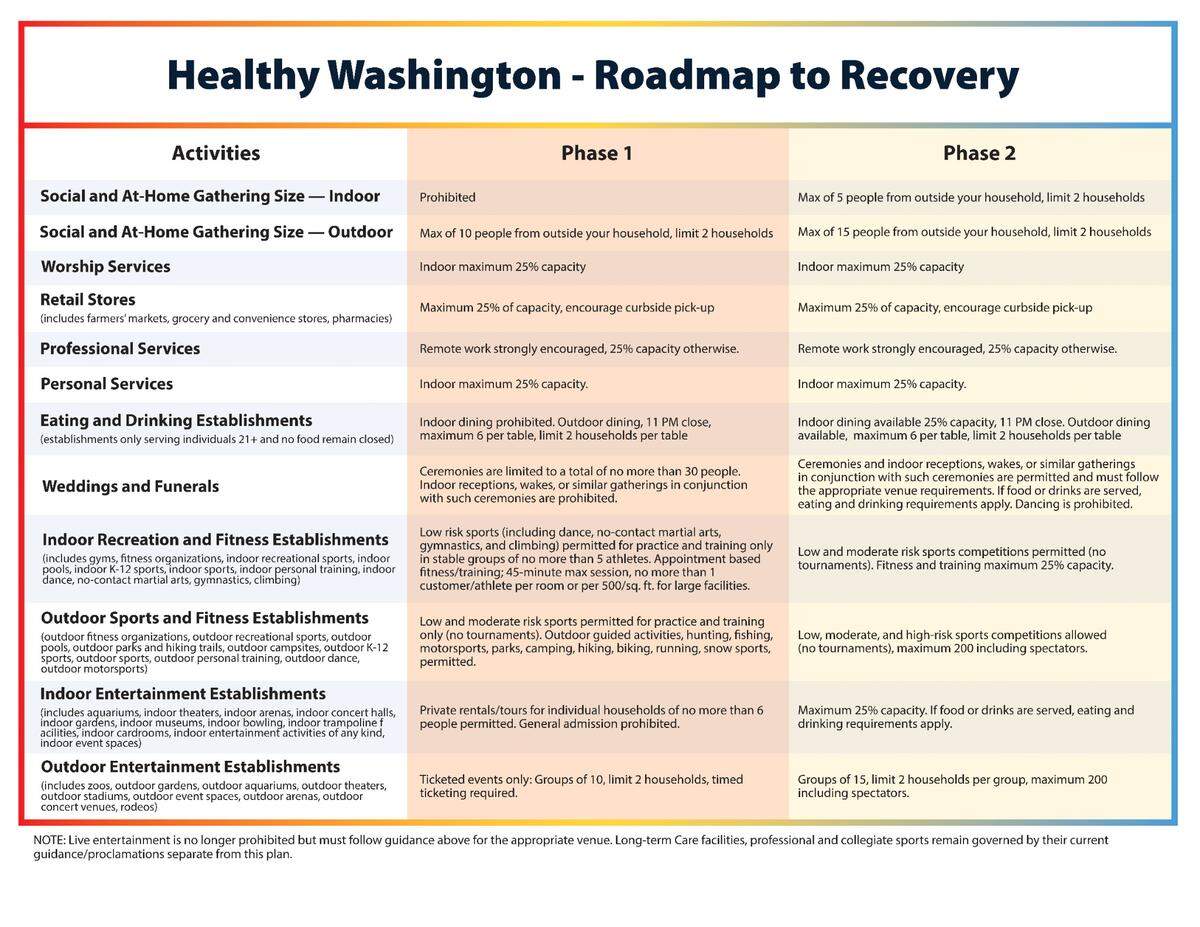
Phase 2 allows for live entertainment with ticketed groups of up to 10 people and very limited fitness activities such as appointment-based training in gyms.
Phase 2 also allows restaurants and indoor fitness centers to open indoors at 25% capacity and allows for sports competitions to resume with limited spectators, and wedding, and funeral ceremonies can increase capacities.
This story was originally published March 11, 2021 at 9:33 AM.