Whatcom to start Phase 2 early. State reports 1 death and 65 new COVID cases Thursday
For the third straight day, Whatcom County’s COVID-19 death total increased, as the Washington State Department of Health’s dashboard reported Thursday, Feb. 11, that another resident’s death is believed to be related to coronavirus. The state also reported 65 new confirmed cases Thursday after two straight days of decreases.
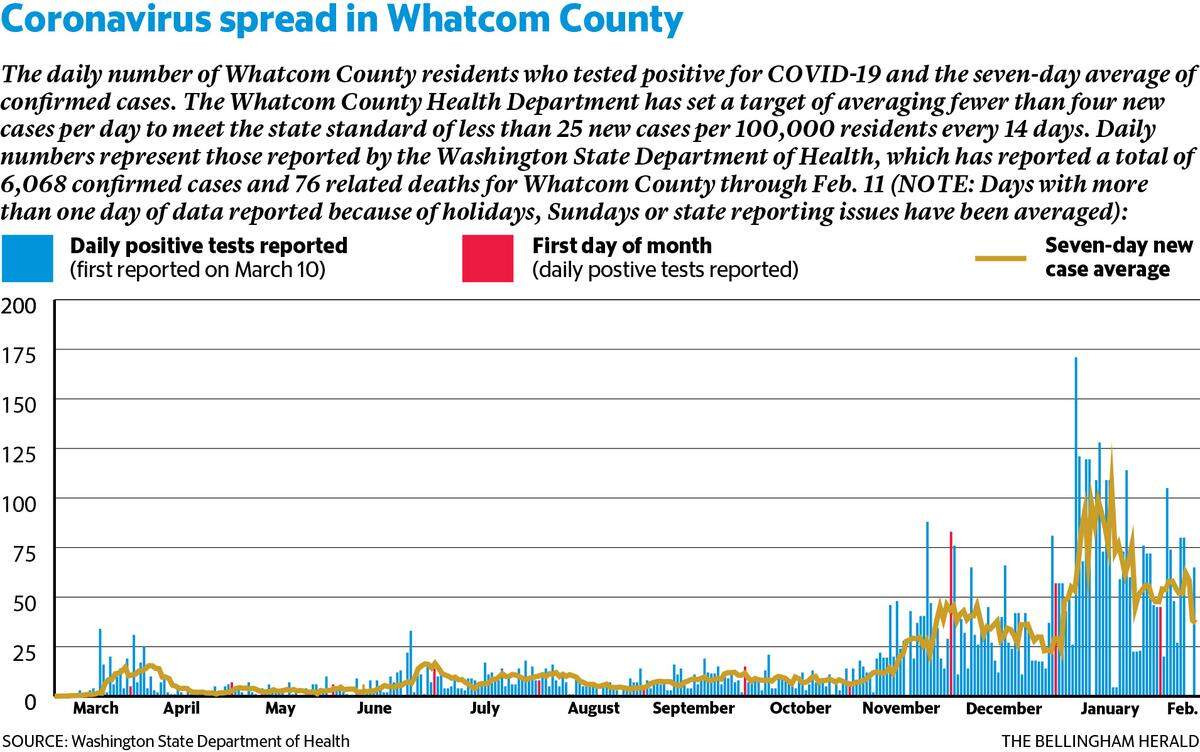
Overall, Whatcom County has seen 6,068 confirmed cases and 76 related deaths during the pandemic, according to state data as of 11:59 p.m. Wednesday, Feb. 10, meaning 1.2% of all COVID cases in Whatcom County have been linked to a death.
Eighty additional probable cases — an increase of four from Wednesday’s report — have been reported in Whatcom County during the pandemic, resulting from positive antigen tests not confirmed by a molecular test.
The COVID-related deaths reported Thursday bring Whatcom’s total to 12 reported so far in February, including seven in the past three days, though only one of those people actually first tested positive for COVID-19 in February.
According to the state’s epidemiologic curves, the person whose death was reported Thursday first tested positive for COVID-19 on Jan. 23. No other information, such as gender, age or hometown was reported.
The 65 new cases reported Thursday mean Whatcom County has had 2,599 cases — or 42.8% of its pandemic total — reported so far in 2021. But, thanks in part to the two case total decreases reported Tuesday and Wednesday, Whatcom’s weekly average of reported cases dropped to 37.0 — its lowest mark since Jan. 2.
The state cautioned that Thursday’s case counts may include up to 300 duplicates statewide.
The state Department of Health data Thursday showed Whatcom County has had 296 hospitalizations during the pandemic, an increase of one from Wednesday’s report.
The state also reported that a total of 163,111 molecular tests have been administered in Whatcom County during the pandemic — an increase of 910 tests from Wednesday’s report — meaning 3.7% of all reported tests during the pandemic have come back positive. The state cautioned that negative test results from Nov. 21-30 remain incomplete.
Wednesday’s vaccination report said that as of 11:59 p.m. Monday, Feb. 8, Whatcom County had administered 18,891 vaccinations — an increase of 441 vaccinations from Monday’s report, which was through 11:59 p.m. Saturday, Feb. 6. An average of 320.3 Whatcom County residents per day received a vaccination dose from Feb. 2-8, down from the 340.0 seven-day average on Monday. Vaccination data is released Mondays, Wednesdays and Fridays.
The state estimates that 8.74% of the county (or approximately 19,691 residents) have received their first dose of a COVID-19 vaccine and 2.26% of the county (or approximately 5,092 residents) are fully vaccinated. The number of vaccines given and people vaccinated may not match, according to the dashboard, because people may be vaccinated in counties other than where they live.
According to the data released Wednesday, Whatcom residents have received approximately 1.9% of the 987,682 total vaccine doses administered in the state — down from 2.0% in Monday’s report — and has administered the 12th-most doses in the state. For comparison, Whatcom County represents 3.0% of the state’s total population and is the state’s ninth-largest county, according to 2019 U.S. Census estimates.
St. Joseph hospital in Bellingham, which is licensed and staffed for 241 beds, reported to The Herald on Friday it was treating eight patients for COVID-19, down four from Thursday’s report. It is the first time the hospital has had single-digit COVID-related patient numbers since Dec. 23, when it also had a count of eight. St. Joseph has banned visitors at the medical center until further notice while COVID-19 remains a public health threat.
Western Washington University’s most recent on-campus student COVID testing data show Thursday that since Sept. 15 WWU has completed 20,882 tests and 73 students have tested positive — unchanged from Wednesday’s report. The college has seen 35 new cases since the school resumed testing following the winter break after seeing 38 cases during the fall quarter.
The Nooksack Indian Tribe announced in a Facebook post Thursday that it has seen three more confirmed cases within its community, bringing the pandemic total to 58. Nine cases are active, one case is listed as unrecovered while 48 have recovered, according to the post. So far, the Nooksack health team has conducted 2,771 tests during the pandemic, with results for 12 pending. Nooksack instituted a Shelter in Place Order on Jan. 6, mandating that all residents stay in their homes except for essential reasons and restricted them from gathering with people outside their households until further notice.
The Lummi Tribal Health Center reported in a Facebook post Thursday that it had 11 new confirmed cases, bringing the total number of cases in the Lummi community during the pandemic to 390. The Lummi health department reported it has 79 active cases and one current hospitalization. During the pandemic, 12 community members have been hospitalized, three have died and the health center has conducted 4,335 tests. Positive tests for the last two weeks are at 23.06%. The Lummi Indian Business Council’s Phase 1 Shelter in Place Order is in place until Feb. 23.
Early Phase 2 start
Gov. Jay Inslee announced Thursday that Whatcom County, which is part of the North Region in the “Healthy Washington — Roadmap to Recovery” reopening plan — and four other regions across the state will be moving to Phase 2 effective on Monday, Feb. 15.
A press release from Inslee’s office later Thursday announced that the five regions moving to Phase 2 will get to do so a day early on Sunday, Feb. 14. Originally, the regions were scheduled to have to wait until Monday, but with Valentine’s Day weekend usually providing a large portion of restaurants’ annual revenue, the move was made to allow them — and patrons looking to celebrate with a special someone —to benefit as much as possible.
“I know this creates more options for restaurants to make Valentine’s Day special for couples who hoped they could have a night out,” Inslee said in the release. “I am confident people, young and old, will celebrate safely. And if it’s a first date that doesn’t go well, remind them to stay six feet away from you.”
Inslee also said during the online briefing that definitive plans have not been made over what metrics will be required for regions to advance to Phase 3 or even what Phase 3 will look like. In fact, Inslee said he does not yet have a date he will be able to announce those plans.
Whatcom’s risk assessment
The state’s Risk Assessment Dashboard was last updated Thursday evening for data as of 11:59 p.m. Wednesday, Feb. 10. With a shift to “Healthy Washington” goals to resume business activities, the state is more specific on reporting dates for some metrics. The dashboard does not update on the weekends.
Whatcom County was missing the marks on two key metrics:
▪ Whatcom is missing the target rate of fewer than 25 new cases per 100,000 residents Jan. 19-Feb. 1 with a rate of 329.3 — a decrease from 332.4 reported Wednesday. Whatcom County has the 12th-highest infection rate in the state — down one spot from Wednesday — according to Thursday’s data.
▪ Whatcom had an average COVID-19 molecular testing rate per 100,000 people Jan. 18-24 of 399.2. No goal was stated for this metric, however, the overall statewide number was 281.6, and Whatcom’s average was a decrease from the 403.3 reported Wednesday.
▪ Whatcom is missing the target of less than 2.0% of individuals testing positive for COVID-19 Jan. 18-24 with a rate of 5.6% — a decrease from the 5.8% reported Wednesday and the 10th-lowest rate in the state — an improvement of three spots from Wednesday.
The latest Healthcare System Readiness risk assessment dashboard, updated Thursday evening for data through Wednesday, shows for the North region, which combines Whatcom, Skagit, Snohomish, San Juan and Island counties:
▪ Occupied beds: 1,006 of the region’s 1,227 adult hospital beds (82.0%) were occupied, missing the state’s goal of 80% or less and a decrease of 30 occupied beds from data Wednesday.
▪ COVID occupied beds: 57 of the region’s 1,227 adult hospital beds (4.6%) were occupied by COVID patients, making the state’s goal of 10% or less and a decrease of nine occupied beds from data Wednesday.
▪ Occupied ICU beds: 88 of the region’s 133 adult ICU beds (66.2%) were occupied. The state does not have a goal for this metric, but it was a decrease of 13 beds being used from data Wednesday.
▪ COVID occupied ICU beds: 16 of the region’s 133 adult ICU beds (12.0%) were occupied by COVID patients. The state does not have a goal for this metric, but it was a decrease of 13 beds being used from data Wednesday.
Numbers elsewhere
New coronavirus cases and deaths according to Johns Hopkins University Friday morning:
▪ The U.S. has more than 27.3 million reported cases, the most of any nation, and more than 475,000 deaths.
▪ Worldwide, there are more than 107.9 million reported cases and 2.3 million deaths.
Washington state reported these numbers from the Department of Health Thursday afternoon:
▪ 309,673 confirmed cases, an increase of 1,281 from reported cases on Wednesday.
▪ 16,486 probable cases, an increase of 172 from Wednesday’s data.
▪ 18,531 coronavirus-related hospitalizations, an increase of 15 from data Wednesday.
▪ 4,840,076 total molecular tests, an increase of 25,411 from Wednesday’s data.
▪ 4,633 deaths related to COVID-19, an increase of 30 from data reported Wednesday. That means 1.4% of all Washington residents who have tested positive for coronavirus have died.
According to the state’s latest vaccination report, which is updated Mondays, Wednesdays and Fridays:
▪ 987,682 vaccinations had been given through Tuesday, an increase of 45,516. The state reported that Monday’s data including 13,575 doses that had previously been unreported.
▪ The state has averaged administering 26,479 doses of vaccines the past seven days — more than half of the Department of Health’s stated daily goal of 45,000, and a slight decrease from the average 26,857 reported Monday.
▪ The state estimates that 10.18% of the state’s residents have received their first dose of a COVID-19 vaccine and 2.84% percent of residents are fully vaccinated.
▪ Approximately 1,223,375 doses have been delivered to Washington state providers (an increase of 166,800 from Monday’s report) and 141,375 doses have been delivered for the CDC’s long-term care program (an increase of 2,925 from Monday’s report).
▪ Of the approximately 1,364,750 doses delivered, 72.37% have been given.
Washington state actions
In the “Healthy Washington” plan introduced by Gov. Jay Inslee Jan. 5, business resumption is tied to targets by health system regions. Whatcom is tied to Skagit, San Juan and Island counties in the plan.
The state will run analyses every other Friday to determine whether regions will move backward or forward in phases the following Monday, officials said.
All regions began in Phase 1 on Jan. 11, and the Puget Sound and West Region will move to Phase 2 Monday, Feb. 1.
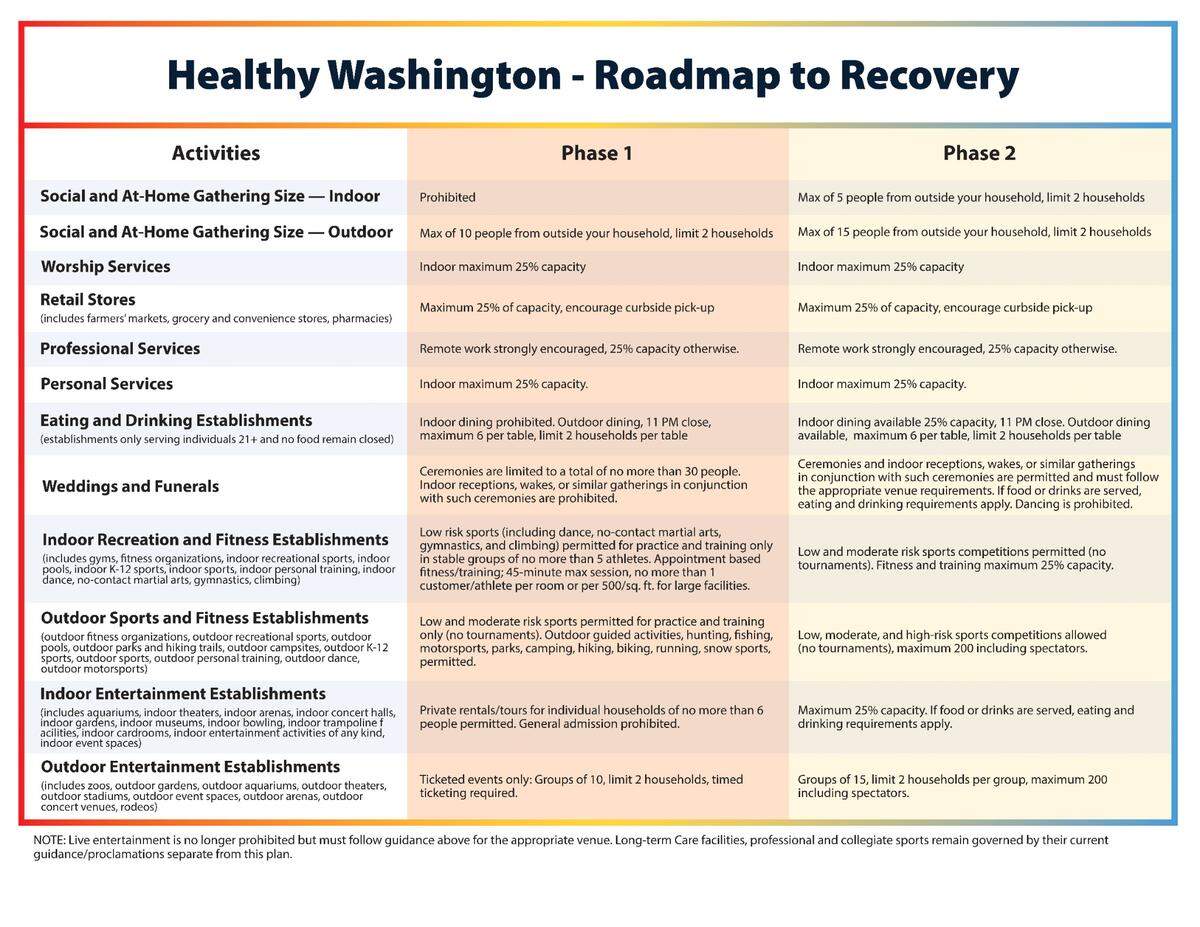
On Thursday Inslee announced the North region, which includes Whatcom, Island, San Juan and Skagit counties will move to Phase 2 along with the East, North Central, Northwest and Southwest regions. It allows live entertainment with ticketed groups of up to 10 people and very limited fitness activities such as appointment-based training in gyms.
Phase 2 allows restaurants and indoor fitness centers to open indoors at 25% capacity and allows for sports competitions to resume with limited spectators, and wedding, and funeral ceremonies can increase capacities.