Whatcom sees 72 new confirmed COVID-19 cases Friday, state reports
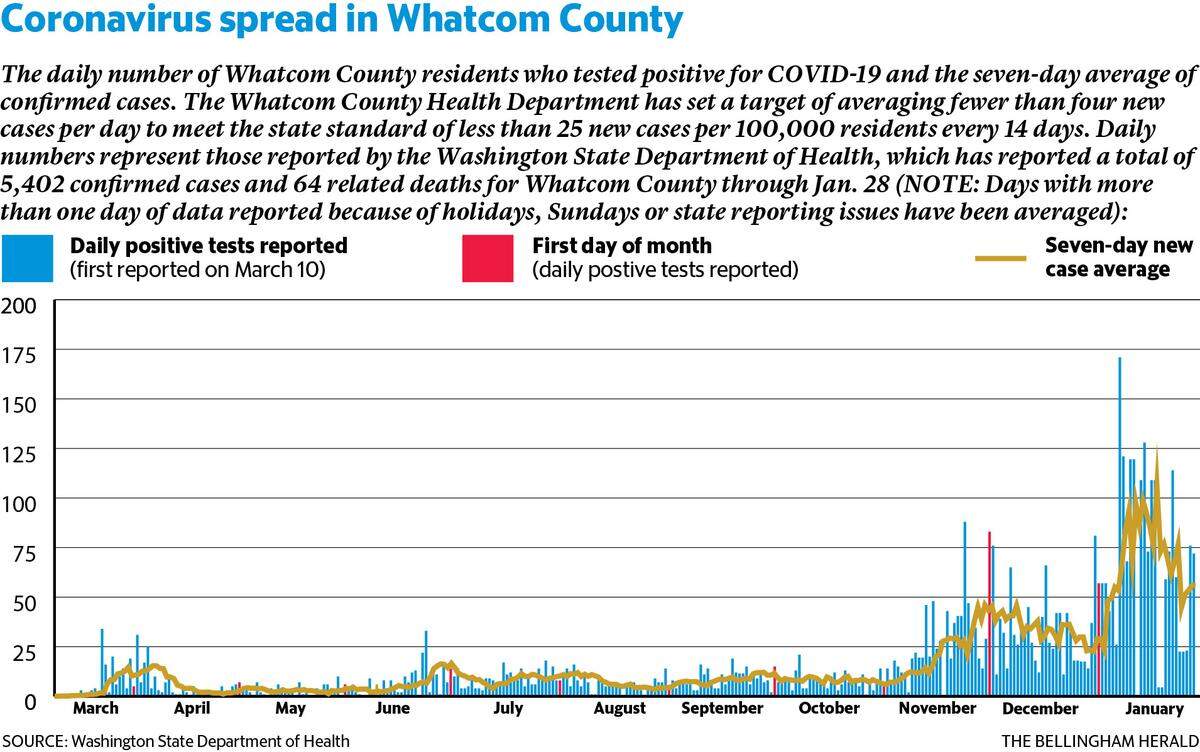
Whatcom County saw 72 new confirmed COVID-19 cases reported by the Washington State Department of Health’s dashboard on Friday, Jan. 29, but no new deaths were reported.
Overall, Whatcom County has seen 5,474 confirmed cases and 64 related deaths during the pandemic, according to state data as of 11:59 p.m. Thursday, Jan. 28, meaning 1.2% of all COVID cases in Whatcom County have been linked to a death.
Seventeen additional probable cases — no change from Thursday’s report — have been reported in Whatcom County during the pandemic, resulting from positive antigen tests not confirmed by a molecular test.
Since Jan. 1, Whatcom County’s reported case total has increased by 2,002 — already the largest count in a month the county has seen by more than 700 cases and more than a third (36.6%) of the county’s total cases during the pandemic.
The state cautioned that Friday’s case numbers could include up to 670 duplicates statewide.
The state Department of Health data Friday also showed Whatcom County has had 273 hospitalizations during the pandemic, an increase of three from Thursday’s report.
The state reported that a total of 147,794 molecular tests have been administered in Whatcom County during the pandemic — an increase of 778 tests from Thursday’s report. The state cautioned that negative test results from Nov. 21-30 and since Jan. 12 still are incomplete.
St. Joseph hospital in Bellingham, which is licensed and staffed for 241 beds, reported to The Herald on Friday it was treating 31 patients for COVID-19, an increase of one from Thursday’s report. The number was down to 26 on Saturday, Jan. 30. St. Joseph has banned visitors at the medical center until further notice while COVID-19 remains a public health threat.
Western Washington University’s most recent on-campus student COVID testing data show Friday evening that since Sept. 15 WWU has tested 18,913 students, 71 of whom had positive tests — one more from Friday’s early report. The college has seen 33 new cases since the school resumed testing following the winter break after seeing 38 cases during the fall quarter.
Whatcom’s risk assessment
The state’s Risk Assessment Dashboard was last updated Friday evening for data as of 11:59 p.m. Thursday, Jan. 28. With a shift to “Healthy Washington” goals to resume business activities, the state is more specific on reporting dates for some metrics. The dashboard does not update on the weekends.
Whatcom County was missing the marks on two key metrics:
▪ Whatcom is missing the target rate of fewer than 25 new cases per 100,000 residents Jan. 6-19 with a rate of 488.2 — a decrease from 520.6 reported Thursday.
▪ Whatcom had an average COVID-19 molecular testing rate per 100,000 people Jan. 5-11 of 432.1. No goal was stated for this metric, however, the overall statewide number was 324.7, but Whatcom’s average was a decrease from the 443.2 reported Wednesday.
▪ Whatcom is missing the target of less than 2.0% of individuals testing positive for COVID-19 Jan. 5-11 with a rate of 9.3% — an increase from the 9.0% reported Thursday.
The latest Healthcare System Readiness risk assessment dashboard, updated Friday evening for data through Thursday, shows for the North region, which combines Whatcom, Skagit, Snohomish, San Juan and Island counties:
▪ Occupied beds: 1,107 of the region’s 1,2656 adult hospital beds (87.5%) were occupied, missing the state’s goal of 80% or less and an increase of 57 occupied beds from data Thursday.
▪ COVID occupied beds: 102 of the region’s 1,265 adult hospital beds (8.1%) were occupied by COVID patients, making the state’s goal of 10% or less and an increase of four occupied beds from data Thursday.
▪ Occupied ICU beds: 99 of the region’s 137 adult ICU beds (72.3%) were occupied. The state does not have a goal for this metric, but it was a decrease of two beds being used from data Thursday.
▪ COVID occupied ICU beds: 24 of the region’s 137 adult ICU beds (17.5%) were occupied by COVID patients. The state does not have a goal for this metric, but it was an increase of one bed being used from data Thursday.
Variant update
The Whatcom County Health Department still has not seen the new B.1.1.7 variant of the COVID-19 virus, commonly known at as the “UK variant,” in Whatcom County, according to a release Friday, despite being reported in nearby Snohomish and Pierce counties.
The variant is more easily transmissible than the virus seen during the first 10-plus months of the pandemic, according to the release, but it does not appear to cause greater harm.
“Everything we’re already doing — wearing masks, washing hands and watching distance — works just as well in preventing transmission of this new variant,” the news release read, adding that the vaccines already available work against the variant.
If the variant does appear in Whatcom County, caseload and hospitalizations could increase, the release said.
Previously, the health department has said that Northwest Labs is looking for the variant in its tests, and the health department will announce if and when it appears in Whatcom County.
Lynden wastewater report
After seeing a spike of 1.02 million viruses per liter of wastewater last week, Lynden has continued to see high viral counts this week, according to a Facebook post by the Lynden Chamber of Commerce.
“These testing results confirm the previously stated concerns that a new baseline has been established, meaning that as measured daily, there are now a greater number of individuals with COVID than before,” the post read, citing viral counts of 609,000 on Jan. 22 and 586,200 on Tuesday, Jan. 26.
The higher numbers mean that more people have the virus, according to the post, as the city’s baseline to show how active the virus is within the community has been raised to 500,000 viruses per liter. Last summer, that mark was considered only 30,000 per liter and the target is now 100,000.
In data released by the health department Tuesday, Lynden’s confirmed case count for the pandemic jumped by 132 and the region had the highest infection rate (1,245 cases per 100,000 residents over a two-week period) in the county.
“What WILL and CAN interrupt this trend is the basics we all know: Avoid large group gatherings, and yes, this also means the indoor sports with spectators and mask, social distance, and wash hands FREQUENTLY, for 20 seconds,” the post read.
The post went on to say Lynden is, “around 15,000 infections short of herd immunity, which means we could expect another 100-150 more deaths in the Lynden area. Maybe not the route we want to take right now.”
Antibody testing
Bloodworks Northwest, a blood bank and medical research institute that has a branch in Bellingham at 410 W. Bakerview Road, No. 117, announced in a news release that it will be testing all blood donations for COVID-19 antibodies during the month of February.
Antibody tests indicated if a donor’s immune system has produced antibodies to the COVID-19 virus, regardless of if the donor has previously shown symptoms.
Donors who test positive for the COVID-19 antibodies will receive follow-up contact from Bloodworks to see if they can make a convalescent plasma donation, which may further help patients, according to the release. Donors will be mailed their test results within two weeks.
“Providing COVID-19 antibody testing indicates for donors if they had previous exposure and infection whether they realized it or not and if they have the special ability to help build a supply of convalescent plasma to provide to patients with serious or immediately life-threatening COVID-19 infections,” Bloodworks’ Executive Vice President of Blood Services Vicki Finson said in the release. “Every eligible donor must come forward so we can support as many patients as possible in our community.”
Donors are urged to make a one-hour donation appointment online at schedule.bloodworksnw.org/DonorPortal or call 800-398-7888. So far, the release said, Bloodworks has provided more than 6,000 convalescent plasma units across Washington, Oregon and elsewhere in the U.S.
Assumption School update
Assumption Catholic School in Bellingham is expected to return to in-person learning on Monday, Feb. 1, according to the school’s Jan. 20 newsletter. Though the newsletter did not say how many had tested positive at the school, it said at least one case was asymptomatic and that the school had returned to remote learning the week of Jan. 25.
“In order to preserve the teachers’ health in the chance that other students were asymptomatic, this current 10-day period of ‘quarantine’ for all students and staff allowed us to resolve any cases before everyone returned in person,” the newsletter read. “As of today, no new cases in the school community have become known and we plan to fully return with all grade levels on Monday, Feb. 1 to celebrate Catholic Schools Week and the beginning of a new semester.”
The school’s Jan. 20 newsletter stated that a teacher had tested positive, and students they had been in contact with had been notified.
Numbers elsewhere
New coronavirus cases and deaths according to Johns Hopkins University Friday evening:
▪ The U.S. has more than 25.9 million reported cases, the most of any nation, and more than 436,541 deaths.
▪ Worldwide, there are more than 102 million reported cases and 2.2 million deaths.
Washington state reported these numbers from the Department of Health Friday evening:
▪ 295,861 confirmed cases, an increase of 1,883 from reported cases on Thursday.
▪ 13,940 probable cases, an increase of 109 from Thursday’s data.
▪ 17,543 coronavirus-related hospitalizations, an increase of 26 from data Thursday.
▪ 4,524,221 total molecular tests, an increase of 28,758 from Thursday’s data.
▪ 4,285 deaths related to COVID-19 were reported, an increase of 42 from Thursday’s report.
Statewide situation report
Washington state is trending in the right direction, according to the latest statewide situation report released Friday.
Both sides of the state have reproductive numbers below 1.0 — 0.73 in western Washington and 0.71 in eastern Washington — meaning the COVID-19 transmission is declining. The reproductive number represents, on average, how many people each person who is diagnosed with COVID-19 infects.
Though case rates remain high across the state, 10 counties had infection rates higher than 200 cases per 100,000 for the two-week period ending Jan. 14. Five counties, including Whatcom, had infection rates higher than 500. But the situation report said Whatcom is seeing slight declines from its record peak levels in January.
Hospital admissions have also flattened, according to the news release on the report, and have even begun to slightly decline since mid-January.
“While we are seeing some initial encouraging signs in the data, disease activity is still high and our state just detected the first cases of a variant that spreads more easily and quickly,” State Epidemiologist for Communicable Diseases Dr. Scott Lindquist said in the release. “Now is the moment to drive down our disease rates and free up more hospital capacity by reducing the number of severe cases that require hospitalization.
“We can all contribute by avoiding gatherings with people who don’t live with us, wearing masks, watching our distance and washing our hands.”
Washington state actions
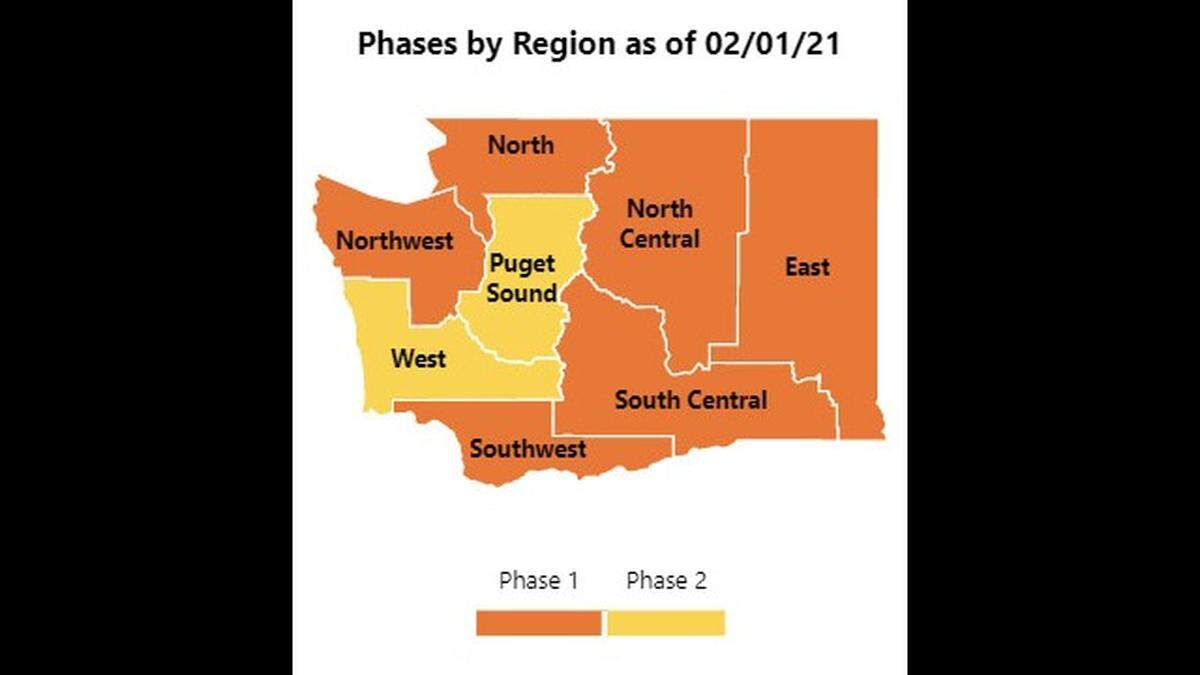
In the “Healthy Washington” plan introduced by Gov. Jay Inslee Jan. 5, business resumption is tied to targets by health system regions. Whatcom is tied to Skagit, San Juan and Island counties in the plan.
The state will run analyses every other Friday to determine whether regions will move backward or forward in phases the following Monday, officials said.
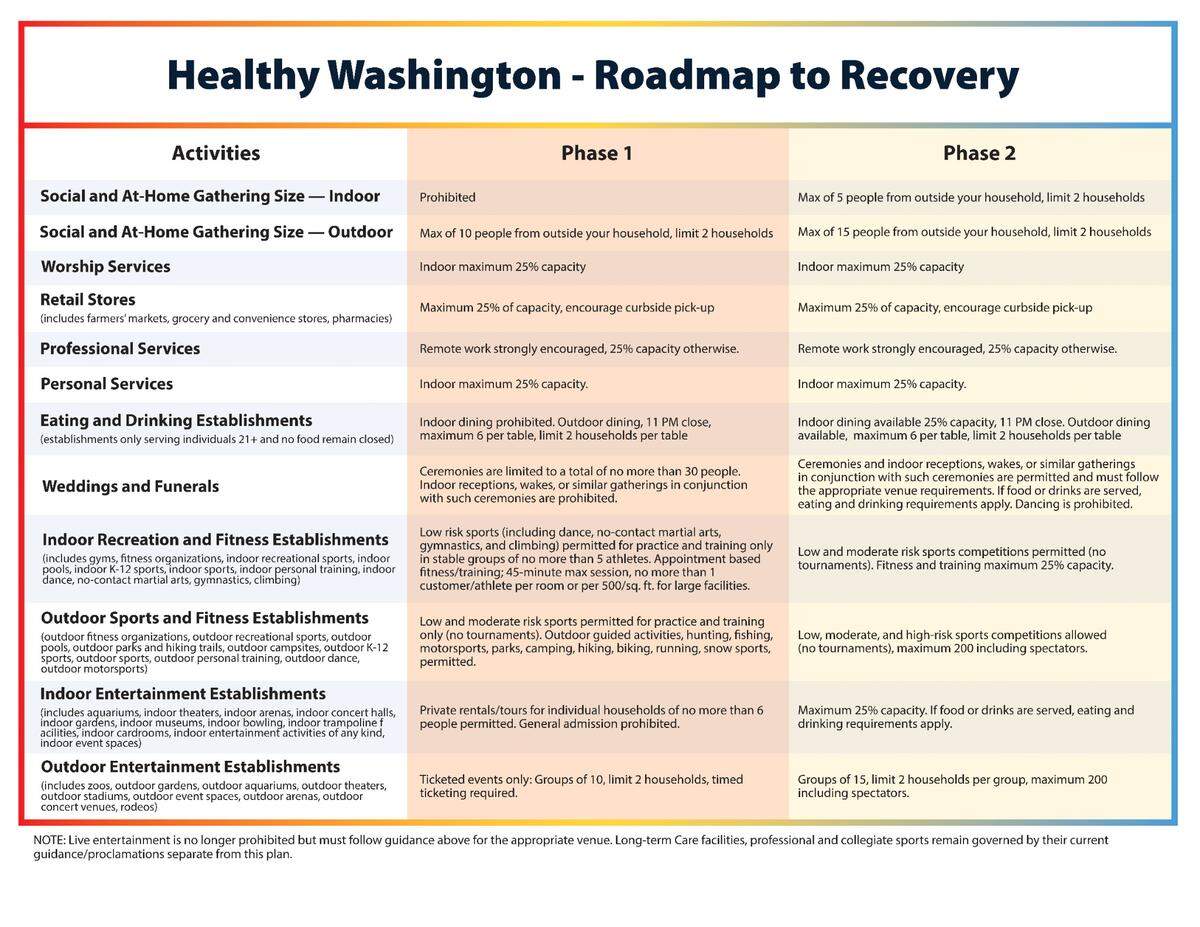
All regions began in Phase 1 on Jan. 11, and the Puget Sound and West Region will move to Phase 2 Monday, Feb. 1. It allows live entertainment with ticketed groups of up to 10 people and very limited fitness activities such as appointment-based training in gyms.
Phase 2 allows restaurants and indoor fitness centers to open indoors at 25% capacity and allows for sports competitions to resume with limited spectators, and wedding, and funeral ceremonies can increase capacities.
Whatcom County is in the North Region, along with Skagit, San Juan and Island counties, and remains in Phase 1.
This story was originally published January 30, 2021 at 5:00 AM.