‘Not a single dose has gone unused,’ PeaceHealth says of its Whatcom COVID vaccine supply
As a pediatrician in Bellingham, Dr. James Bochsler has seen a number of people receive many different vaccinations over the years. But he said there is something different about the people he’s watched receive a COVID-19 vaccine in recent weeks.
“At the vaccine clinics we’ve set up, I see people getting the vaccine, and the smiles I’m seeing and the sense that something good is going to happen is really different from any other vaccine we’re giving,” the vice president and medical director for PeaceHealth Medical Group Northwest told The Bellingham Herald Friday, Jan. 8. “People really do seem to be pleased to be getting it.
“I think they know they’re better protected and their families are better protected, and that is something.”
As of Friday morning, a little more than 3,000 healthcare providers, nurses, first responders and other medical staff have gotten to experience that feeling and received at least their first dose of either the Pfizer or Moderna vaccine at PeaceHealth’s Whatcom County clinics, Bochsler and PeaceHealth Northwest Chief Executive Charles Prosper estimated.
Among those 3,000, Prosper said approximately 2,700 includes caregivers inside Bellingham’s St. Joseph hospital and other providers and medical staff who have received the Pfizer vaccine at a clinic set up at the hospital. Prosper said 280 people have since received their second dose of the Pfizer vaccine.
Additionally, Bochsler said since last week, 368 medical professionals and first responders in Phase 1A, many of whom are from outside PeaceHealth, have received their first doses of the Moderna vaccine at the medical group’s outreach vaccination clinic.
Those numbers do not include Whatcom County residents at long-term care facilities, who are being vaccinated through the Centers for Disease Control and Prevention’s Pharmacy Partnership to provide vaccine to those vulnerable populations. It also doesn’t include others who have been vaccinated through Whatcom’s other community health centers, such as Sea Mar or the Lummi Tribal Health Clinic.
Earlier this week, Whatcom County Health Department Health Information and Assessment Supervisor Amy Hockenberry estimated the county has between 14,000 and 16,000 residents who would qualify for Phase 1A — the top tier in the Washington State Department of Health’s Vaccine Distribution Plan. As of Monday, Jan. 4, she said the county had received 5,900 doses of vaccine — enough for about 37% of its eligible Phase 1A recipients.
The rest of us will all need to exercise patience and vigilance to proper COVID guidelines as we await our turn to be vaccinated over the coming months, Boschler and Prosper said.
“There is a lot of curiosity out there about when I might be able to be vaccinated,” Prosper told The Herald. “We’re following the state guidelines set by the Department of Health and working as fast as we can. Right now, that means we’re focused on the 1A health care providers in our community.”
Not a single dose wasted
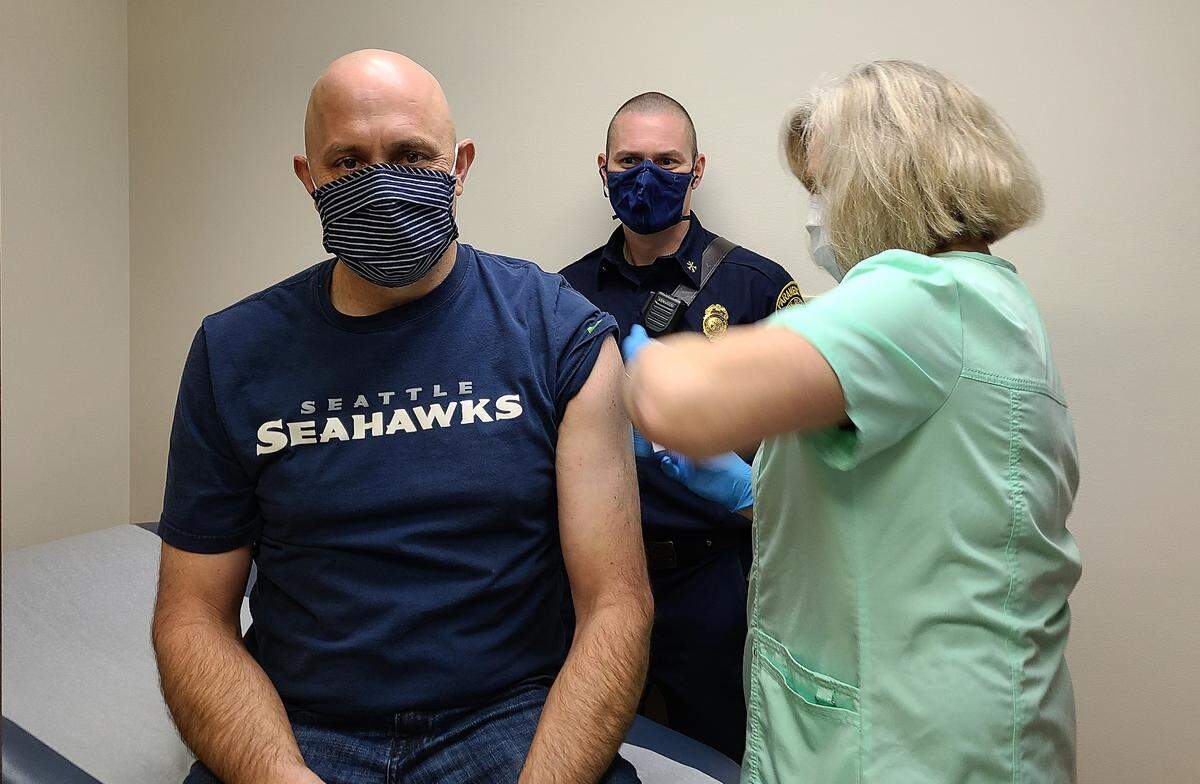
Answering rumors that have surfaced in the community and on social media that some of the doses PeaceHealth has been allocated for Whatcom County have been wasted, Prosper said “not a single dose has gone unused.”
“We are focusing on the amount of available vaccine and requesting as much as we can, but it is still in short supply everywhere,” Prosper said.
Prosper admitted there is some lag time between when PeaceHealth receives a shipment of vaccine and when it’s actually administered. But, he said, that is because extra attention has to be paid to make sure every dose of the vaccine is used and is at its full efficacy.
Each vial contains five or six doses of the vaccine, Prosper said, and because a vial is only good for a limited time once the first dose is drawn, attention has to be paid to make sure five or six recipients are ready to be vaccinated within that window, as the vials can not be placed back into the refrigerator or freezer once they are activated.
“The scheduling is quite complex,” Bochsler said. “We have to make sure we have the right number of people coming in at the right time and the right dosing and the right staffing to administer it.”
Additionally, anybody who receives the vaccine needs to be monitored for at least 15 minutes — 30 if they have certain allergies — to ensure they don’t suffer any adverse reactions during that time frame, Bochsler said. And if that weren’t enough, proper social distancing has to be maintained through the whole process.
Because of those factors, COVID vaccinations can’t be administered like other vaccines during normal doctor’s office visits, Bochsler said. That is why PeaceHealth has set up special clinics for COVID vaccinations and is already thinking ahead to what will be required as more vaccine becomes available and greater numbers of people see their turn come up to receive it.
“It takes a tremendous amount of coordination,” Bochsler said. “It’s substantially more complex than administering the flu vaccine. And on top of that all, we have a very limited time, in terms of the shelf life of the multi-use vials.”
Despite those difficulties, Prosper said, all vaccine that is received in Whatcom County is administered within days of its arrival.
“We are deploying the vaccine as fast as we are receiving it,” he told The Herald. “We are eagerly receiving vaccine materials from the state as they allocate them to us and rapidly deploying them. We are not slowing down and sitting on it. Our goal is to get the vaccinations processed and to people as quickly as possible.”
Proper place in line
Answering rumors that the proper PeaceHealth personnel, such as those who work in the Intensive Care Unit or others who work closely with potential COVID patients, are not the ones receiving the first doses of vaccines, Prosper said guidelines set by the Washington State Department of Health and the Centers for Disease Control and Prevention have been closely followed.
“We’ve made a deliberate effort to focus on those units that care for COVID patients and those with the most general exposure to the public,” Prosper told The Herald. “We are confident that we went through the proper discernment and the highest priority people have first access to the vaccine.”
One of the additional scheduling complications that also could impact who receives the vaccine when, Bochsler said, is that there is a rather narrow window for receiving the second dose. For the Prizer vaccine, it’s plus-or-minus four days three weeks after the first inoculation — plus-or-minus four days four weeks after the first dose for the Moderna vaccine.
If someone misses that window, Bochsler said, they don’t need to start over, but the efficacy of the vaccine is not known if it is missed, and because of that PeaceHealth does its best to make sure to get the proper doses in the proper window. If someone knows that receiving the second dose during the proper window could be an issue, they may be delayed a couple of weeks.
“There are a number of different reasons that could impact the prioritization of who gets vaccinated when,” Bochsler said.
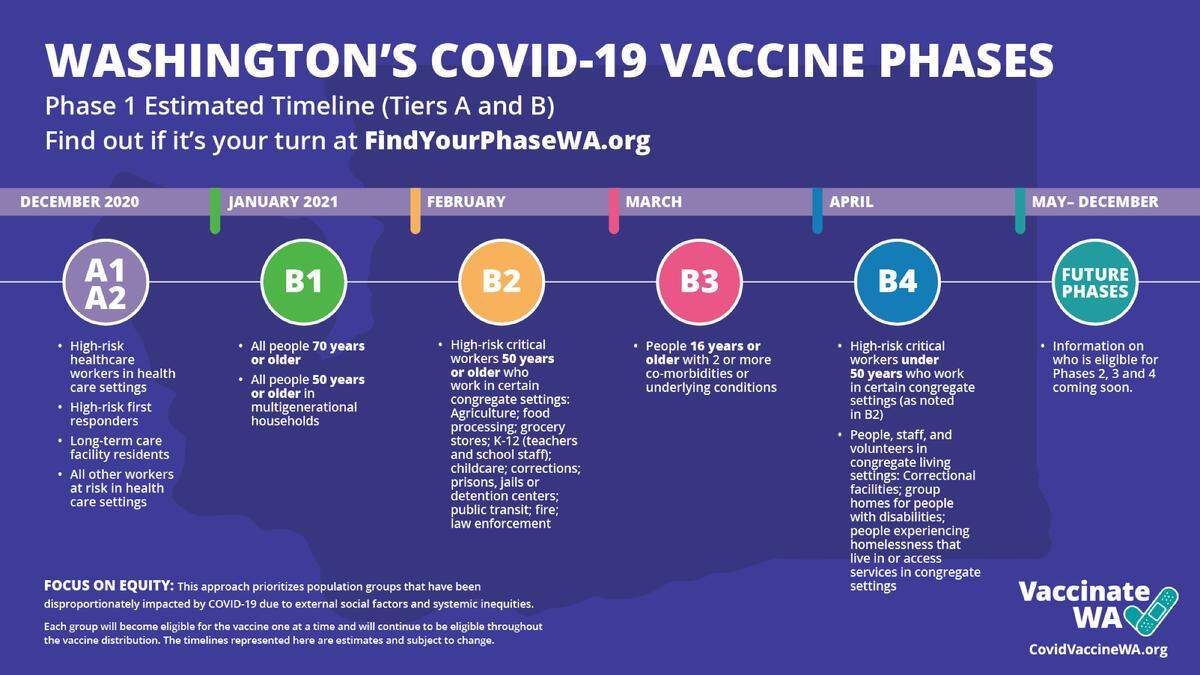
At this time, Whatcom County, and all of Washington state, is administering vaccines to only those in Phase 1, Tiers 1 and 2 (or Phase 1A), which includes:
▪ Healthcare workers at the highest risk of getting or passing COVID-19, including, caregivers, others with direct patient contact in hospitals, home health care, long-term care facilities, urgent care clinics or COVID-19 testing sites.
▪ Paramedics and Emergency Medical Technicians.
▪ Residents in long-term care facilities.
▪ All other workers at risk in healthcare settings.
The state has estimated it could begin to move to Phase 1B late in January.
Those eligible to be vaccinated during that phase would be broken into four tiers:
▪ Phase 1B1 (Tier 1): People 70 and older and people 50 and older who live in multi-generational households.
▪ Phase 1B2 (Tier 2): High-risk critical workers 50 and older who work in congregate settings, such as agriculture, food processing, grocery stores, teachers, childcare, corrections, prisons, jails, public transit, fire and law enforcement.
▪ Phase 1B3 (Tier 3): People 16 and older with two or more co-morbidities or underlying conditions.
▪ Phase 1B4 (Tier 4): High-risk critical workers who work in certain congregate settings under the age of 50 and people, staff and volunteers at congregate living settings, such as correctional facilities, group homes and homeless shelters.
The state Department of Health reported that as of Tuesday, Jan. 5, 425,900 doses of the Pfizer and Moderna vaccines had been delivered to the state and healthcare providers reported 110,225 of those had been administered to Phase 1A recipients since mid-December. Those numbers included doses set aside for long-term care facilities.
Next week, the state says it is expecting 44,850 Pfizer doses for people receiving their first inoculation and 62,400 doses for those receiving their second. The state also expects 44,100 first Moderna doses next week.
The beginning, not the end
Each lesson that is learned during these early stages of vaccination is being used to help plan for the future when more vaccine is available and greater numbers of people are eligible to receive it, Bochsler said.
“Not only at PeaceHealth, but there is a concerted effort in the rest of the medical community planning and getting ready for larger numbers of people to be vaccinated when we have more to distribute,” Bochsler said. “There is a lot of pre-work and planning going on for when we have more. We are planning for the best way to get everybody vaccinated.”
Bochsler said PeaceHealth has emphasized coordinating with Whatcom County’s entire medical community to help set up designated clinic space for when that day comes.
“The past 11 months, our caregivers and providers had to face risks of COVID each and every day as they came into work,” Prosper said. “They’ve protected themselves with PPE and social distancing and proper hand washing, and they’ve always continued until we had broad vaccination across our community.
“I think they’re excited and relieved. This is one of the most positive things that could happen as we protect and strive to protect the broader community.”
For many, Bochsler said, being vaccinated is a signal that this could be the start of the end of the pandemic.
“The devotion we’ve seen from the entire medical community during this pandemic has been tremendous,” Bochsler said. “It’s been a great demonstration of the care and commitment the entire medical community has for our community.”
But this is not the end, Prosper and Bochsler cautioned.
Just because some members of the community have been vaccinated against COVID-19, it doesn’t give them — or anyone else — a free pass to let up.
“Resist the fatigue and keep wearing masks, social distancing and hand washing and protecting yourself,” Prosper said. “We realize that many significant sacrifices have been made. That hard work needs to continue in order to protect our community.
“We (PeaceHealth) are going to continue to ask for more vaccine supply in the future. We are absolutely committed to distributing it. But we are not out of this yet. We need to maintain those good practices so we can all stay safe and get through this as a community.”