New state COVID-19 business reopening plan tied to cutting regional case rates. Here’s how
So long, Safe Start — Washington Gov. Jay Inslee on Tuesday unveiled a new plan for reopening the economy from COVID-19 restrictions.
“2020 is officially behind us, we know that brighter days are ahead,” Inslee said at a virtual press conference, “and we’re here to talk about a new way to move our state forward economically while we’re beating the pandemic.”
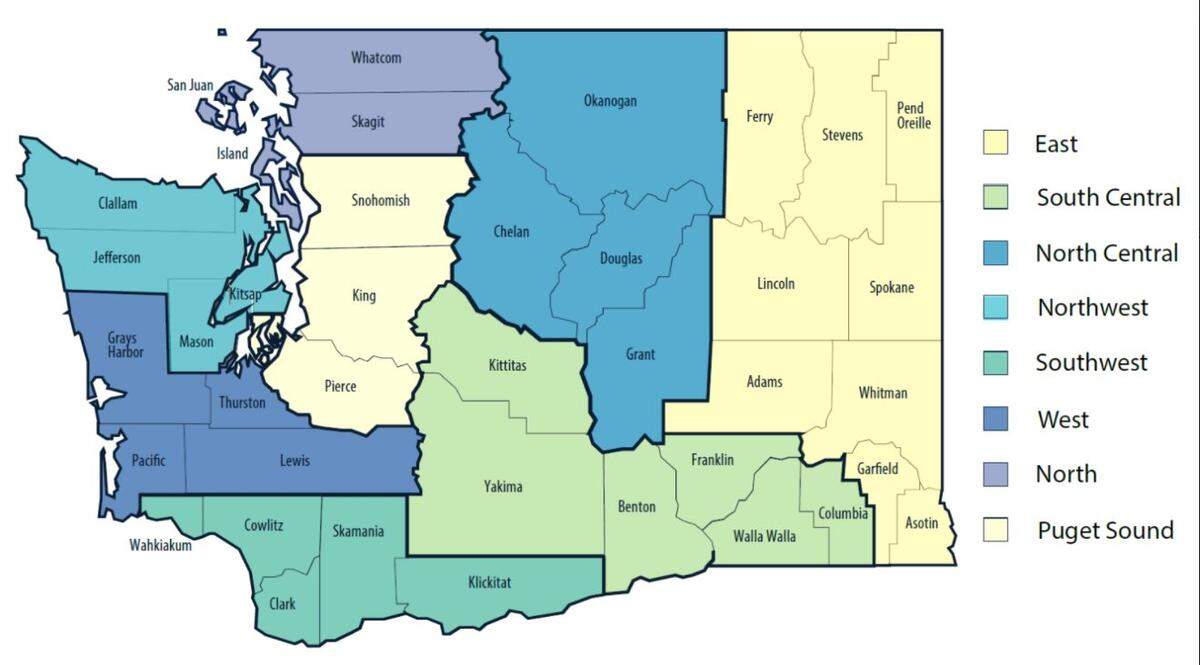
Under the new “Healthy Washington—Roadmap to Recovery” plan, counties are grouped into eight regions of at least four counties each, based on health system resources. All regions are currently considered to be in Phase 1 of the two-phase plan, which goes into effect Jan. 11.
Whatcom is tied to Skagit, San Juan and Island counties in the plan.
The governor’s office foreshadowed that there would be a new plan last week, when he extended current statewide restrictions only one week through Jan. 11. Those limitations have closed restaurants and bars to indoor dining, gyms to indoor activity, and limited occupancy at retail stores to 25% since mid-November.
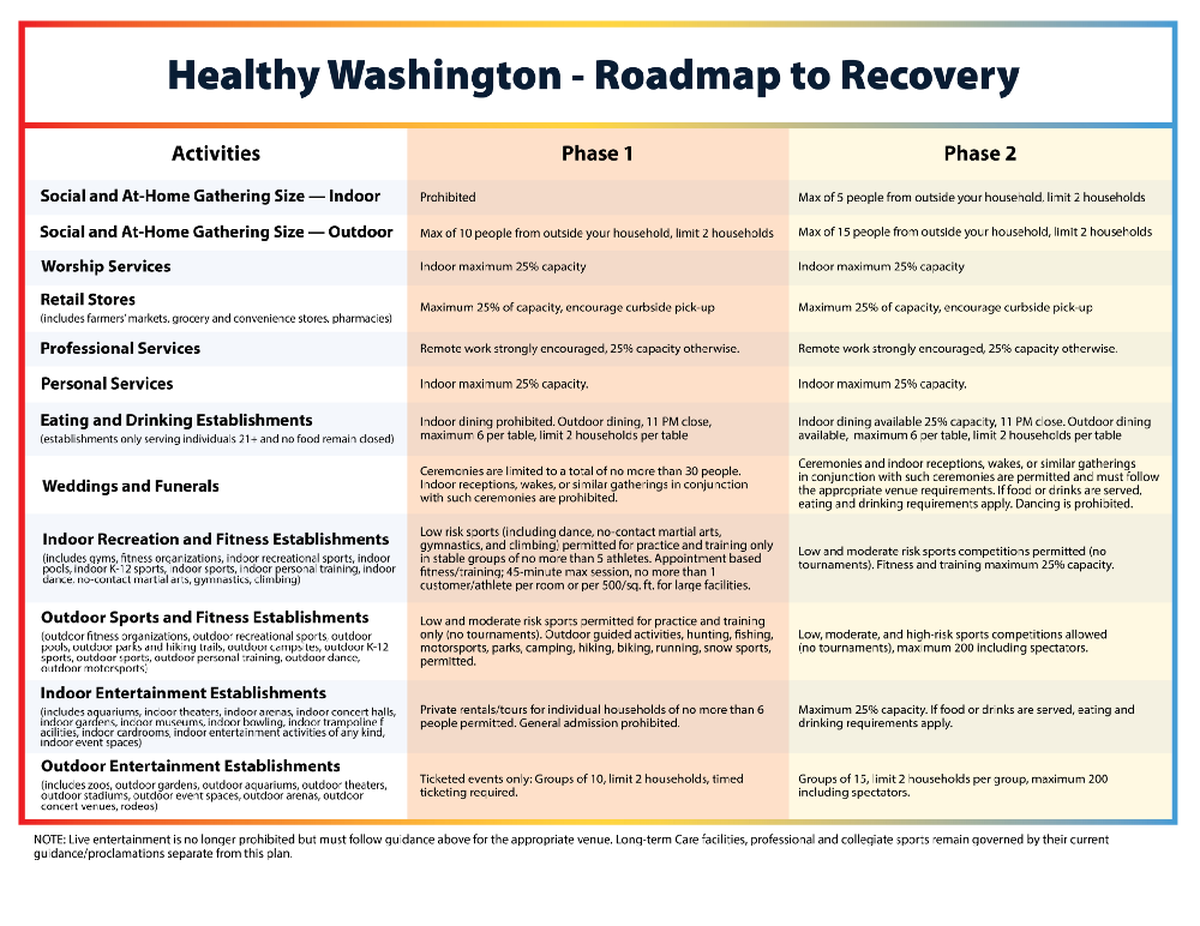
Phase 1 of the new plan mostly aligns with statewide restrictions currently in place, but includes what Inslee called a “small resumption of activity statewide.”
While fitness centers have been closed to indoor activity, some very limited fitness activities will be allowed, for example, such as appointment-based training in gyms with a maximum of 45-minute sessions with no more than one customer per room (or per 500 square feet in big facilities).
Outdoor entertainment hasn’t been allowed, but ticketed groups of 10 people with a limit of two households will be allowed at “outdoor entertainment establishments,” including zoos and outdoor concert venues. Timed ticketing is required under the plan, along with the standard mask and physical-distancing requirements.
Indoor social gatherings are still prohibited, but the maximum number of people allowed at outdoor social gatherings in Phase 1 will increase to a maximum of 10 people from outside your household, with a limit of two households. Current restrictions set that limit at five people from outside the household or fewer.
Indoor dining is still prohibited in Phase 1, while outdoor dining is allowed with a maximum of six people and two households per table. Retail stores are still limited to 25% capacity.
In Phase 2, restrictions relax a bit — indoor social gatherings of 5 or fewer people from outside the household and a limit of two households are allowed, for example, and the outdoor social gathering restriction loosens to 15 people from two households.
Restaurants in Phase 2 can open for indoor dining at 25% capacity. Indoor fitness centers can open at 25% capacity. Outdoor sports can go from practice and training to competitions, but still no tournaments. “Indoor entertainment establishments” such as theaters, museums, and bowling can go from offering private rentals or tours for households of up to six people to opening at 25% capacity.
More phases could be added as the state of the pandemic in Washington evolves, according to the governor’s office.
Moving through phases
To advance to Phase 2 in the new plan, a region has to meet four targets: A 10% decline in case rates per 100,000 population over the last 14 days compared to the prior two weeks, 10% decline in two-week COVID hospital admission rate per 100,000 population, total ICU occupancy rates below 90%, and a test positivity rate below 10%, according to officials.
Regions have to keep meeting at least three of the metrics to stay in Phase 2, though the trend metrics will have a little more flexibility than ICU occupancy and test positivity rates. Regions can have declining or flat case rates and COVID hospital admission rates and still be considered meeting those metrics, said Lacy Fehrenbach, Deputy Secretary for COVID-19 Response at the state Department of Health.
Regions that fail two or more metrics slide backward to Phase 1 under the plan.
The flexibility to meet just three of the metrics and to have flat trends while in Phase 2 are meant to provide stability within the system, especially when a region moves forward and activity initially increases there, according to Fehrenbach.
There’s no application process this time to move through phases: The state will run analyses each Friday, including this week, to determine whether regions will move backward or forward in phases the following Monday, officials say.
Each region’s metrics will be available on the state’s Risk Assessment Dashboard on Fridays, according to the governor’s office.
“The numbers will tell the tale,” Inslee said.
Restaurant, bar capacity
Bars and restaurants were generally not surprised when Gov. Inslee extended November’s rollback through the new year.
The governor’s announcement was a step in the right direction, although not as expansive as hoped, said Guy Occhiogrosso, president/CEO of the Bellingham Regional Chamber of Commerce.
“It’s a path to reopening for restaurants and fitness centers,” said Occhiogrosso, but added he was hoping Phase 2 would be at 50% capacity for indoor dining.
At 25% capacity, Occhiogrosso said some local restaurants that closed during the current set of restrictions may not be able to reopen.
“At 50% it is a more financially feasible point to reopen,” Occhiogrosso said.
Occhiogrosso said the general attitude among his members varies on a case-by-case basis. Some are a little more optimistic with the current stimulus package in place and a vaccine being distributed, but it also remains very difficult to survive this current set of restrictions.
The Washington Hospitality Association was not pleased with the governor’s new plan.
“Today’s announcement is not a roadmap to recovery. It is a roadmap to a near-complete collapse of main street neighborhood restaurants and hospitality businesses,” the association said in an emailed statement.
The association believes that opening restaurants will help drive down cases.
“We know that the increase in cases over the last two months is due to private social behavior – not restaurants. In fact, restaurants provide a place with effective protections that allow people to gather safety, but not while we’re closed,” the association said in the email statement.
Lower rate nationally
Before the current statewide restrictions, counties’ progression through the state’s four-phase “Safe Start” reopening plan had been paused since summer.
Inslee announced that plan in early May, and an expansion by the end of the month allowed counties to move through phases of reopening. By the end of June, cases were rising, a statewide mask mandate went into effect, and officials paused counties moving to Phase 4.
Not long after, the state paused all county advancements, though requirements in some phases had been tweaked since, allowing more activity in some phases.
The rules introduced in November were the most sweeping for Washington since March, when Inslee issued the two-week “stay-at-home” order requiring most residents to stay home unless going out for necessities such as groceries, a doctor’s appointment, or the pharmacy.
The restrictions were introduced in response to a raging “third wave” of the virus. The state is seeing signs that disease growth has slowed, and Washington has one of the lowest rates of the disease in the nation, Secretary of Health Dr. Aumair Shah said Tuesday.
Shah said the governor’s latest restrictions are working, but “we’re not out of the woods yet.”
This story was originally published January 5, 2021 at 6:02 PM.