Whatcom sees 14 new COVID-19 cases Monday, as three areas had surges last week
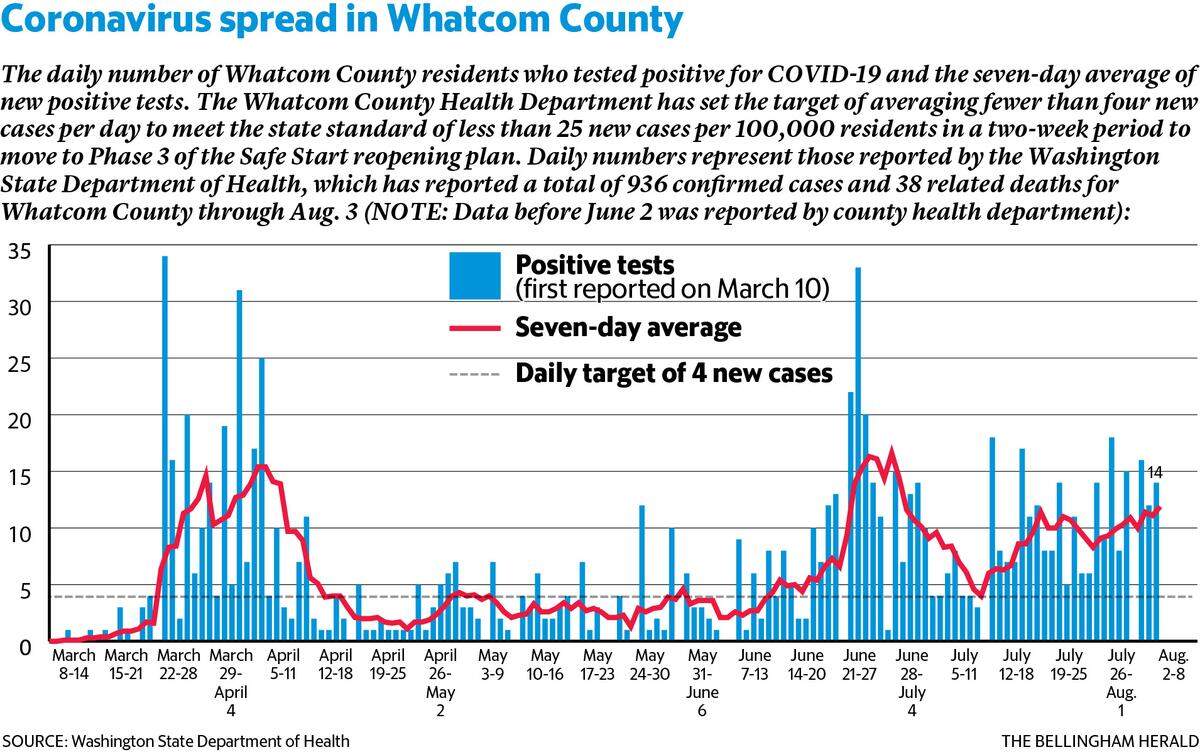
Fourteen more Whatcom County residents have tested positive for COVID-19 according to the Washington State Department of Health on Monday, Aug. 3. No new deaths were reported.
Whatcom County now has had 936 confirmed cases and 38 deaths during the pandemic, according to the state. The new numbers mean 4.1% of people diagnosed with the new coronavirus in Whatcom have died — according to state Department of Health data as of 11:59 p.m. Sunday, Aug. 2.
The state also reported Monday that Whatcom County has had 80 hospitalizations and has conducted 32,697 tests, with 2.9% returning positive results.
The most recent data from the state’s Risk Assessment Dashboard, reported on Thursday, July 30, for data ending 11:59 p.m. Wednesday, July 29, shows Whatcom County missing four of five Phase 2 metrics goals:
▪ Whatcom is missing the target rate of fewer than 25 new cases per 100,000 residents every 14 days with a rate of 62.6.
▪ Whatcom is missing the target rate of more than 50 individuals tested for each new confirmed case the past week with a rate of 46.0.
▪ Whatcom is missing the target of 2% or less of individuals testing positive for COVID-19 during the past week with a rate of 2.2%.
▪ Whatcom is missing the target of less than 80% of all licensed hospital beds occupied by non-COVID-19 patients with 84.3% reported by the state.
▪ Whatcom is making the target of less than 10% of all licensed hospital beds being occupied by COVID-19 patients with 1.2% reported by the state.
St. Joseph hospital in Bellingham reported to The Bellingham Herald on Monday that it was treating two patients for the new coronavirus.
U.S. and Washington state
More than 18.3 million cases of COVID-19 have been confirmed worldwide, with more than 694,713 deaths as of Tuesday morning, according to Johns Hopkins University. The United States has over 4.71 million confirmed cases — the most reported cases of any nation — and at least 155,478 related deaths.
Overall, the Washington State Department of Health Sunday evening reported 58,715 cases (an increase of 542), 1,600 deaths (an increase of four) and 5,744 coronavirus-related hospitalizations (an increase of 52). Approximately 2.7% of all confirmed cases in the state have resulted in death, while 5.8% of the 1,008,822 tests administered have come back positive for COVID-19.
Whatcom’s COVID case locations
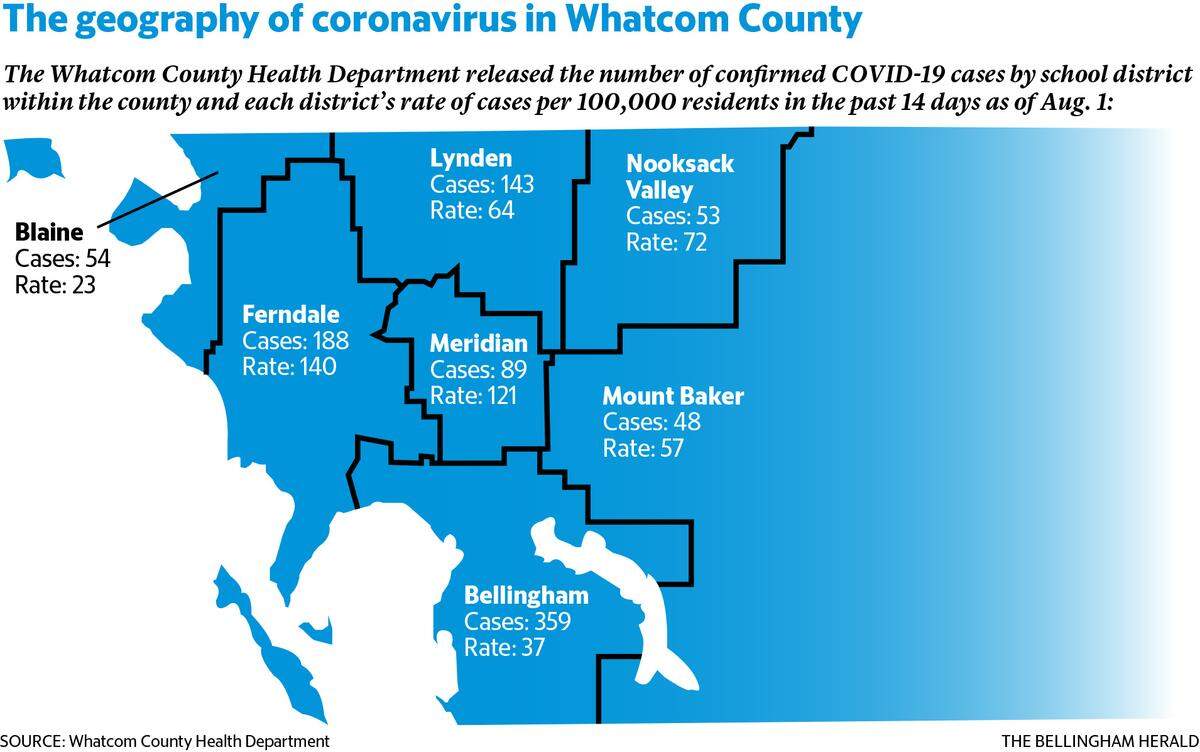
More than half of Whatcom County’s seven school districts saw their coronavirus infection rates rise last week, though the number of reported COVID-19 cases within the Meridian School District boundaries — an area that has seen one of the county’s highest infection rates in recent weeks — did begin to slow.
The Whatcom County Health Department, which releases data on COVID-19 positive tests by school district, published new data on its website Monday, Aug 3.
Last week’s data was the first time the county began releasing the rate of infection per 100,000 over the past 14 days, rather than a cumulative total. The Ferndale district continued to have the highest infection rate, while Blaine is now the county’s lowest.
Three districts — Ferndale, Mount Baker and Nooksack Valley— had the number of cases grow by at least 14% last week, while the county, overall, saw its number of cases grow by 10% between July 25 and Aug. 1.
Here is what the data showed for the seven regions in the county:
Bellingham: Up 8.8% (29 cases) since July 27 to 259 cases, and the rate of new cases per 100,000 residents in the past 14 days increased from 29 to 37.
Blaine: Up 5.9% (three cases) since July 27 to 54 cases, and the rate of new cases per 100,000 residents in the past 14 days decreased from 28 to 23.
Ferndale: Up 15.3% (25 cases) since July 27 to 188 cases, and the rate of new cases per 100,000 residents in the past 14 days decreased from 147 to 140.
Lynden: Up 8.3% (11 cases) since July 27 to 143 cases, and the rate of new cases per 100,000 residents in the past 14 days increased from 54 to 64.
Meridian: Up 4.7% (four cases) since July 27 to 89 cases, and the rate of new cases per 100,000 residents in the past 14 days decreased from 186 to 121.
Mount Baker: Up 14.3% (six cases) since July 27 to 48 cases, and the rate of new cases per 100,000 residents in the past 14 days increased from 44 to 57.
Nooksack Valley: Up 15.2% (seven cases) since July 27 to 53 cases, and the rate of new cases per 100,000 residents in the past 14 days increased from nine to 72. Before this week, Nooksack Valley did not have any reported cases the when data was released the previous two weeks.
Race and ethnicity
Race and ethnicity data for Whatcom County residents testing positive for COVID-19 also was updated Monday.
Hispanic residents, who can be of any race, represent 29% of the confirmed COVID-19 cases in the county — slightly up from 28% from data released July 27 — though 9% of the county identifies as Hispanic.
According to the health department data, 62% of the confirmed COVID-19 cases in Whatcom County are white residents — a drop from 65% reported July 27 — though 82% of the county’s population identifies as white.
Meanwhile, 6% of confirmed cases are for residents who identify as American Indian or Alaska Native — unchanged from July 27 — though those races represent only 3% of the county’s population.
Asian and Native Hawaiian/Pacific Islander residents account for 3% of the county’s coronavirus cases — unchanged from July 27 — though those races represent 5% of the county’s population.
Black residents account for 1% of the county’s COVID-19 cases — down from 2% on July 27 — slightly lower than the 2% of Whatcom’s total population that identifies as Black.
The remaining 9% of the county’s coronavirus cases were listed as “other” in the health department’s data.
Herd immunity
Because of the number of unknowns surrounding COVID-19, the Whatcom County Health Department said it’s not the best way to help slow the spread of the respiratory illness in our community.
“The best way to lower transmission is to stick with the work we’ve been doing, like wearing a face covering, keeping gatherings small and maintaining at least six-feet of physical distance,” the health department said in a release Sunday, Aug. 2.
Herd immunity, the health department said in the release, occurs when a high percentage of the community develops an immunity to the disease either by vaccination or prior illness, making the person-to-person spread unlikely, even for those who have not been vaccinated.
But for herd immunity to work with COVID-19, which is very contagious, many experts estimate 70% of the people would need to develop immunity — approximately 160,000 Whatcom County residents, the health department said.
“Relying on herd immunity to lower the spread of COVID-19 before we have a vaccine would mean that a significant number of people would need to become infected, unnecessarily putting many people’s lives at risk,” the release stated.
Also, the health department said, it is not yet known for sure if people who have been infected with COVID-19 become immune afterwards or for how long.
“Most people who’ve recovered from COVID-19 do make antibodies against the virus,” the release stated. “But so far, it’s unknown whether this will protect them against the virus if they’re exposed to it again.”
Phased reopening
Gov. Jay Inslee July 28 extended the pause indefinitely on counties moving ahead in the Safe Start Washington plan.
Five counties remain in a modified version of Phase 1, 17 counties — including Whatcom — are in Phase 2 and 17 counties are in Phase 3.
Phase 2 allows restaurants and taverns to operate at half capacity with table occupancy limited to five, hair and nail salons and barber shops to resume business, and retail stores to reopen for in-store purchases at 30% capacity. It also allows additional outdoor recreation and gatherings with no more than five people outside of a person’s household.
Phase 3 allows gyms and movie theaters to operate at half capacity and restaurants to increase capacity to 75%. A prohibition on bar seating at restaurants and taverns was added in this phase earlier in July.
This story was originally published August 3, 2020 at 1:48 PM.