
Ready to start investing? This is what you should know about bonds
Investing terms can be very confusing. We’re breaking them down, starting with bonds.
So what are bonds? They are a debt obligation where you lend money to a company or government and receive interest plus the principal in return.
Let’s say you’re sitting at the lunch table in third grade. Your friend (who represents the government or a corporation) asks you for a pack of Skittles (the bond). Your friend promises to pay you back with the Skittles in one month (the maturity of the bond) and will bring you a mini Reese’s Pieces (the fixed interest) each week until the month is up.
Just because you gave your friend Skittles doesn’t mean you can tell them what to do with said Skittles.
Similarly, buying a bond doesn’t give you any ownership rights — one way bonds are different from stocks. It’s you giving a loan to the bond issuer.
With bonds, you get paid through interest payments (Reese’s Pieces). And if you hold it to maturity, you can get the initial amount (full pack of Skittles) you paid back.
You can profit if you resell the bond for more than you paid. However, bonds will give you smaller returns than stocks and the yields can fall. Plus, companies (and your friend since 1: third-graders can’t take themselves to the store and 2: don’t always have money to buy Skittles) can default on these.
When you include bonds in your investment portfolio, they give you an income stream and mitigate risks from the stocks in your portfolio.
The definitions to know:
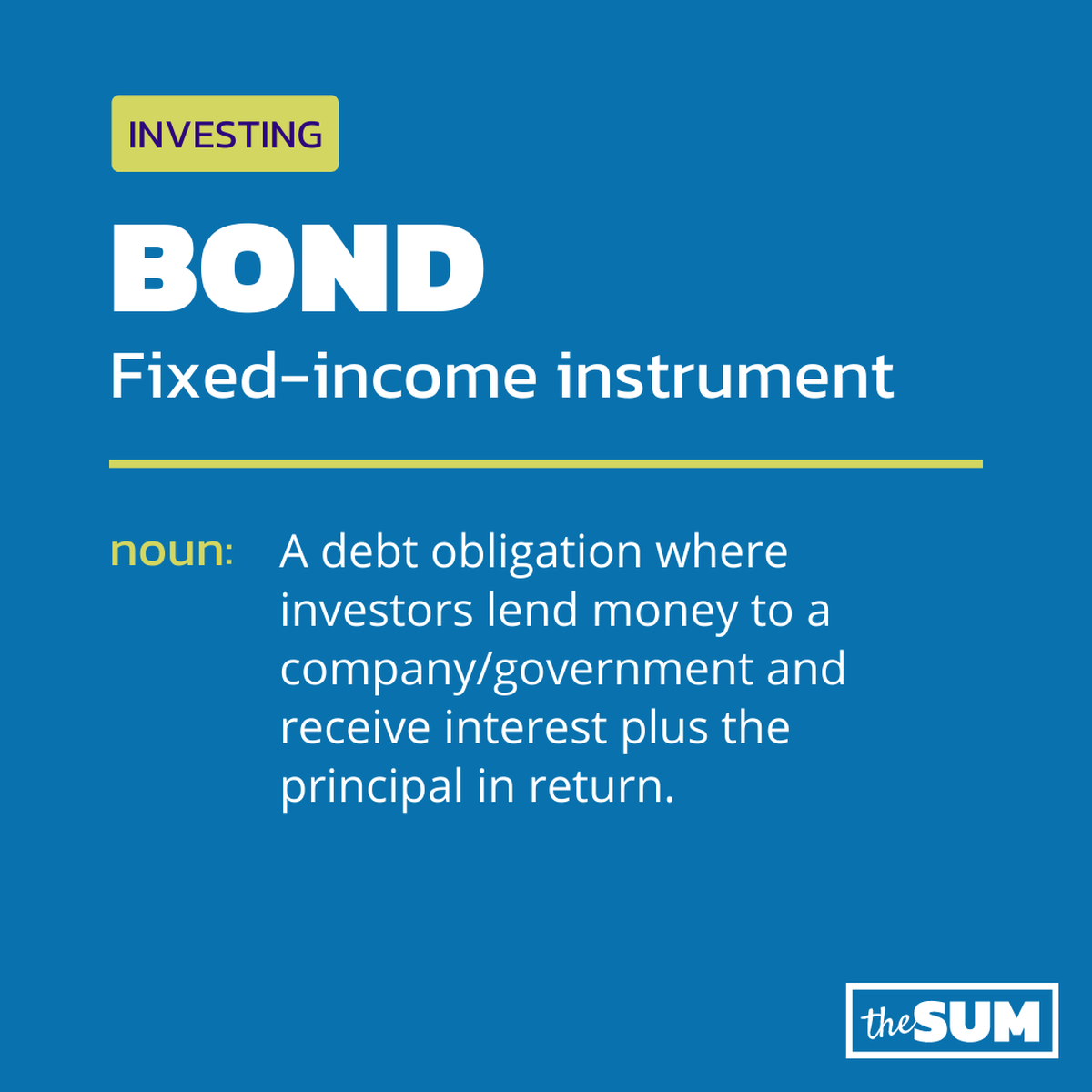
Bond: A debt obligation where investors lend money to a company/government and receive interest plus the principal in return.
Coupon rate: The interest paid to bondholders, usually annually or semiannually. To calculate: divide the annual payments by the bond’s face value.
Maturity date: The date when the principal is paid to investors, ending the obligation from the company or government. Can be short (1-3 years), medium (over 10 years) or long-term.
Face Value (Par value): How much the bond is worth when issued and paid to the bondholder once it matures. Does not indicate the actual market value.
Yield to maturity: The annual return if a bond is held to maturity and all coupons are reinvested at the same rate. Other measures of return: Current yield, nominal yield, yield to call and realized yield.
Price: How much a bond would cost on the secondary market. One factor considers how favorable its coupon is compared to other bonds. When interest rates go up, bond prices go down.
Duration risk: Measured in years, assesses a bond’s sensitivity to interest rate changes. Coupon rate and time to maturity affect duration. Higher duration = the more a bond’s price drops as interest rates rise.
Bond ratings: The strength of a bond in its ability to pay principal/interest. The higher the rating, the lower the risk of default. Ratings BBB to Baa or above = investment grade. BB to Ba or below = junk bonds.
Sources:
- Investopedia: 4 Basic Things to Know About Bonds
- Investopedia: Face Value: Definition in Finance, Comparison With Market Value
- Investopedia: Duration Definition and Its Use in Fixed Income Investing
- Vanguard: What is a bond?
- Forbes: Fixed-Income Basics: What Is A Bond?
- Nerdwallet: What Are Bonds and How Do They Work?
- U.S. Securities and Exchange Commission: What Are Corporate Bonds?
READ MORE ABOUT THIS IN THE SUM
The Sum breaks down complex economic issues and how they impact your life in just a few minutes a day. Follow thesum.news on Instagram for the full story.
This story was originally published January 6, 2023 at 12:14 PM with the headline "Ready to start investing? This is what you should know about bonds."