What’s behind the promising decline in Whatcom County drug overdoses, deaths in 2024?
Drug overdoses and overdose deaths appear to have dropped sharply across Whatcom County over the past year, as programs aimed at prevention, intervention, treatment and follow-up care are showing signs of success.
Officials at the Whatcom County Department of Health and Community Services and other agencies are keeping their fingers crossed that the trend will hold.
For 2024, there were 83 confirmed or probable overdose deaths in Whatcom County — 54 fewer than there were in 2023.
“The numbers are definitely trending in a direction that we like to see,” epidemiologist Jake Brandvold told The Herald in a Dec. 20 interview with several officials at the Whatcom County Department of Health and Community Services.
“We are hopeful that we continue to see these low numbers and that it is reflective of what is going on in the community,” Brandvold said. But that doesn’t mean that we are going to slow down on our efforts or anything. We want to remain vigilant in the services that we are providing to make sure that we keep seeing numbers like this.”
Preliminary reports through December show that there were 1,247 suspected drug overdoses as determined by emergency medical services calls last year, down from 1,456 in 2023, according to figures posted at the Whatcom Overdose Prevention website. Overdoses are “probable” until confirmed by blood work, which can take months, officials at the Whatcom County Medical Examiner’s Office told The Herald.
“We still have a considerable amount of cases where we’re waiting on toxicology results,” said Louise Trapp, operations manager at the Medical Examiner’s Office. “We want to have good data. There are results that are still pending. It’s several months’ worth.”
Even so, the number of probable drug overdose deaths in 2024 stands in stark contrast to 2023, and Health Department officials said they didn’t see signs of a sharp rise in December overdose deaths.
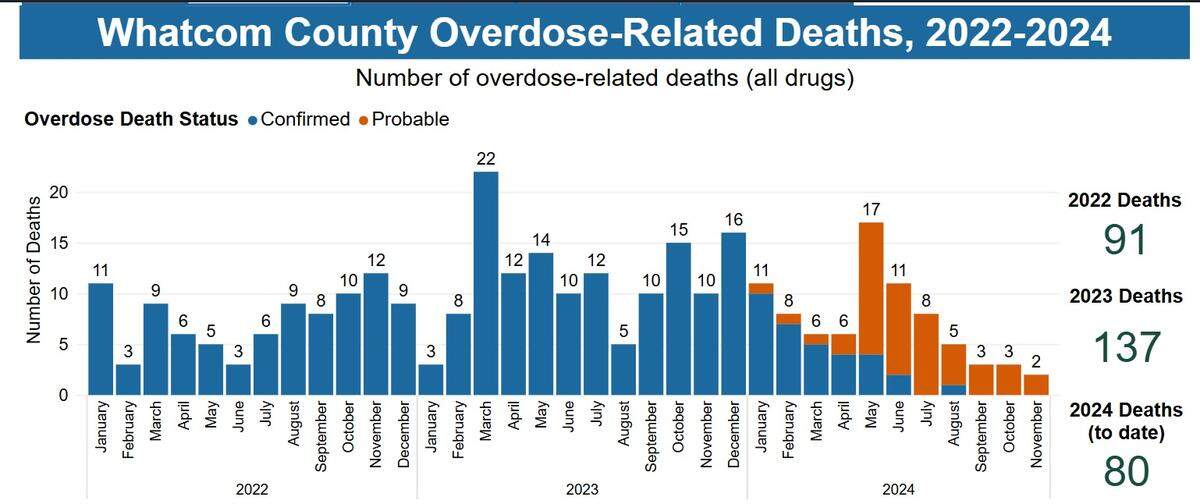
That reverses the steep annual increases in drug overdoses and overdose deaths over the past five years, mirroring a trend seen across the United States, according to a recent report from the U.S. Centers for Disease Control and Prevention.
Overdose deaths in Whatcom County soared from 91 in 2022 to 137 in 2023, fueled by cheap and easily available drugs — especially the synthetic opioid fentanyl — coupled with rising rents, homelessness and a decline in livability among the area’s poorest and most vulnerable people.
But 83 deaths is still an alarmingly high human toll, said Kari Holley, an opioid prevention specialist with the Health Department.
“We’re still five times higher than we were five years ago,” Holley told a Whatcom County Council committee on Tuesday.
According to the medical examiner’s annual report, 17 people died of drug overdoses in 2019.
Some 58% of all overdoses were linked to opioids last year, down from 66% in 2023. In 2019, opioids accounted for 49% of all overdoses.
Fighting the epidemic
Whatcom County officials are determined to ease fentanyl’s carnage and began attacking it as a public health crisis similar to the way that governments respond to a natural disaster. In 2023 the county formed “the MAC” — the Whatcom County Multi-Agency Coordination Group — that regularly brings together officials from government, health care, fire and emergency medical services, law enforcement, school districts, substance-use disorder treatment and prevention professionals, social workers and others.
Both Bellingham Mayor Kim Lund and County Executive Satpal Sidhu issued executive orders last year to address the crisis.
In an email, Lund told The Herald that she and her administration have “deep compassion” for those who are affected by fentanyl.
“Knowing that the city is part of a much larger constellation of organizations working on solutions and interventions, I took action quickly with an executive order in February 2024 that outlined public safety-focused directives where the city could make an immediate difference,” Lund said.
She said Bellingham Police have played a key role in fighting the fentanyl crisis.
“In 2024, Bellingham Police Department recommitted two staff to the Whatcom County Drug Task Force, and that additional staffing has significantly enhanced law enforcement’s capacity to combat the sale of drugs in Bellingham specifically, and throughout the region,” Lund said.
Bellingham and Whatcom County had some of the first dogs in Washington state that are certified to detect fentanyl, and “officers have also worked hundreds of hours in emphasis patrols in high-impact areas to successfully deter the sale and use of drugs,” Lund said.
Bellingham also hired a new project manager focused entirely on human services.
Sidhu told The Herald in an email that the fentanyl crisis is bigger than Whatcom County.
“We know that our expansion of specific local interventions, like distribution of overdose reversal medication and EMS response, have helped to keep people alive. Our prevention efforts are also important and help to keep people safe by steering them away from addictive drugs. However, at the local level we don’t have control over the big picture — the multitude of interwoven factors that have created and sustained the fentanyl crisis,” Sidhu said.
“My executive order signed nine months ago was intended to highlight the extraordinary toll that fentanyl has had on our community and to ensure that we were doing everything that is within our capacity to address the crisis. I’m confident that this has had a positive impact, but I also recognize that these efforts alone will not be sufficient,” he said.
Earlier this month Bellingham Police helped the Whatcom County Sheriff’s Office Gang and Drug Task Force arrest 11 suspected street-level drug dealers in the downtown business district.
Earlier this year, the drug task force seized 70 pounds of narcotics, mostly fentanyl-laced, during an investigation that led to the arrest of several members of a drug-trafficking organization, Sheriff’s Office spokeswoman Amy Cloud told The Herald.
“A decline in fentanyl-related deaths is good news, but the battle against the terrible effects of fentanyl in our community must continue full force,” Cloud said in an email.
What’s working?
A combination of factors is driving the decline, Health Department officials told The Herald.
Local health officials are addressing the overdose crisis using a format they call PITA — prevention, intervention, treatment and aftercare.
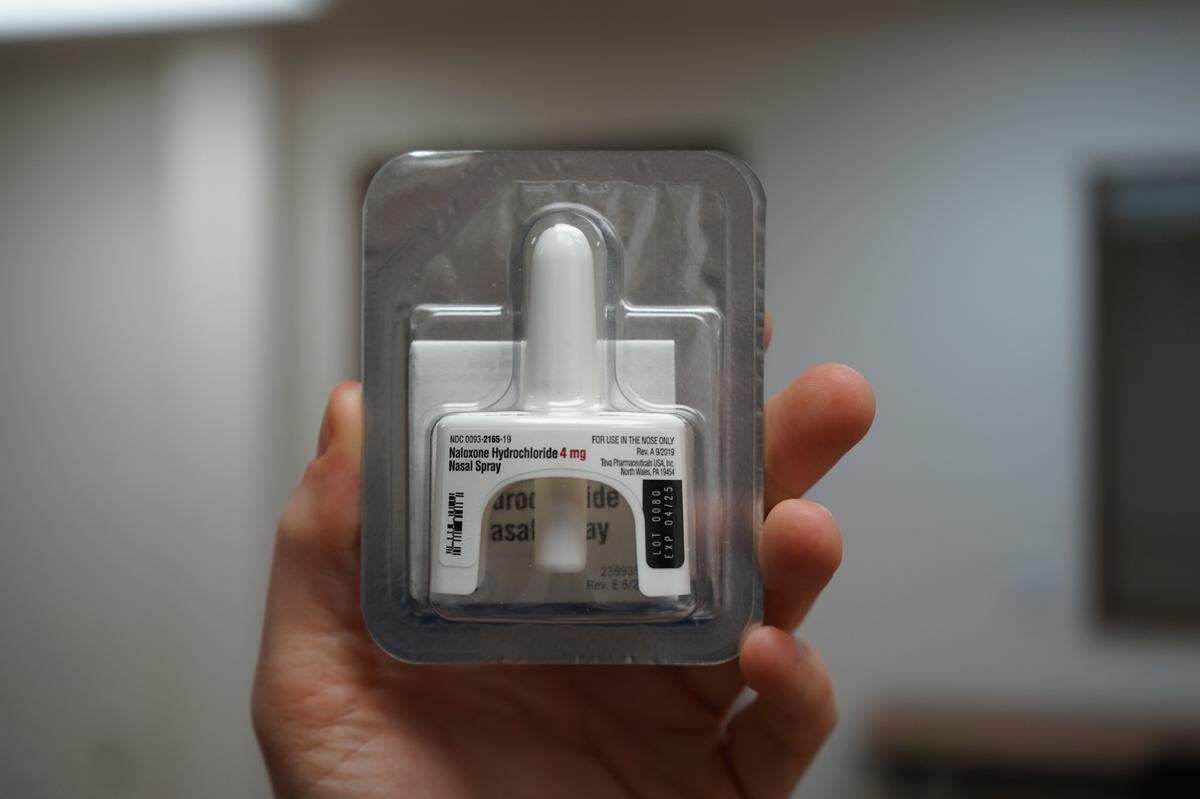
County health officer Dr. Amy Harley said three primary categories of efforts have been effective in starting to turn the tide: widespread availability and use of naloxone, expanding access to treatment, and increasing services for people with opioid use disorder.
“Those three categories of interventions I think are what we can probably say is driving the downward trend in our county, to the best of our ability to say that,” Harley said.
A key piece in the spectrum of interventions is the recent addition of a substance abuse professional in the Emergency Department at St. Joseph Medical Center, Harley said.
More than 50 health care professionals, many from the St. Joseph ER, were trained on buprenorphine and other medications for opioid use disorder, PeaceHealth spokeswoman Anne Williams said in an emailed statement.
“This is a life-saving treatment for those that have suffered from overdose that diminishes the physical dependency, cravings, and withdrawal symptoms caused by fentanyl. It lowers the chances someone will misuse opiates after they get out of the hospital and helps stabilize someone as part of a treatment plan,” Williams said.
Buprenorphine reduces drug cravings and prevents relapse, Harley said.
Looking ahead
“We’re cautiously optimistic. And while we can’t point to one thing, collectively, nor would we want to, we really think it is this combination of bringing the community together,” opioid prevention specialist Holley told The Herald.
“There’s a lot of behind-the-scenes stuff that goes on that is really helping our community. And we’re hopeful. None of us do this work to see the trends go in a different direction. But we also know that we didn’t get into this crisis overnight, and we’re not going to solve it overnight.”
This story was originally published January 16, 2025 at 5:00 AM.