A Bellingham household cut its energy use by 85% — here’s how they did it
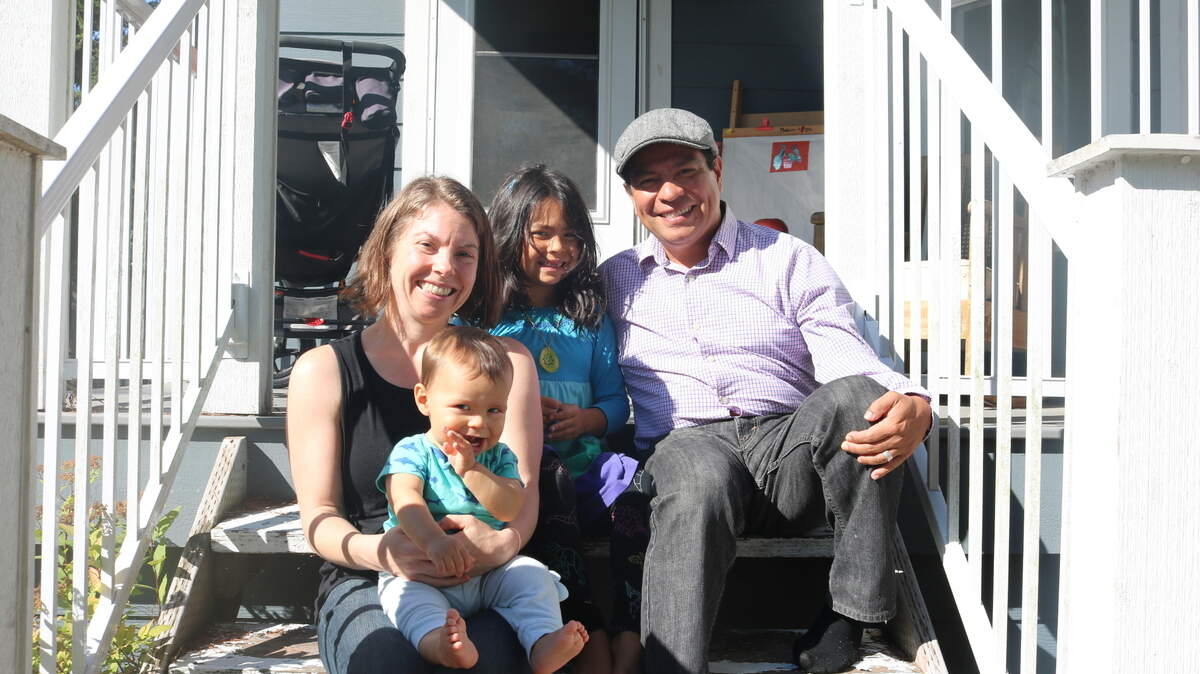
From the outside, Kat McAvoy’s early 20th-century house in the Happy Valley neighborhood looks like any other older home in Bellingham.
But it’s actually a quite extraordinary structure — through a deep energy retrofit, McAvoy and her husband were able to reduce their home’s energy use by an estimated 85%.
That’s good news for the environment. If less electricity has to be generated, less planet-warming greenhouse gas emissions are produced.
McAvoy further boosted the climate-friendliness of her home by switching out the natural gas water heater and furnace for more energy efficient electric equipment.
Natural gas is a fossil fuel chock full of the potent greenhouse gas methane, according to the Environmental Protection Agency, despite what you may have heard from the gas industry’s campaign to promote the energy source as clean.
Electricity, on the other hand, is becoming ever-cleaner as many governments attempt to transition toward renewable energy sources such as hydropower, wind and solar. Washington state is no exception — Gov. Jay Inslee signed the Clean Energy Transformation Act into law in 2019, committing the state to “an electricity supply free of greenhouse gas emissions by 2045.”
“Yes, there are definitely system upgrades and bigger costs upfront,” McAvoy said. “But thinking about the long-term health and energy impact it would have, we thought it would be a neat thing to be part of.”
At the very least, McAvoy’s deep energy retrofit is a feel-good story about a homeowner achieving the utility bill savings, in-home comfort and health benefits that can come with improved energy efficiency and electrification.
It’s more than that to some locals who work in the field. To them, the retrofit is an important case study that can help the city chart a path toward achieving its climate and energy goals. Bellingham aims to reduce community emissions by 85% compared to 2000 levels by mid-century.
“Our existing building stock is one of our largest contributors to greenhouse gas emissions,” said Rose Lathrop, program director for Sustainable Connections, a local nonprofit that promotes thriving communities, green building, zero waste and local businesses. “We have to tackle existing buildings if we want to tackle the climate crisis.”
Families like McAvoy’s prove that it’s possible to increase energy efficiency and transition to all-electric equipment in existing buildings, Lathrop said. These sorts of case studies also highlight issues that still need to be addressed, such as cost and best practices for installation.
“It’s going to take thousands of homeowners to make improvements to get to our climate goals,” Lathrop said. “If we don’t have people on the bleeding edge demonstrating success, it will be hard to make the case.”
How to do a deep energy retrofit
McAvoy and her husband Ario Salazar fell in love with their Happy Valley home in early 2015, purchasing it despite its outdated interior and drafty corners. They knew they wanted to do a remodel and add some extra insulation, but they never intended to go as deep as they did.
That intention shifted when McAvoy came across an advertisement for the Community Energy Challenge. This local nonprofit initiative, founded with federal funds in the wake of the 2009 financial crisis, encourages residential and commercial energy efficiency retrofits in Whatcom, Skagit, San Juan and Island counties. It is led by Sustainable Connections and the Opportunity Council, which serves homeless and low-income individuals.
The Community Energy Challenge offers energy audits, in which an expert makes a site visit and compiles a report outlining all possible energy efficiency measures that could be taken. The cost of the audit depends on the size of the structure and household income — homes that are 2,500 square feet or larger cost $350, smaller homes are $195 and moderate-income households may be eligible for a $95 audit. Homes that are deemed low-income can get their audit for free, said Lathrop with Sustainable Connections.
“It’s like taking your house to the doctor and getting your check up and full blood panel,” Lathrop said. “You’ve got a full list of things to do afterwards.”
McAvoy was curious about the energy savings and financial incentives she could receive through the nonprofit, so she scheduled an audit. The financial help she was offered was even more extensive than McAvoy said she expected: She was eligible for the Community Energy Challenge’s Toward Net Zero Energy project, a pilot program it was running at the time to identify opportunities, costs and barriers to decarbonizing existing homes. Being part of the program gave her access to $15,000 in grants.
In addition to the pilot program funding, McAvoy and her husband had access to the standard Community Energy Challenge and utility efficiency incentives and rebates, which totaled $6,500. The total cost of the deep energy retrofit was about $51,500, and McAvoy and her husband had to cover $30,000 of that.
Insulation and air sealing were added throughout the house to keep any outside air from leaking in. The old natural gas furnace and water heater were swapped for a hydronic radiant heating system and heat pump water heater, both of which run on electricity and are more energy efficient than the home’s old equipment.
The whole process took about two years to complete, and McAvoy and her family moved into the home in 2017.
The home is so tightly sealed that little air gets in from the outside, McAvoy said, but a ventilation system pumps fresh air into spaces that need it, like the bathrooms and kitchen. The system is designed to transfer heat from the air it’s expelling to the air it’s bringing in, so that the house doesn’t get cold, McAvoy said.
It’s been four years since McAvoy and her family moved in, and she said she has no regrets about investing in the deep energy retrofit.
“There’s nothing that’s not comfortable,” McAvoy said. “Our heating system comes on when we want it to.”
The big question: Cost
The price of the retrofit wasn’t cheap, even with the grant money and incentives. But because McAvoy and her husband already planned on doing a certain amount of remodeling, she said the investment made sense.
“If you are able to do a remodel and have that already budgeted, there are definitely ways to make choices that can impact your energy use and not have it be incredibly outside your planned budget,” McAvoy said.
Plus, the increased energy efficiency means the family’s monthly electric bill hovers around $40 to $50 dollars, McAvoy said. The lowest bill McAvoy has gotten was $32. At its absolute highest, during the most frigid months of the year, her bill reached $80.
The family no longer pays a bill to Cascade Natural Gas, since they have gotten off the gas system. Through utility bill savings, the deep energy retrofit is expected to pay for itself in a little less than eight years, McAvoy said.
But not everyone can afford the upfront cost of electrification and energy efficiency, and that’s an environmental justice problem, Lathrop from Sustainable Connections said. Natural gas also exposes households to indoor air pollution, according to a report by clean energy nonprofit Rocky Mountain Institute, and has resulted in devastating pipeline explosions and fires nationwide, as recorded by environmental nonprofit Green America.
“Our most vulnerable populations, the ones most impacted by natural gas and climate change, we need to help them first,” Lathrop said. “We need to be putting our investments and resources toward that.”
However, electrification advocates also have to tread carefully when encouraging low-income families to switch off natural gas, Lathrop said. While electric equipment can often reduce utility bills, it also has the potential to raise costs for certain households depending on the building itself and how energy efficient the new equipment is compared to the old.
Thus, transitioning existing homes off of natural gas needs to be done thoughtfully and with particular attention paid to each individual household, Lathrop said.
An enormous obstacle to getting low-income families off of natural gas is the lack of public resources available to support fuel switching, Lathrop said. She believes that utilities, even privately-owned ones, such as Puget Sound Energy and Cascade Natural Gas, should be mandated by the state to provide fuel-switch incentives.
“If you are on gas and trying to electrify, there are no incentives for our residents in Bellingham or Whatcom County,” she said. “That’s something we need to change.”
The Community Energy Challenge is launching a new pilot program this month, similar to the one McAvoy participated in, that will focus on fuel-switching from natural gas to electric equipment. There is a total of $6,000 available for Bellingham’s low-income residents and $4,000 for the city’s average residents.
How that money will be divvied up is still being determined, Lathrop said — it might be that 10 average residents get $400 each or 20 residents get $200 each. More details regarding the pilot program, named Pump it Up!, will be announced during Bellingham’s ALL IN for Climate Action Week, which runs from Sept. 20 through 26.
Lathrop urges those interested in getting an energy audit or switching from gas to electric equipment to look into their options sooner rather than later. The waitlist to get a Community Energy Challenge audit is currently two months long, she said.
Lathrop, herself, fell victim to procrastination — about eight years ago, in the final days of December, her gas water heater died unexpectedly. She wanted to replace it with a heat pump water heater, but in the panic of needing hot water quickly, she ended up sticking with fossil fuels.
“It would be two weeks before the heat pump water heater arrived,” Lathrop remembers. “All of a sudden I have another gas water heater in my house.”
This story was originally published September 9, 2021 at 5:00 AM.