Whatcom’s 4 regions with the highest COVID infection rates all saw decreases last week
The four Whatcom County school district regions with the highest two-week COVID infection rates all saw those rates drop last week, but only one had a big enough drop to fall out of the top four.
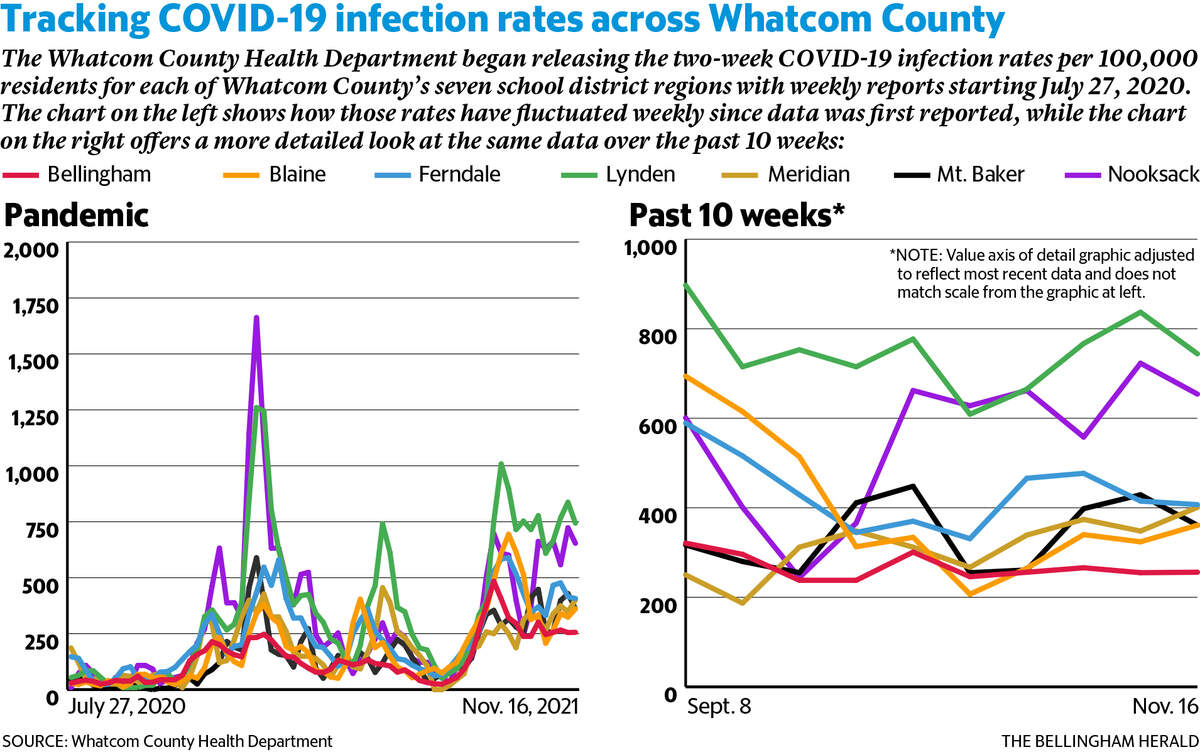
The regions geographically covered by the Ferndale, Lynden, Mount Baker and Nooksack Valley school districts all saw their two-week average of COVID-19 cases per 100,000 residents decrease last week, the Whatcom County Health Department’s latest location data showed on Tuesday, Nov. 16.
The Bellingham, Blaine and Meridian regions, meanwhile, saw increases, though Bellingham’s rate increased by just one new case per 100,000 residents from last week’s report.
Weekly infection rates in all three regions that saw increases were highest among residents between the ages of 5 and 17, the county data showed, including a rate of more than 600 cases per 100,000 resident 5-17 in the Meridian region.
The Nooksack Valley region also saw a high weekly infection rate among 5- to 17-year-olds with 566 cases per 100,000 residents, though that was only half what the rate reached earlier in the week, according to the county data.
The Lynden region also surpassed 3,000 COVID cases during the pandemic, joining Bellingham and Ferndale as the only regions with case totals that high. Of those three, Lynden has the most total cases per 100,000 residents during the pandemic with a rate of 14,684, The Bellingham Herald’s analysis found. Ferndale’s rate is 10,160 and Bellingham has had 5,454 total cases per 100,000 residents.
The Mount Baker region, meanwhile, saw its two-week hospitalization rate jump to 56 per 100,000 residents — the highest any of the seven regions has seen since early September.
The county health department releases weekly data on the location of COVID-19 cases using school districts as geographical boundaries, including each region’s number of total cases during the pandemic, infection rate, hospitalization rate, percentage of residents who have initiated vaccination and a breakdown of case rates by age. Data in this week’s report was through Saturday, Nov. 13.
Overall, Whatcom County saw a 2.6% growth in cases with 437 cases between Nov. 7 and 13 — down from the 450 new cases the county reported the previous week, according to the data.
With 887 cases in the past two weeks, Whatcom County has an overall two-week infection rate of 394, based on 225,300 residents in the county. Three of the county’s regions had infection rates lower than that mark, according to the county’s data this week.
As of Wednesday, Nov. 15, the Washington State Department of Health reported that 67.6% of all Whatcom County residents had initiated vaccination and 62.4% had completed it.
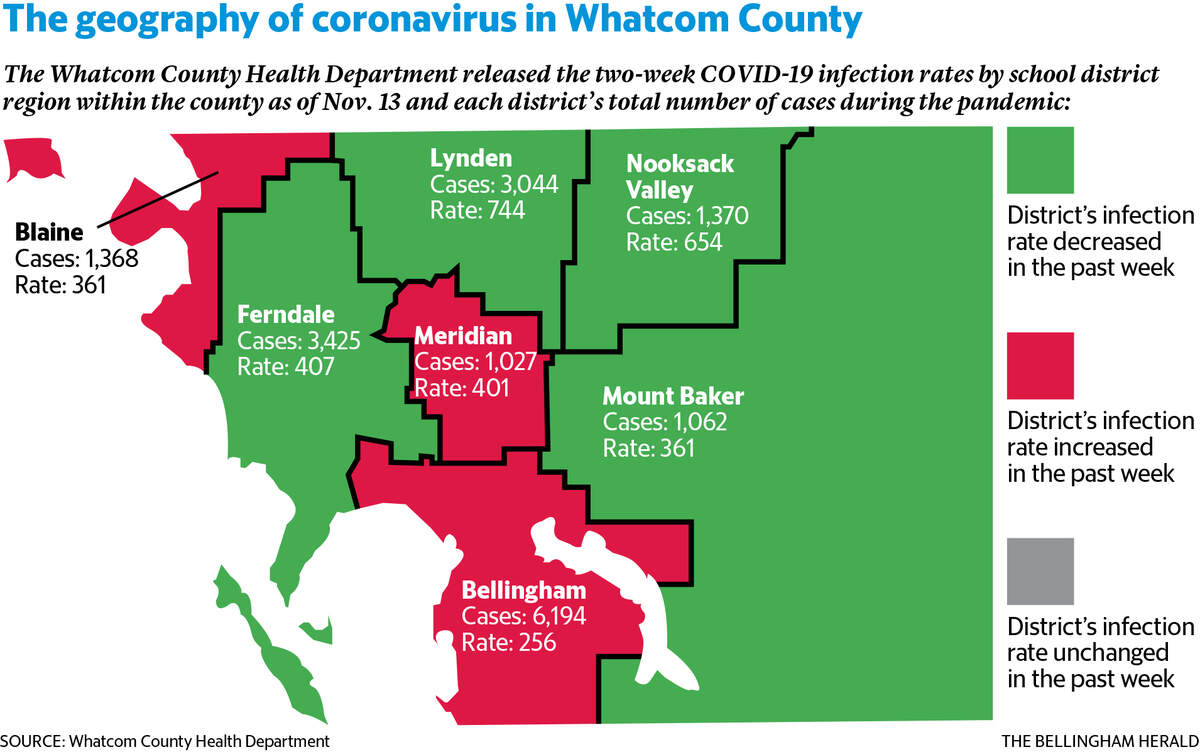
Here is what the health department’s latest data showed for the seven regions in the county:
Bellingham: Up 2.4% (147 cases) since the Nov. 9 report to 6,194 total cases, and the rate of new infections per 100,000 residents in the past 14 days increased from 255 last week to 256 this week. Approximately 76% of residents in the region have initiated vaccination, and the region has seen 11 COVID-related hospitalizations per 100,000 in the past two weeks.
Blaine: Up 3.7% (49 cases) since the Nov. 9 report to 1,368 total cases, and the rate of new infections per 100,000 residents in the past 14 days increased from 324 last week to 361 this week. Approximately 69% of residents in the region have initiated vaccination, and the region has seen no COVID-related hospitalizations per 100,000 residents in the past two weeks.
Ferndale: Up 2.3% (78 cases) since the Nov. 9 report to 3,425 total cases, but the rate of new infections per 100,000 residents in the past 14 days decreased from 415 last week to 407 this week. Approximately 65% of residents in the region have initiated vaccination, and the region has seen 20 COVID-related hospitalizations per 100,000 residents in the past two weeks.
Lynden: Up 2.7% (80 cases) since the Nov. 9 report to 3,044 total cases, but the rate of new infections per 100,000 residents in the past 14 days decreased from 837 last week to 744 this week. Approximately 54% of residents in the region have initiated vaccination, and the region has seen 47 COVID-related hospitalizations per 100,000 residents in the past two weeks.
Meridian: Up 2.7% (27 cases) since the Nov. 9 report to 1,027 total cases, and the rate of new infections per 100,000 residents in the past 14 days increased from 348 last week to 401 this week. Approximately 63% of residents in the region have initiated vaccination, and the region has seen 27 COVID-related hospitalizations per 100,000 residents in the past two weeks.
Mount Baker: Up 2.5% (26 cases) since the Nov. 9 report to 1,062 total cases, but the rate of new infections per 100,000 residents in the past 14 days decreased from 429 last week to 361 this week. Approximately 46% of residents in the region have initiated vaccination, and the region has seen 56 COVID-related hospitalizations per 100,000 residents in the past two weeks.
Nooksack Valley: Up 2.2% (30 cases) since the Nov. 9 report to 1,370 total cases, but the rate of new infections per 100,000 residents in the past 14 days decreased from 723 last week to 654 this week. Approximately 51% of residents in the region have initiated vaccination, and the region has seen nine COVID-related hospitalizations per 100,000 residents in the past two weeks.